
BNSF vs UP: Trackage Rights Battle Impacts US Intermodal Rail
BNSF seeks STB intervention to protect trackage rights over Union Pacific lines, crucial for intermodal freight.
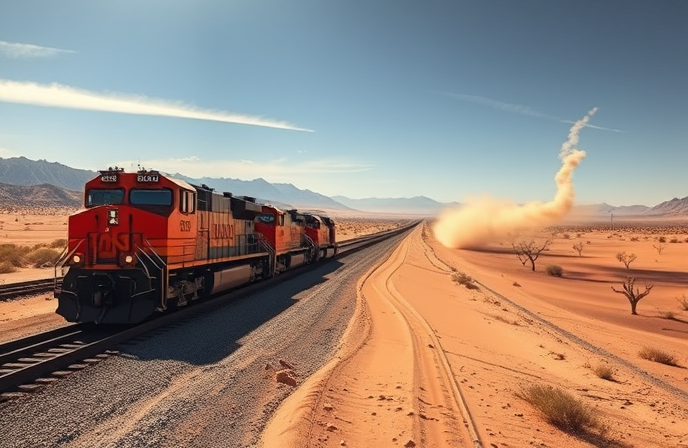
BNSF Seeks Emergency Intervention to Preserve Trackage Rights
In a move underscoring the ongoing competitive landscape of North American rail, BNSF Railway Co. has petitioned the Surface Transportation Board (STB) for immediate action. The request, filed on July 7th, 2024, aims to prevent Union Pacific Railroad (UP) from allegedly blocking BNSF’s established trackage rights over UP lines. The dispute centers on BNSF’s need to utilize these rights across California, Nevada, and Utah to facilitate the movement of double-stack intermodal trains for interchange with the Salt Lake Garfield & Western Railway (SLGW) in Salt Lake City. The core issue boils down to UP’s alleged obstruction of these rights. BNSF, in its filing, cited the rights as a condition imposed by the STB nearly three decades ago. The stakes are high, reflecting the cutthroat rivalry for intermodal business. The petition highlights the critical importance of upholding these agreements to ensure efficient rail operations and maintain competitive freight options.
Origins of the Dispute: Merger Conditions and Trackage Rights
The heart of the matter lies in the 1996 merger of Union Pacific and Southern Pacific Rail Corp. (SP). As a condition of approval for this consolidation, the STB mandated that BNSF (then Burlington Northern Santa Fe) be granted specific trackage rights over certain UP lines. These rights were intended to foster competition and prevent a monopoly in key corridors. BNSF argues that it has consistently exercised these rights, enabling it to serve customers and offer competitive services. The current petition signifies a breakdown in this long-standing arrangement, where UP is now seemingly obstructing BNSF’s access. This represents not just a disruption of existing operations, but also a potential breach of the STB’s original conditions for the merger. The ability to utilize these routes allows BNSF to access markets and fulfill its obligations to customers, highlighting the significance of this legal battle.
The Impact on Intermodal Traffic and Competition
The primary driver of this dispute is the fiercely contested intermodal market. As BNSF’s filing states, “UP and BNSF compete vigorously for intermodal rail movements to/from the West Coast.” The specific intermodal trains in question are destined for interchange with the SLGW in Salt Lake City. In the past year, two major intermodal customers have switched a “significant portfolio of business” from UP to BNSF. BNSF now contends that it must utilize these trackage rights across the UP lines in the specified states, to move this recently won business. Should the STB not intervene, this could force the railway to restructure the routes and potentially affect service to their customers. The competition is critical, as any impediment to these routes risks hindering the movement of goods, potentially raising costs, and impacting the overall efficiency of the supply chain.
Legal and Regulatory Framework: The Surface Transportation Board’s Role
The Surface Transportation Board (STB) plays a crucial role in regulating the freight rail industry in the United States. The STB’s intervention is the current focal point. The Board’s responsibility is to ensure fair competition and the efficient movement of goods. The STB must balance competing interests while maintaining an environment of effective and safe rail transport. A favorable ruling for BNSF would reinforce the sanctity of existing trackage rights and strengthen the Board’s authority to oversee these agreements. Conversely, a ruling that favors UP could have far-reaching consequences, potentially emboldening other railroads to challenge similar arrangements and negatively affect competition. This case serves as a test of the STB’s commitment to its mandate, while influencing the future of railway competitiveness.
Conclusion
The petition by BNSF Railway Co. against Union Pacific Railroad represents a critical juncture in the ongoing evolution of the North American rail landscape. The STB’s decision will resonate throughout the industry, setting a precedent for how trackage rights, merger conditions, and intermodal competition are managed. The outcome of this legal battle will define competition. If the STB intervenes successfully, BNSF would retain access and the intermodal network will flourish. The immediate implications of the STB’s response extend beyond the involved railways and will influence the operational efficiency and cost-effectiveness of supply chains that rely on rail transport. The future outlook of rail is a constant evolution, and the STB’s role will have to be adaptive in order to promote a vibrant rail industry.
Company Summary
BNSF Railway Co. is one of North America’s largest freight railroads. BNSF’s network spans 32,500 route miles across 28 states and three Canadian provinces. The railroad transports a diverse range of commodities, including agricultural products, consumer goods, coal, and intermodal containers. BNSF plays a vital role in the U.S. and North American economies, moving approximately 3.6 million carloads of freight annually. The company’s focus is on the safe and efficient transportation of goods, while continuing to expand its network infrastructure and capacity.
Union Pacific Railroad is a major freight transportation company operating the largest railroad network in North America. Its 32,400-mile network connects the West Coast and Gulf Coast ports with the Midwest and provides rail service to the majority of the U.S. population. UP hauls a variety of commodities, including agricultural products, automotive, chemicals, and intermodal containers. Union Pacific’s operations are instrumental to the global supply chain, and is focused on increasing service reliability and efficiency.

Railway infrastructure, rolling stock and transport technologies specialist focused on global rail industry developments, high-speed rail systems, signaling technologies and freight transportation. Covering railway investments, public transport modernization, rail operations and international mobility projects across Europe, Asia and North America.
RELATED POSTS

October 1, 2026 7:09 am
United States regulators confirmed a September 30 deadline for the...

October 8, 2026 1:15 pm
Alstom secured a €1bn contract to build 13 automated trains,...

October 4, 2026 5:14 pm
Alstom secured a CA$4.7 billion order from VIA Rail Canada...

October 1, 2026 12:13 am
Illinois approved $1.5 billion annually for the Northern Illinois Transit...

October 6, 2026 2:14 am
Union Pacific launched export rail shipments with Ferromex to deliver...

October 1, 2026 6:10 am
Amtrak approved a System Expansion Committee on July 30 to...