
Protecting Passengers: EU’s New Rail Fire Safety Standard
EN 45545-7 ensures railway fire safety. This standard rigorously governs flammable liquid and gas systems, preventing leaks and protecting passengers and crew.
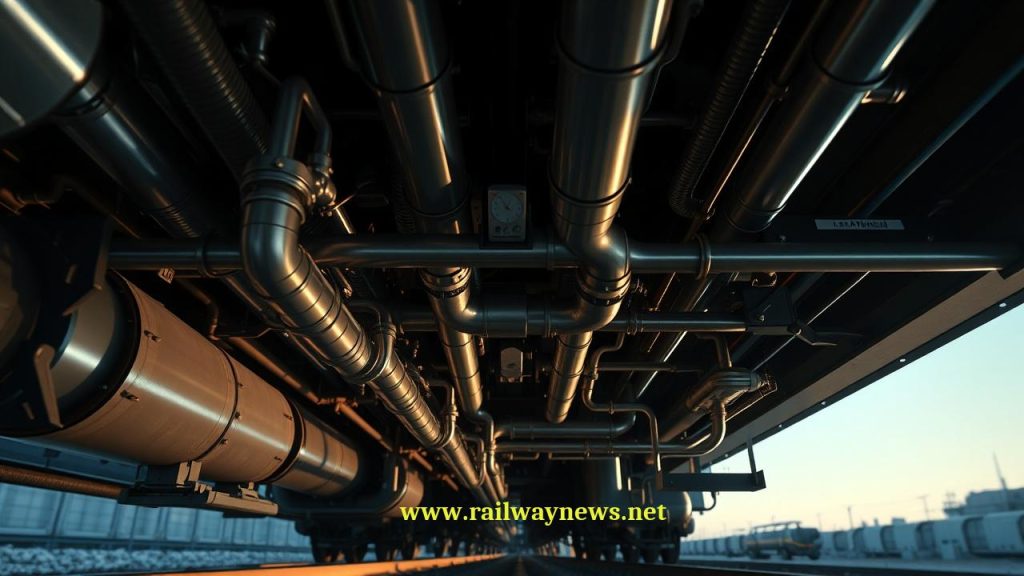
What is EN 45545-7: A Technical Overview
EN 45545-7 is a specific part of the detailed European standard for fire protection on railway vehicles, EN 45545. This part exclusively addresses the fire safety requirements for installations carrying flammable liquids and flammable gases. Its primary objective is to mitigate the risk of fire by defining stringent rules for the design, installation, and maintenance of systems such as diesel fuel lines, hydraulic circuits, and liquefied natural gas (LNG) propulsion systems.
The standard’s core purpose is to prevent the release of flammable substances and, in the event of a leak, to control the substance and prevent its ignition. It provides a systematic approach to ensure that these potentially hazardous systems do not compromise the overall fire safety of the railway vehicle and the safety of its passengers and crew.
Core Objectives and Principles of the Standard
The requirements outlined in EN 45545-7 are built upon several fundamental fire safety principles. The goal is to create a robust, multi-layered defense against fire incidents originating from flammable fluid systems. The main objectives include:
- Prevention of Leaks: Ensuring the mechanical and thermal integrity of all components, including pipes, hoses, tanks, and connections, to withstand the demanding operational conditions of a railway environment (e.g., vibration, temperature fluctuations).
- Control of Ignition Sources: Mandating the separation of flammable fluid installations from potential ignition sources, such as hot engine components, electrical equipment, and braking systems.
- Containment of Spills: In the case of a leak, ensuring that flammable liquids are safely contained and directed away from hazardous areas and potential ignition sources.
- Safe Management of Gas Leaks: For flammable gas systems, ensuring that any potential leak is safely ventilated and dispersed to prevent the formation of an explosive atmosphere.
- System Integrity and Shutdown: Implementing safety devices and control systems, such as emergency shut-off valves and pressure relief devices, to isolate systems in an emergency.
Scope and Application of EN 45545-7
This part of the standard applies to all railway vehicles and covers the design and installation of systems that contain and circulate flammable liquids or gases. This includes, but is not limited to:
- Diesel Fuel Systems: Tanks, pumps, filters, and pipework for diesel-powered traction units.
- Hydraulic Systems: High-pressure oil circuits for systems like brakes, suspension, and tilting mechanisms.
- Cooling Systems: Systems that may use flammable coolants or additives.
- Gas Propulsion Systems: Installations for Liquefied Natural Gas (LNG) or Compressed Natural Gas (CNG).
- Auxiliary Systems: Such as heating systems that use diesel fuel (e.g., Webasto-type heaters) or cooking installations using Liquefied Petroleum Gas (LPG).
It is important to note that EN 45545-7 focuses on the installation’s safety aspects, not the fire properties of the fluids themselves. The fire performance of materials used within these installations (e.g., hoses, seals, insulation) is covered by EN 45545-2.
Key Technical Requirements and Design Considerations
To achieve its safety objectives, EN 45545-7 specifies detailed technical requirements for the entire lifecycle of the installation, from design to maintenance.
System Design and Component Selection
The standard mandates that all components must be suitable for their intended use. This means they must be resistant to the specific fluid they carry, as well as the expected pressure, temperature, and mechanical stresses. Key considerations include:
- Material Compatibility: All materials (metals, elastomers, plastics) must be chemically compatible with the flammable fluid to prevent degradation.
- Pressure and Temperature Ratings: Components must have pressure and temperature ratings that exceed the maximum operating conditions of the system with an appropriate safety factor.
- Vibration Resistance: Given the high-vibration environment of a train, all pipework and components must be securely mounted using appropriate clamps and supports to prevent fatigue failure. Flexible hoses must be used where relative movement is expected.
Installation, Routing, and Protection
The physical location and routing of pipes and hoses are critical for fire prevention. EN 45545-7 provides clear guidelines:
- Segregation: Flammable fluid lines must be routed as far as practically possible from ignition sources like exhaust manifolds, electrical switchgear, and resistors.
- Mechanical Protection: Where pipes and hoses pass through areas where they could be exposed to mechanical damage (e.g., from ballast impact under the vehicle), they must be protected by robust conduits or shields.
- Fire Barriers: If it is not possible to achieve sufficient separation distance, fire-resistant barriers compliant with EN 45545-3 must be installed between the flammable fluid installation and the potential ignition source.
- Ventilation: Areas containing flammable gas components must be adequately ventilated to prevent gas accumulation. For liquids, areas with potential for vapor accumulation also require sufficient ventilation.
Containment, Drainage, and Safety Devices
The standard acknowledges that leaks can occur despite robust design and requires measures to manage them safely.
- Containment for Liquids: Potential leak points, such as connections and filters, and equipment containing a significant volume of flammable liquid must be fitted with drip trays or a containment system. This system must be capable of collecting the leaked fluid and draining it to a safe location, away from hot surfaces or electrical equipment.
- Emergency Shut-off Valves: Fuel tanks and high-pressure systems must be equipped with emergency shut-off valves. These can be activated manually or automatically (e.g., by a fire detection system) to quickly isolate the fluid supply in an emergency.
- Pressure Relief Devices: Sealed tanks and vessels must be fitted with pressure relief valves to prevent over-pressurization and rupture in a fire situation.
Comparison of Safety Measures: Flammable Liquid vs. Flammable Gas Systems
While sharing common principles, the specific safety measures required by EN 45545-7 differ significantly between flammable liquid and flammable gas installations due to their different physical properties.
| Safety Aspect | Flammable Liquid Systems (e.g., Diesel) | Flammable Gas Systems (e.g., LNG/CNG) |
|---|---|---|
| Primary Hazard | Pool fires, sprays igniting on hot surfaces. | Formation of an explosive gas cloud (VCE – Vapour Cloud Explosion), jet fires. |
| Leak Management Strategy | Containment. Use of drip trays and collection systems to capture and drain leaked liquid to a safe place. | Dispersion. Ensuring leaks are rapidly and safely ventilated to the atmosphere to prevent accumulation. |
| Detection Systems | Typically relies on visual inspection or liquid sensors in containment trays. | Mandatory gas detection sensors in enclosed or semi-enclosed spaces where gas can accumulate. |
| Pipework and Connections | Focus on robust, leak-proof mechanical joints (e.g., flared fittings, high-quality compression fittings). | Emphasis on minimizing connections. Welded joints are preferred over mechanical fittings where possible to reduce leak points. |
| Emergency Shutdown | Emergency shut-off valves at the tank outlet to stop the flow of liquid. | Automatic excess flow valves and remotely operated shut-off valves to quickly isolate gas sources in case of a major line break. |
Conclusion: The Role of EN 45545-7 in Holistic Railway Safety
EN 45545-7 is a critical standard that addresses a specific but high-consequence risk in railway vehicles. By enforcing a rigorous, proactive approach to the design and installation of flammable fluid systems, it significantly reduces the likelihood of fires originating from sources like diesel fuel or hydraulic oil. Its requirements, when combined with the other parts of the EN 45545 series, form an integrated safety concept that makes modern railway vehicles exceptionally resilient to fire, protecting lives, assets, and operational continuity.

Railway infrastructure, rolling stock and transport technologies specialist focused on global rail industry developments, high-speed rail systems, signaling technologies and freight transportation. Covering railway investments, public transport modernization, rail operations and international mobility projects across Europe, Asia and North America.