
The Red Light Nightmare: Understanding SPAD (Signal Passed at Danger)
SPAD stands for “Signal Passed at Danger.” It is a critical safety incident where a train passes a stop signal (red light) without authority, posing a high risk of collision or derailment.
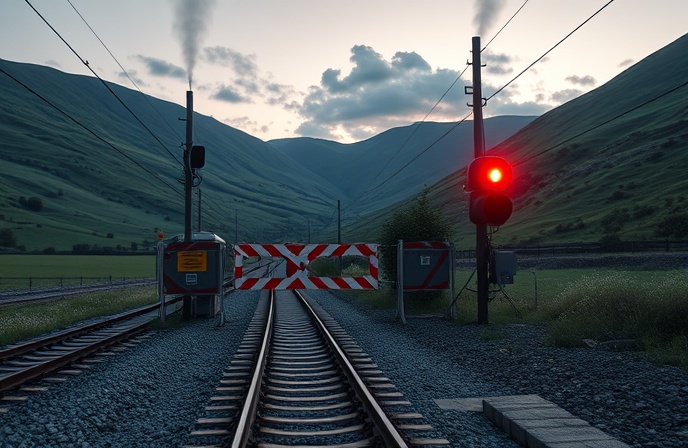
⚡ In Brief
- A SPAD (Signal Passed at Danger) occurs when a train crosses a stop signal — the railway equivalent of a red traffic light — without authority, entering a section of track protected by that signal for safety reasons.
- The vast majority of SPADs — approximately 95% — result in no collision, because the protected section is either clear, the overlap beyond the signal stops the SPAD train before it reaches the hazard, or other trains are not present. The 5% that result in consequences range from minor damage to catastrophic collisions.
- Human factors account for approximately 80–90% of SPAD causation — driver fatigue, distraction, misjudgement of braking distance, low adhesion conditions, and poor signal sighting — with infrastructure and rolling stock factors responsible for the remainder.
- Signal sighting — the distance at which a driver can first see a signal clearly enough to read its aspect — is a frequently identified contributory factor in SPAD investigations. A signal that is difficult to see due to curvature, gradient, foliage, sun glare, or poor placement gives the driver insufficient time to react and brake before the signal, even at permitted speeds.
- Signals with disproportionately high SPAD rates — “SPAD risk signals” — can be identified statistically from incident records and targeted with specific mitigations including enhanced ATP protection, improved sighting, reduced approach speed, and AWS/TPWS enhancement.
Signal SN109 at Ladbroke Grove, West London, had been passed at danger eight times in the six years before 5 October 1999. Eight reported incidents, eight investigations, eight sets of corrective actions — including a recommendation after the seventh SPAD to reduce the approach speed and improve signal sighting. The recommendation was under review when the eighth SPAD occurred. On that occasion, the SPAD train entered a section occupied by an oncoming high-speed express. Thirty-one people died.
What made SN109 different from the hundreds of other signals that recorded SPADs during the same period was not the character of the drivers who passed it — it was the signal’s location, sighting geometry, and the speed at which trains approached it. It was a signal that a significant proportion of unfamiliar drivers found ambiguous or difficult to identify in time to stop. The eight previous SPADs were warning signals that were not acted on at the system level with sufficient urgency. This is the SPAD story: a combination of human performance, infrastructure design, and safety system capability, in which statistics can predict where the next serious SPAD incident will occur — if the data is used.
What Is a SPAD?
A SPAD occurs when a train passes a signal displaying a stop aspect (red) without the authority to do so. The stop signal protects what lies beyond it — typically a track section occupied by another train, a conflicting route at a junction, a section under engineering possession, or the end of a movement authority. Passing the signal is dangerous because the train enters protected space without warning to the other occupant or to the system managing conflicting movements.
The severity of a SPAD depends entirely on what is in the protected section beyond the signal:
- If the section is genuinely clear (the signal was showing red as a precaution or as part of normal block operation with no train present), the SPAD is a safety incident but causes no immediate hazard.
- If another train occupies the section, the SPAD creates a collision risk that depends on the speed of both trains and the distance between them.
- If a junction is set for a conflicting route, the SPAD train may traverse the switch at the wrong setting, causing a derailment.
- If a possession is in operation, the SPAD train may enter an area where track workers are present without any protection.
SPAD Causation: A Taxonomy
| Category | Cause | Approximate Frequency | Prevention Measure |
|---|---|---|---|
| Human factors (~85%) | Driver fatigue / microsleep | ~15% of SPADs | Roster management; vigilance device; fatigue risk management |
| Driver distraction (phone, conversation, task) | ~20% of SPADs | Mobile phone prohibition; ATP enforcement | |
| Late braking / misjudgement | ~30% of SPADs | ATP continuous supervision; improved signal sighting | |
| AWS/TPWS acknowledgement without braking | ~20% of SPADs | Better ergonomic design; ATP that enforces speed after acknowledgement | |
| Infrastructure (~10%) | Poor signal sighting (curve, sun, foliage) | ~7% of SPADs | Signal repositioning; additional AWS/TPWS; cab signal supplement |
| Signal aspect confusion (wrong route display) | ~3% of SPADs | Signal re-arrangement; route indicator improvements | |
| Rolling stock / adhesion (~5%) | Low adhesion (leaves, ice) extending braking distance | ~4% of SPADs | Autumn speed restrictions; WSP; Sandite application; approach speed limits |
| Brake failure | ~1% of SPADs | Pre-departure brake test; maintenance regime |
Signal Sighting: The Infrastructure Factor
Signal sighting — the distance at which a driver can first identify a signal’s aspect clearly enough to make a braking decision — is one of the most consequential infrastructure factors in SPAD prevention. UK standards specify a minimum sighting distance for each signal based on the line speed: at 100 mph, the driver must be able to see a signal at least 880 metres ahead to have time to react and brake before reaching it.
Sighting distance can be degraded by:
- Track curvature: On a curve, the signal may not be visible until the train has rounded enough of the curve to bring it into the driver’s line of sight.
- Gradient: A signal located beyond a crest is invisible until the train crests the hill.
- Foliage: Trees and vegetation alongside the track can obstruct the signal, particularly seasonally when in leaf.
- Sun glare: A signal facing into low winter or summer sun may be unreadable due to glare, particularly at dawn and dusk when the sun is at signal-head height.
- Multiple signals: In complex station and junction areas, multiple signals may be visible simultaneously and the driver must identify which signal applies to their train — the potential for misidentification is a real and documented SPAD cause.
Signal sighting is assessed during route surveys and is part of the signal engineering sign-off process for new or modified signalling. However, sighting conditions can change after installation — tree growth, new building construction alongside the line, or changes to the track geometry at major renewals can all reduce previously adequate sighting distances.
The Overlap: Protection Beyond the Signal
Railway signalling provides a critical safety margin beyond the stop signal through the concept of the “overlap” — a defined length of track beyond the signal that is kept clear whenever the signal is at danger. Typically 135–200 metres on UK mainlines, the overlap provides a buffer zone into which a SPAD train can continue for a defined distance without immediately colliding with whatever the signal is protecting.
The overlap distance is calculated based on the line speed, train braking performance, and the consequences of signal overrun. On high-speed mainlines, overruns can be at high speed and the overlap must be correspondingly long. In complex station throats where multiple tracks converge, overlaps may be shorter due to physical space constraints, making high-speed approaches to these signals particularly dangerous.
This is why not every SPAD becomes a collision — most SPAD trains stop within the overlap before reaching the hazard. But a SPAD at high speed (the train approaching the signal at or near line speed rather than decelerating toward a controlled stop) can carry the SPAD train well beyond the overlap, into the protected section proper.
SPAD Risk Signals: Identifying the Statistical Outliers
In any railway network, SPAD incidents are not uniformly distributed across all signals. A relatively small number of signals — “SPAD risk signals” or “high-SPAD signals” — account for a disproportionate share of all SPAD incidents. Statistical analysis of incident records consistently finds a pattern where roughly 20% of signals account for 80% of SPADs. These are signals where the combination of approach speed, sighting distance, driver workload, and local environmental conditions creates conditions more likely to result in a missed or late recognition of the stop aspect.
Identifying SPAD risk signals and targeting them with specific mitigations is one of the most cost-effective approaches to SPAD reduction:
| Risk Factor | Typical Mitigation |
|---|---|
| Poor sighting distance | Relocate signal; add AWS magnet / TPWS loops at greater distance; add AWS repeater |
| High approach speed | Reduce approach speed limit; add flashing yellow approach; ATP protection if not present |
| Low-adhesion location (leaf-fall route) | Autumn approach speed restriction; sandite application programme; extend TPWS overspeed loop |
| Driver workload / attention conflict | Remove conflicting signals; improve route indicator; train drivers on specific hazard |
| Frequently occupied (high SPAD probability even if approach correct) | Improve block section design; reduce conflicting movements; add overlap extension |
The Defence Layers Against SPAD
Modern railway safety uses a multi-layer defence against SPADs. No single layer is sufficient alone; the layers are designed to be independent so that a failure in one does not negate the others:
Layer 1 — Driver training and procedures: Route learning, simulator-based training on high-risk signals, fatigue management, mobile phone prohibition.
Layer 2 — AWS (Automatic Warning System): A magnet in the track before each signal generates an audible warning in the cab when the signal is at caution or danger. The driver must acknowledge the warning; failure to acknowledge triggers an automatic brake application. AWS is not a full ATP system — it warns and requires acknowledgement, but does not enforce the braking curve after acknowledgement.
Layer 3 — TPWS (Train Protection and Warning System): Loop inductors near the signal apply emergency brakes if the train passes over them at a speed that would not permit stopping before the signal. TPWS provides targeted protection at signal locations but does not supervise speed between signals.
Layer 4 — Full ATP (ETCS / national systems): Continuous supervision of speed against the permitted braking curve from the first cautionary signal to the stop signal. A train that is decelerating too slowly anywhere in the approach will be stopped by ATP before reaching the signal. Full ATP prevents virtually all SPADs caused by human factors.
Layer 5 — Signal overlap: The protected clear zone beyond the signal that a SPAD train can enter without immediately reaching the hazard, providing a last-chance stopping distance.
Layer 6 — Interlocking protection: Even if a SPAD occurs, the interlocking continues to protect the route — conflicting routes remain locked, points cannot be moved into the path of the SPAD train while it occupies the overlap.
Notable SPAD-Related Collisions
| Incident | Year | Fatalities | Key Cause | ATP Present? |
|---|---|---|---|---|
| Purley, UK | 1989 | 5 | Driver error; passed signal at danger | No — triggered ATP mandate (not implemented) |
| Cowden, UK | 1994 | 5 | Driver error; single-line section; token system failure | No |
| Ladbroke Grove (Paddington), UK | 1999 | 31 | Driver passed SN109 (8th SPAD on same signal); poor sighting | No — ATP not installed despite mandate |
| Chatsworth, USA | 2008 | 25 | Driver distracted by texting; passed red signal | No — PTC not yet implemented |
| Bad Aibling, Germany | 2016 | 12 | Dispatcher error (authorised conflicting movements); driver passed signal | No — single-line section; older signalling |
| Tempi Valley, Greece | 2023 | 57 | Station master set conflicting route; driver passed signal; head-on at speed | No — ETCS not yet installed; signalling system incomplete |
The Tempi Valley Lesson: SPAD as Systemic Failure
The March 2023 Tempi Valley collision in Greece — 57 fatalities, the worst rail disaster in Greek history — illustrates that SPAD incidents are rarely caused by a single isolated driver error. The train that passed the signal did so because a station master had manually set a conflicting route, authorising two trains onto the same single-line section. The signal the driver passed was red because the route management system had correctly identified the conflict — but the station master had overridden the system to allow the northbound train to proceed.
Investigation revealed that the Greek railway network had been operating for years with signalling infrastructure that was incomplete, inadequately maintained, and without the electronic interlocking and ATP systems that would have prevented the dispatcher error from resulting in a physical collision. The SPAD was the proximate cause; the systemic under-investment in safety infrastructure was the root cause. This pattern — a SPAD that could have been prevented by technology that was specified, planned, funded, but not yet installed — recurs across the history of catastrophic rail collisions.
Editor’s Analysis
The pattern of serious SPAD incidents is remarkably consistent across countries, decades, and safety regimes: a small number of identified risk signals, multiple previous incidents on those signals, recommendations for ATP or infrastructure improvements, and a catastrophic collision before the improvements are implemented. Ladbroke Grove 1999 followed Purley 1989. Tempi Valley 2023 occurred despite Greek safety authorities and the EU having identified the need for ATP on that route for years. The technology to prevent virtually all consequential SPADs — full continuous ATP, as demonstrated by the Shinkansen’s sixty-year collision-free passenger record — has existed since the 1960s. The barrier is not technical; it is the combination of cost, implementation complexity, and the optimistic belief that driver training and procedural mitigations are adequate substitutes for engineering controls. They are not. ATP is the only measure that physically prevents a SPAD from occurring regardless of driver state. Every other measure — AWS, TPWS, training, vigilance devices — reduces the probability of a SPAD but cannot eliminate it. The cost of SPAD-related collisions — in lives, injury, disruption, legal liability, and reputational damage — consistently exceeds the cost of the ATP that would have prevented them. The industry knows this. The challenge is sustaining the political and institutional will to implement ATP universally before the next catastrophic SPAD makes the question academic. — Railway News Editorial
Frequently Asked Questions
- Q: Does every SPAD result in a collision?
- No — the large majority of SPADs do not result in collisions. Analysis of UK SPAD data by the Office of Rail and Road has consistently shown that approximately 95% of SPADs result in no collision or derailment. In most cases, the train stops within the signal overlap before reaching the protected hazard; or the protected section is clear (the signal was at danger because a conflicting route was set, not because a train was immediately ahead); or the following interlocking actions prevent a conflicting movement from occurring. The 5% that result in consequences range from minor buffer strikes and derailments to catastrophic head-on collisions. The rare but catastrophic outcome is precisely why every SPAD — however minor — is treated as a safety event requiring investigation and corrective action.
- Q: What is the difference between a SPAD and a “wrong side failure”?
- A SPAD is an event caused by a train passing a correctly-displaying stop signal — the signal is showing red as intended, and the train passes it without authority. A “wrong side failure” is a different category of event where a signalling system component fails in a way that presents a less restrictive indication than is safe — for example, a signal that should be showing red (stop) but is showing green (proceed) due to a component failure. Both can result in a train entering a protected section without authority, but the causes and prevention strategies are different. SPADs are primarily addressed through driver behaviour management and ATP enforcement. Wrong side failures are addressed through safety-certified component design (where failure modes are engineered to produce the most restrictive indication) and regular inspection and testing of signalling equipment. Railway safety standards require that signalling components fail to the safe side — a failure should produce a red signal, not a green one — which is why wrong side failures, while they occur, are relatively rare.
- Q: What is the “Overlap” beyond a signal and how long is it?
- The overlap is a defined length of track beyond a stop signal that is kept clear whenever the signal is at danger — it provides a buffer zone into which a SPAD train can travel a limited distance without immediately colliding with whatever the signal is protecting. On UK mainlines, the standard overlap is 135 metres (440 feet), but this can be extended to 200 metres or more at signals where high-speed approach is possible. Some signals in complex station areas have shorter overlaps of 45–75 metres due to physical space constraints. The overlap is kept clear by the interlocking: it is not possible to set a route that would bring another train into the overlap zone while the protecting signal is at danger. When a train occupies the first part of the overlap after a SPAD, the interlocking detects the occupation and further protects the area by locking conflicting routes.
- Q: Can a driver be prosecuted for a SPAD?
- In most jurisdictions, a SPAD resulting in no injury is an internal railway safety event rather than a criminal matter — the driver faces disciplinary procedures under employment law, potentially including retraining, restricted duties, or dismissal depending on the severity and circumstances, but not criminal prosecution. Where a SPAD results in a collision causing death or serious injury, criminal investigation may follow. In the UK, railway operators can be prosecuted under the Health and Safety at Work Act for systemic failures that contributed to an accident; individual drivers can be prosecuted for gross negligence manslaughter if their actions are found to be sufficiently negligent. The driver involved in the Ladbroke Grove collision died in the accident; subsequent prosecutions focused on the infrastructure manager and operator. In countries with less developed regulatory frameworks, the criminalization of driver error — prosecuting drivers for accidents without examining the systemic factors — has been criticised by safety experts as counterproductive, discouraging safety reporting and creating incentives to conceal incidents.
- Q: How many SPADs occur per year in the UK and is the number falling?
- The Office of Rail and Road (ORR) publishes annual SPAD statistics for Great Britain. The total number of SPADs on the national rail network has fallen significantly over the past three decades — from over 700 per year in the early 1990s to approximately 120–150 per year in recent years, against a background of significantly increased train mileage. The reduction reflects the cumulative effect of AWS expansion, TPWS installation (completed across the national network by 2004), driver training improvements, route risk assessments, and targeted infrastructure improvements at high-risk signals. The remaining SPADs are disproportionately concentrated at a small number of identified risk signals and on heritage and light rail networks with older safety systems. The ORR’s SPAD target for the national network is fewer than 100 per year. The remaining reduction requires either comprehensive ATP deployment — which would virtually eliminate human-factor SPADs — or continued targeted improvements at the most-at-risk signals.

Railway infrastructure, rolling stock and transport technologies specialist focused on global rail industry developments, high-speed rail systems, signaling technologies and freight transportation. Covering railway investments, public transport modernization, rail operations and international mobility projects across Europe, Asia and North America.
RELATED POSTS

September 6, 2026 5:19 am
Hitachi delivered Taiwan's first N700ST high-speed train from Japan in...

September 5, 2026 4:19 pm
CPK launched formal tender talks with four consortia to design...

September 5, 2026 7:14 pm
HS2 Ltd signed renegotiated civils contracts with EKFB and Align...

September 6, 2026 4:12 am
Alstom delivered the first of 100 new G Class trams...

September 6, 2026 1:17 am
Hitachi Toshiba Supreme Consortium confirmed the first of 12 N700ST...

September 6, 2026 6:17 am
Hungary ordered a national ban on most freight trains from...