1. What Is Railway Cybersecurity Monitoring?
Railway cybersecurity monitoring is the process of collecting, analysing and correlating security-relevant information from railway IT and OT environments. Its purpose is to identify abnormal behaviour, unauthorised access, suspicious communication, unexpected configuration changes and other indicators that may signal a cyber threat.
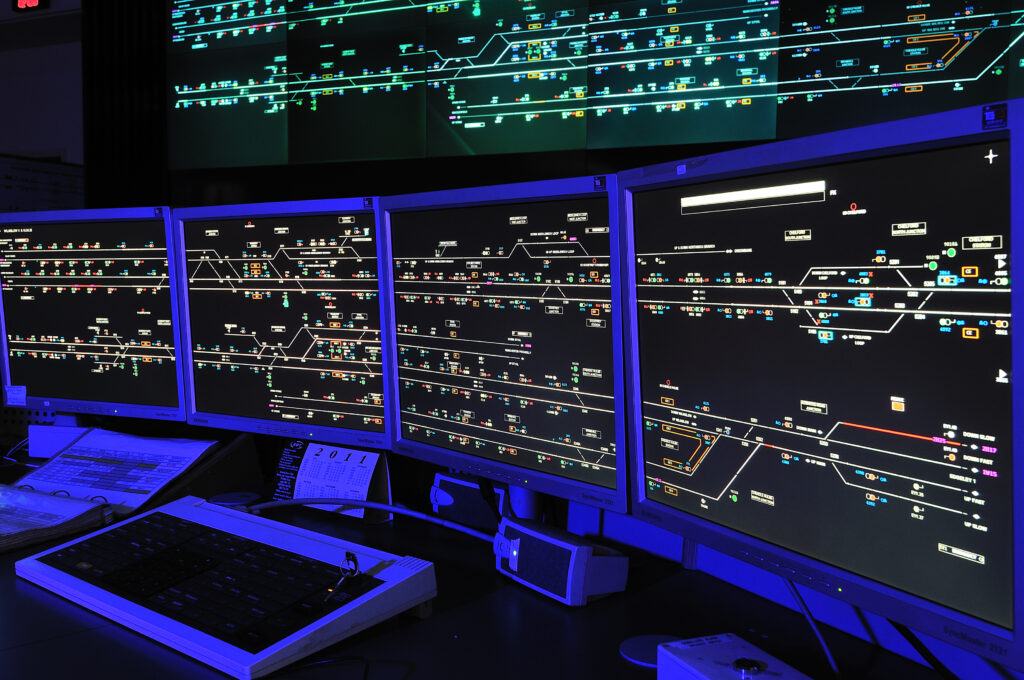
Monitoring can cover both centralised railway infrastructure and distributed equipment in stations, depots, control centres, substations, trains and maintenance facilities.
Typical monitoring objectives include:
- Identifying unauthorised connections to railway networks.
- Detecting unusual communication between OT devices.
- Monitoring privileged accounts and remote maintenance sessions.
- Identifying suspicious changes to system configurations.
- Detecting malware indicators and compromised endpoints.
- Recognising unusual activity involving engineering workstations.
- Monitoring critical network boundaries and external connections.
- Supporting investigation, incident response and service recovery.
Monitoring does not automatically prevent an attack. It provides the visibility needed to identify suspicious activity, assess its significance and initiate an appropriate response.
2. What Is an OT Security Operations Center?
A Security Operations Center (SOC) is an organisational capability responsible for monitoring security events, analysing alerts, investigating potential incidents and coordinating defensive actions.
An OT SOC applies these activities to operational technology environments. In railways, this means understanding the systems and operational processes that support train movements, signalling, power supply, communications, station facilities and rolling stock.
An OT SOC may operate as a dedicated railway security function, as part of a broader corporate SOC with specialised OT analysts, or through a managed security service provider. The organisational model depends on the size of the railway organisation, its technical capabilities, operational requirements and regulatory obligations.
2.1 IT SOC and OT SOC: Key differences
| Area | Traditional IT SOC | Railway OT SOC |
|---|---|---|
| Primary environment | Corporate IT, servers, endpoints and cloud services | Signalling, SCADA, train control, energy and industrial networks |
| Main priorities | Information security, business systems and data protection | Operational availability, integrity, resilience and safe railway operations |
| Monitoring methods | Endpoint agents, log analysis, network detection and cloud telemetry | Passive network monitoring, carefully selected endpoint telemetry and system logs |
| Response options | Account suspension, endpoint isolation and automated containment | Coordinated response with OT engineers and operational authorities |
| Technology constraints | Generally more flexible deployment and update cycles | Legacy devices, proprietary protocols and strict availability requirements |
| Incident assessment | Business impact and information security | Cybersecurity impact together with operational and potential safety consequences |
| Change management | IT service and change-control procedures | Railway engineering, maintenance, safety and operational change procedures |
The distinction is important. A security tool that works well in a corporate network may be unsuitable for a signalling or traction power environment. The OT SOC must understand not only whether an event is suspicious, but also what a proposed response could mean for railway operations.
3. Which Railway Systems Should Be Monitored?
A railway monitoring programme should begin with an inventory of the systems, communication paths and external connections that support railway operations. Not every asset requires the same monitoring frequency or detection capability.
| Railway domain | Examples of monitored systems | Monitoring priorities |
|---|---|---|
| Signalling and train control | Interlocking interfaces, ETCS, RBC, ATP and signalling workstations | Unauthorised access, unexpected communication and configuration changes |
| Traffic management | TMS, CTC, OCC and dispatching systems | Account activity, unusual system access and service availability |
| Railway energy | SCADA, substations, traction power and remote terminal units | Abnormal commands, communication changes and engineering access |
| Telecommunications | Railway radio, fibre networks, IP infrastructure and network management | Unexpected connections, network changes and service disruption |
| Stations and depots | Passenger information, CCTV, access control and building management | Compromised devices, unauthorised administration and network boundary activity |
| Rolling stock | TCMS, onboard networks, diagnostics and train-to-ground interfaces | Unexpected communication, software changes and suspicious maintenance access |
| Corporate IT | Identity systems, email, servers, databases and business applications | Credential theft, malware, phishing and lateral movement |
| Supplier connections | Vendor portals, maintenance gateways and remote support systems | Third-party access, unusual sessions and unauthorised data transfer |
Monitoring should include the interfaces between these domains. A compromised corporate account, for example, may become relevant to railway operations if the account has access to a maintenance gateway or another system connected to OT.
4. Railway OT SOC Architecture
A railway OT SOC architecture should provide visibility across distributed operational environments without creating unnecessary connections or performance risks.
A practical architecture can be organised into five functional layers.
4.1 Data collection layer
This layer collects security-relevant information from network infrastructure, firewalls, servers, engineering workstations, monitoring sensors and selected operational systems.
Possible sources include:
- Network traffic metadata and passive packet inspection.
- Firewall and gateway logs.
- VPN and remote access records.
- Identity and authentication logs.
- Server and workstation security events.
- SCADA and engineering system logs where supported.
- Configuration management records.
- Endpoint detection alerts from compatible devices.
- Physical access and maintenance records where relevant.
4.2 Network visibility layer
Network monitoring sensors observe communication at selected points, such as network boundaries, industrial switches, data aggregation points and security zones.
Passive network taps or properly configured switch monitoring ports can provide visibility without actively communicating with the monitored equipment. This is particularly useful where operational devices have limited resources or cannot tolerate intrusive security tools.
4.3 Analysis and correlation layer
Collected events are processed by security monitoring platforms. A Security Information and Event Management (SIEM) system can correlate events from different sources, identify patterns and support investigations.
For OT environments, the analysis should incorporate knowledge of industrial protocols, device roles, normal communication paths and railway operating conditions.
4.4 Detection and alerting layer
Detection systems identify suspicious behaviour and generate alerts for investigation. These may include signature-based detection, protocol-aware rules, behavioural analysis and threat intelligence indicators.
4.5 SOC operations and response layer
Analysts investigate alerts, assess operational significance, coordinate with railway engineering teams and escalate confirmed incidents through approved procedures.
The SOC should not independently issue commands to safety-related equipment or disconnect critical systems without the required operational authorisation.
5. Passive Network Monitoring in Railway OT
Passive network monitoring is one of the most useful techniques for establishing visibility in industrial and railway environments. It observes network traffic without intentionally initiating communication with the monitored devices.
This approach is valuable because many OT systems are designed for predictable and relatively stable communication. A change in the normal pattern may indicate a misconfiguration, equipment fault, unauthorised connection or possible cyber incident.
5.1 Establishing a network baseline
Before effective anomaly detection can be implemented, the organisation needs to understand normal network behaviour.
A baseline should identify:
- Which devices normally communicate with each other.
- Which protocols and services are used.
- Typical communication frequency and direction.
- Expected connections during normal operating conditions.
- Approved maintenance and engineering activities.
- Known changes associated with timetable, maintenance or operational cycles.
For example, if a signalling workstation normally communicates with a defined set of systems, an unexpected connection to an unfamiliar device may deserve investigation. However, the alert should be assessed against planned maintenance, engineering changes and legitimate operational activity before it is classified as an incident.
5.2 Detecting changes in communication patterns
Passive monitoring can help identify:
- New or unexpected network devices.
- Communication between previously unrelated network segments.
- Unusual protocol usage.
- Unexpected communication outside approved maintenance windows.
- Repeated connection attempts or unusual traffic volumes.
- Changes in communication between industrial controllers and supervisory systems.
These observations are indicators, not automatic proof of malicious activity. Detection rules should account for normal engineering and operational changes.
6. SIEM, IDS, NDR and OT-Specific Detection Tools
Railway OT SOCs may use several complementary technologies. No single platform provides complete visibility across all railway systems.
| Technology | Purpose | Railway application |
|---|---|---|
| SIEM | Collects, normalises and correlates security events | Central analysis of firewall, identity, server and OT-related logs |
| IDS | Detects suspicious network or host activity | Monitoring industrial protocols and unusual communication patterns |
| NDR | Analyses network traffic to identify threats and anomalies | Visibility across railway network zones and OT communication paths |
| EDR | Detects and investigates suspicious endpoint behaviour | Compatible servers, engineering workstations and corporate endpoints |
| OT asset discovery | Identifies devices and communication relationships | Maintaining an inventory of industrial devices and network connections |
| Threat intelligence | Provides information about threats, indicators and adversary techniques | Contextualising alerts against relevant railway and industrial threats |
| SOAR | Coordinates and automates selected security workflows | Case creation, notification and approved administrative tasks |
Security Information and Event Management (SIEM) and Security Orchestration, Automation and Response (SOAR) platforms can improve operational efficiency, but automation must be carefully limited in OT environments. An automated action that isolates a corporate laptop may be acceptable under an approved policy; automatically disconnecting an operational controller or a critical railway gateway may create unacceptable consequences.
7. What Should a Railway OT SOC Detect?
Detection rules should be designed around railway assets, operational processes and realistic threat scenarios. Generic IT alerts alone are not sufficient to understand the security condition of a railway OT environment.
7.1 Unauthorised access
Examples include unusual login attempts, access from unapproved locations, use of dormant accounts, unexpected privileged sessions and access outside authorised maintenance periods.
7.2 Unexpected network communication
Alerts may be generated when a device communicates with an unfamiliar endpoint, a new protocol appears in a restricted zone or traffic crosses a network boundary without an approved operational reason.
7.3 Configuration and software changes
Changes to controller configurations, engineering files, firmware versions and system parameters should be compared with approved maintenance and change records.
7.4 Suspicious remote maintenance
Remote sessions should be monitored for unexpected account use, unusual duration, access outside approved windows and attempts to reach systems outside the authorised scope.
7.5 Malware and ransomware indicators
Detection may include suspicious processes, malicious files, unusual encryption activity, abnormal file access and indicators associated with known malware campaigns. OT systems may not support conventional endpoint agents, so network and adjacent-system telemetry can be particularly important.
7.6 Denial-of-service and availability anomalies
Monitoring should identify unusual traffic volumes, repeated connection attempts, resource exhaustion indicators and unexpected service interruptions. These events must be correlated with equipment faults, network maintenance and other non-malicious causes.
8. Railway-Specific Threat Detection Scenarios
The following scenarios illustrate how a railway OT SOC could use monitoring information. They are hypothetical examples intended to explain detection and investigation processes, not claims about incidents at specific operators.
| Scenario | Potential indicators | Initial SOC action |
|---|---|---|
| Unexpected signalling network connection | New device or communication path in a restricted zone | Validate asset identity and approved engineering changes |
| Unusual SCADA engineering access | Privileged login outside an authorised maintenance window | Check account owner, work order and session records |
| Compromised maintenance workstation | Suspicious process activity or unexpected connections | Coordinate investigation with OT engineering before containment |
| Supplier account misuse | Remote session from an unexpected source or outside approved hours | Verify supplier authorisation and access scope |
| Abnormal train-to-ground communication | Unexpected endpoint, traffic pattern or data exchange | Validate against vehicle architecture and fleet operations |
| Unusual traffic management system activity | Unexpected account privileges or unusual administrative changes | Review identity logs, change records and system events |
| Possible ransomware activity | Unusual file operations and alerts from connected systems | Assess affected assets and coordinate incident response |
9. Integrating IT SOC and OT SOC Operations
Railway organisations should avoid treating IT and OT security as completely separate activities. Corporate IT systems, supplier platforms and remote access services can provide pathways into operational environments. At the same time, OT incidents may affect business systems, customer services and regulatory reporting obligations.
An integrated operating model should establish clear responsibilities for:
- Sharing security alerts between IT and OT teams.
- Correlating identity, network and endpoint events.
- Escalating incidents that may affect railway operations.
- Coordinating with signalling, power, rolling stock and telecommunications engineers.
- Managing supplier and third-party notifications.
- Maintaining a common incident record and evidence trail.
- Coordinating business continuity and operational recovery.
A central SOC can provide common processes, threat intelligence and reporting. Specialist OT analysts and railway engineering personnel should provide the context needed to interpret operational events correctly.
10. Alert Triage and Incident Classification
A monitoring platform may generate thousands of events, but not every alert represents a cyber incident. Effective SOC operations depend on consistent triage and prioritisation.
A practical process can use four stages:
Stage 1: Initial validation
Determine whether the alert is technically valid. Check the source, timestamp, affected asset, event type and available supporting evidence.
Stage 2: Operational context
Consult asset inventories, network architecture, maintenance schedules, approved change records and relevant engineering teams. Determine whether the activity is expected.
Stage 3: Risk assessment
Assess the potential impact on confidentiality, integrity, availability and railway operations. Consider the affected system’s criticality and the possibility of further compromise.
Stage 4: Escalation and response
Assign the appropriate incident category, notify responsible personnel and follow the approved incident response procedure.
Severity should not be determined solely by the number of affected devices. An event involving a single highly critical operational asset may require more urgent attention than a larger number of low-impact corporate endpoints.
11. OT SOC Incident Response and Operational Coordination
When a monitoring alert is confirmed as a potential incident, the SOC should coordinate with the organisation’s incident response team and relevant operational authorities.
A railway incident response process may include:
- Detection: identify suspicious activity through monitoring, reporting or threat intelligence.
- Validation: establish whether the event is genuine and identify affected assets.
- Operational assessment: consult the relevant railway engineering and operational teams.
- Containment planning: identify proportionate measures that do not create unacceptable operational consequences.
- Authorised response: implement approved actions through the responsible technical and operational personnel.
- Recovery: restore systems using verified configurations, approved backups and controlled procedures.
- Post-incident review: document the event, improve detection rules and update risk assessments.
The SOC should not assume that the fastest technical containment action is always the safest operational decision. Disconnecting a system, disabling a network route or restarting a controller may have consequences that require engineering assessment.
For a detailed explanation of the wider incident management process, see Railway Cybersecurity Incident Response and Resilience.
12. Threat Intelligence for Railway OT Monitoring
Threat intelligence helps analysts understand which threats, vulnerabilities and adversary techniques may be relevant to their environment. It can improve the context of alerts and support the development of detection rules.
Useful information sources may include:
- ENISA transport and railway cybersecurity publications.
- National cybersecurity authorities and Computer Security Incident Response Teams (CSIRTs).
- Railway industry information-sharing communities.
- Relevant industrial cybersecurity advisories.
- Vendor security bulletins and vulnerability notifications.
- Trusted information from infrastructure managers, railway undertakings and suppliers.
Threat intelligence should be filtered according to the organisation’s actual assets and technologies. An indicator associated with a general industrial threat does not automatically apply to every railway system.
Information-sharing arrangements should also protect sensitive operational data. Network diagrams, detailed configurations and security weaknesses should only be shared through appropriate channels and with authorised recipients.
13. Artificial Intelligence and Behavioural Analytics
Artificial intelligence (AI) and machine learning can support security monitoring by identifying unusual patterns across large volumes of network and system data. Behavioural analytics may help identify deviations from established communication baselines, unusual account activity and emerging threat patterns.
Potential applications include:
- Identifying unusual communication between OT devices.
- Correlating related alerts from multiple monitoring systems.
- Prioritising events based on asset criticality and operational context.
- Supporting investigation through event summarisation.
- Identifying changes in network behaviour over time.
AI-based detection also has limitations. Changes in railway operating conditions, engineering work and maintenance activities can produce unusual but legitimate behaviour. Poorly trained models may generate false positives or fail to recognise new threats.
AI should support qualified SOC analysts and railway engineers. It should not independently issue commands to safety-related equipment, modify critical configurations or initiate disruptive containment actions without an authorised and validated process.
14. Common Challenges in Railway OT Monitoring
Railway environments present several challenges that can limit the effectiveness of monitoring programmes.
14.1 Legacy equipment
Older systems may have limited logging, outdated operating systems or proprietary communication protocols. Some cannot support modern endpoint monitoring tools.
14.2 Incomplete asset inventories
Without an accurate inventory, analysts may not know which devices are connected, which systems are critical or whether an observed communication path is legitimate.
14.3 Limited protocol visibility
Some railway systems use specialised or vendor-specific protocols. Monitoring platforms may not interpret all messages or understand their operational meaning.
14.4 False positives
Maintenance, timetable changes, commissioning and engineering work can change normal network behaviour. Detection rules need operational context to avoid unnecessary escalation.
14.5 Limited specialist skills
Effective OT monitoring requires knowledge of cybersecurity, industrial networks and railway engineering. A SOC analyst may recognise an unusual event but still need an engineer to understand its operational significance.
14.6 Monitoring coverage gaps
Distributed infrastructure, isolated systems and third-party environments may not provide continuous telemetry. Monitoring programmes should identify and document these gaps rather than assume complete visibility.
15. Building a Railway OT SOC: A Practical Roadmap
Railway organisations do not need to deploy every monitoring technology at once. A phased programme can establish visibility, improve detection and gradually expand operational capability.
| Phase | Main activities | Expected outcome |
|---|---|---|
| 1. Preparation | Define scope, responsibilities, critical assets and operational constraints | Approved OT monitoring strategy |
| 2. Asset visibility | Build inventories, network diagrams and communication baselines | Improved understanding of the monitored environment |
| 3. Initial monitoring | Deploy passive sensors at selected network boundaries and collect available logs | Initial security visibility without unnecessary operational disruption |
| 4. Detection engineering | Develop railway-specific rules and alert priorities | More relevant and actionable alerts |
| 5. SOC integration | Connect IT and OT security processes and define escalation procedures | Coordinated incident handling |
| 6. Response validation | Conduct tabletop exercises and controlled technical tests | Tested roles, procedures and communication channels |
| 7. Continuous improvement | Review performance, coverage, incidents and detection quality | More mature monitoring capability |
16. Measuring OT SOC Performance
Monitoring effectiveness should be measured using operationally meaningful indicators. The number of alerts generated is not a reliable measure of security maturity on its own.
Possible Key Performance Indicators (KPIs) include:
- Asset visibility: percentage of in-scope critical assets included in the inventory and monitoring programme.
- Network coverage: percentage of priority network zones with suitable monitoring visibility.
- Detection time: time between the beginning of a detectable event and its identification.
- Investigation time: time required to validate and classify an alert.
- False-positive rate: proportion of alerts assessed as non-malicious or expected activity.
- Escalation performance: proportion of relevant alerts delivered to the correct operational personnel within the defined target.
- Incident exercise results: performance during planned incident response and coordination exercises.
- Detection coverage: extent to which relevant threat scenarios are covered by monitoring rules and procedures.
- Log availability: availability and integrity of required security event records.
Metrics should be interpreted in context. A short detection time is valuable only if alerts are accurate, relevant and connected to an effective response process.
17. Standards and Regulatory Framework
Railway OT monitoring draws on railway-specific cybersecurity guidance, industrial security standards and broader information security frameworks. These documents provide useful requirements and practices, but their applicability depends on the organisation, system, contract and jurisdiction.
| Standard or framework | Relevance to monitoring and SOC operations |
|---|---|
| CLC/TS 50701:2023 | Railway-sector cybersecurity management across the RAMS lifecycle, including risk management and security activities. |
| IEC 62443 series | Industrial automation and control system security, including security programmes, system requirements, zones and conduits. |
| NIST SP 800-82 Rev. 3 | OT security guidance covering monitoring, network visibility, detection and operational constraints. |
| NIST Cybersecurity Framework 2.0 | Govern, Identify, Protect, Detect, Respond and Recover functions for cybersecurity risk management. |
| ISO/IEC 27001:2022 | Information security management and organisational control framework. |
| ISO/IEC 27002:2022 | Security controls supporting logging, monitoring, access management and incident handling. |
| ISO/IEC 27035 series | Information security incident management principles and processes. |
17.1 NIST SP 800-82 Rev. 3 and the Rev. 4 draft
NIST SP 800-82 Rev. 3, published in September 2023, provides guidance on securing OT while addressing performance, reliability and safety requirements. Its monitoring recommendations include network monitoring, behavioural anomaly detection, SIEM, IDS and IPS capabilities.
The guidance also highlights the value of understanding normal OT network behaviour before deploying anomaly detection. Passive monitoring can be an appropriate starting point, particularly where active scanning may affect operational equipment.
As of November 2026, NIST has published an initial public draft of SP 800-82 Rev. 4, with public comments due by 30 November 2026. The draft should not be described as a final replacement for Rev. 3.
17.2 NIS2 and railway cybersecurity monitoring
The NIS2 Directive (EU) 2022/2555 identifies rail transport among the high-criticality sectors. Depending on the applicable scope and national implementation, railway infrastructure managers and railway undertakings may be subject to cybersecurity risk-management and incident-reporting obligations.
Article 21 requires appropriate and proportionate technical, operational and organisational measures to manage cybersecurity risks. Monitoring capabilities can support these obligations by helping organisations identify incidents, preserve evidence and assess their impact.
Monitoring is not, by itself, proof of NIS2 compliance. Organisations must assess the complete set of applicable requirements, their national implementing legislation and any sector-specific obligations.
18. Railway OT SOC: In-House, Shared or Managed Service?
There is no single SOC operating model suitable for every railway organisation. Infrastructure managers, passenger operators, freight companies and maintenance providers have different technical resources and monitoring requirements.
| Model | Advantages | Considerations |
|---|---|---|
| Dedicated in-house OT SOC | Direct operational knowledge, close coordination with engineering teams and greater control over monitoring processes | Requires specialist personnel, technology investment and continuous operational coverage |
| Shared railway-sector SOC | Shared expertise, common detection practices and potential cost efficiencies | Requires clear information-sharing rules, access controls and governance arrangements |
| Managed OT security service | Access to specialist monitoring capabilities and external expertise | Requires careful supplier selection, data protection, service-level agreements and railway-specific competence |
| Hybrid model | Combines internal railway knowledge with external monitoring and specialist support | Responsibilities and incident escalation paths must be clearly defined |
When using external providers, railway organisations should assess the provider’s OT expertise, personnel qualifications, incident escalation procedures, data handling practices and ability to work within railway operational constraints.
19. Future Developments in Railway Cybersecurity Monitoring
19.1 Embedded onboard monitoring
Monitoring capabilities are increasingly being explored for integration into rolling stock networks. Embedded sensors and edge devices may help detect suspicious communication and abnormal onboard behaviour. Their deployment must be validated against vehicle architecture, performance requirements and operational constraints.
19.2 Cross-domain monitoring
As trains, infrastructure, stations and control centres become more connected, security monitoring will increasingly need to correlate events across different railway domains.
19.3 More detailed asset and configuration visibility
Accurate asset inventories, software versions and configuration baselines can improve vulnerability management and help analysts identify unexpected changes.
19.4 AI-assisted security operations
AI may support alert prioritisation, anomaly analysis and investigation workflows. Human review and operational approval remain essential for actions that could affect railway systems.
19.5 Railway-specific threat intelligence and information sharing
Cooperation between infrastructure managers, railway undertakings, manufacturers, suppliers and national cybersecurity authorities can improve awareness of relevant threats and emerging vulnerabilities.
20. Frequently Asked Questions
What is an OT SOC in the railway sector?
A railway OT SOC is a security operations capability that monitors operational technology environments such as signalling, SCADA, traction power, train communication networks and other systems supporting railway services.
What is the difference between an IT SOC and an OT SOC?
An IT SOC primarily monitors corporate IT and information systems. An OT SOC monitors industrial and operational systems while accounting for availability, reliability, engineering and safety constraints.
Can a railway OT SOC monitor signalling systems?
Yes. Monitoring may include approved network visibility, system logs, access records and configuration events associated with signalling environments. Deployment must be carefully designed to avoid interference with operational equipment.
Is passive monitoring safer than active scanning?
Passive monitoring generally avoids initiating communication with monitored devices and is often a suitable starting point in sensitive OT environments. Active scanning may still be useful in controlled circumstances, but its effects should be assessed and tested before deployment.
Does a SIEM platform provide complete OT security?
No. A SIEM correlates security events, but effective OT security also requires asset visibility, network monitoring, protocol knowledge, engineering context, incident procedures and appropriate response capabilities.
Should a railway OT SOC automatically isolate compromised devices?
Not without an approved operational assessment and response procedure. Isolation may affect essential services or connected equipment. Actions involving critical railway systems should be coordinated with authorised operational and engineering personnel.
Can smaller railway operators use managed OT SOC services?
Yes. Managed services may provide access to specialist expertise and monitoring capabilities. The provider must understand railway OT requirements and operate under clearly defined access, escalation and data protection arrangements.
How does cybersecurity monitoring support NIS2?
Monitoring can help identify incidents, assess their impact, preserve evidence and support reporting obligations. It is one element of a wider cybersecurity risk-management programme, not a complete compliance solution.
Conclusion
Railway cybersecurity monitoring is essential for understanding what is happening across increasingly connected railway environments. A well-designed OT SOC can help detect suspicious activity, identify unauthorised access, investigate abnormal network behaviour and coordinate incident response across operational and corporate systems.
However, successful monitoring depends on more than technology. It requires accurate asset inventories, network visibility, railway-specific detection rules, trained analysts, engineering involvement and clear operational authority. Passive monitoring and risk-based detection provide a practical foundation, particularly for sensitive or legacy systems.
As railway digitalisation continues, cybersecurity monitoring should become a standard part of railway asset management, operational resilience and lifecycle security. The objective is not simply to generate more alerts, but to identify meaningful threats early and respond without compromising the availability and safe operation of railway services.
References and Further Reading
- ENISA – Railway Cybersecurity (2020).
- ENISA – Railway Cybersecurity: Good Practices in Cyber Risk Management (2021).
- NIST SP 800-82 Rev. 3 – Guide to Operational Technology Security (2023).
- NIST SP 800-82 Rev. 4 – Initial Public Draft (2026).
- NIST Cybersecurity Framework 2.0.
- ENISA – Cybersecurity of the Transport Sector.
- ENISA and European Rail ISAC – Zoning and Conduits for Railways.
- Europe’s Rail – On-Board Cybersecurity Monitoring and Threat Detection for Rolling Stock (2026).
- Directive (EU) 2022/2555 – NIS2.
- CLC/TS 50701:2023 – Railway Applications: Cybersecurity.
Related RailwayNews Wiki articles: