1. What Is Railway Operational Technology?
Operational technology refers to programmable systems and devices that monitor or control physical equipment, processes and events. In railway environments, OT may collect information from field equipment, process operational data, issue control commands or support the safe and reliable delivery of railway services.
Examples include signalling equipment, interlocking systems, train control technologies, traffic management platforms, traction power monitoring, station control systems and onboard train networks. The precise boundary between OT and IT varies between railway organisations and system architectures.
OT should not be treated as a single network or product category. It is an operational environment made up of different technologies, suppliers, interfaces and asset lifecycles. A station information display, a traction power control system and an interlocking installation do not have the same operational role or risk profile.
2. Railway OT vs IT: Key Differences
Information technology (IT) primarily supports information processing, business applications and data exchange. Operational technology interacts with physical equipment or processes. Railway organisations use both environments, and the two may exchange information through controlled interfaces.
| Aspect | IT environment | OT environment |
|---|---|---|
| Primary purpose | Business information and services | Monitoring and control of operational processes |
| Typical examples | Email, finance, ticketing, passenger applications | Signalling, SCADA, interlocking, train control |
| Key operational priorities | Confidentiality, integrity and availability | Availability, integrity, predictable performance and safe operation where applicable |
| Change management | Often follows frequent software and service cycles | Must account for operational windows, validation and system dependencies |
| Maintenance constraints | Updates may be deployed relatively frequently | Updates may require extensive testing, supplier coordination and planned access |
| Typical consequence of disruption | Loss of business or information services | Operational disruption and, depending on the system, potential safety consequences |
These are general distinctions, not absolute rules. IT systems can be essential to railway operations, while not every OT component has a direct safety function. Risk assessment must consider the actual role and dependencies of each asset.
3. Which Railway Systems Use OT?
3.1 Signalling and train protection
Signalling and train protection systems support the safe movement of trains by controlling or supervising movement authorities, routes, speed restrictions and related operational conditions. Depending on the railway, these systems may include interlocking, trackside equipment, train protection systems, radio block centres and onboard equipment.
Examples include the European Train Control System (ETCS), automatic train protection (ATP) and communications-based train control (CBTC). Their architectures and security requirements differ. A security assessment must identify the actual equipment, interfaces, data flows and operational responsibilities rather than assume that all signalling systems use the same design.
3.2 Traffic management and control centres
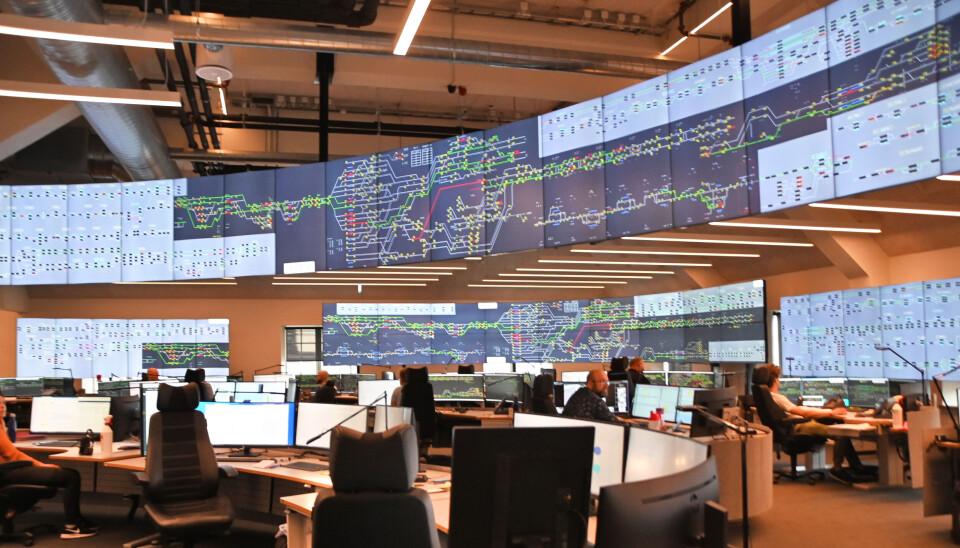
Traffic management systems (like ERTMS) and control-centre platforms support dispatching, timetable management, train regulation, route status monitoring and operational coordination. Their disruption may reduce the ability of railway staff to monitor or manage traffic efficiently, even where the underlying signalling equipment remains functional.
3.3 SCADA and railway power systems
Supervisory Control and Data Acquisition (SCADA) systems can monitor and control distributed infrastructure. In railways, applications may include traction power, substations, tunnel equipment, ventilation, pumping and other fixed installations. The security requirements depend on the function, connectivity and operational impact of each installation.
3.4 Rolling stock and onboard networks
Modern trains contain interconnected electronic systems. The Train Control and Management System (TCMS) coordinates and monitors onboard subsystems. Other equipment may include train protection, passenger information, diagnostics, communications, door control and energy management systems.
Not every onboard network has the same criticality. The security architecture should distinguish safety-related functions, operational functions, passenger services and maintenance interfaces, while controlling the connections between them.
3.5 Stations, depots and maintenance facilities
Station and depot environments may contain access control, CCTV, building management, passenger information, platform equipment, workshop systems and diagnostic tools. These systems can create pathways into wider organisational networks if connections, accounts and maintenance procedures are not properly controlled.
4. Cybersecurity Threats to Railway OT
Railway OT can be exposed to threats originating from external attackers, compromised suppliers, malicious insiders, accidental configuration changes and weaknesses in legacy equipment. The following categories describe common risk scenarios; they do not imply that every railway system is equally exposed.
4.1 Ransomware and malware
Malware can disrupt the computers and services used to support railway operations. An infection in corporate IT may affect scheduling, maintenance coordination, ticketing or access to operational information. If IT and OT environments are inadequately separated, an incident may spread or disrupt services that support operational technology.
4.2 Unauthorised access
Weak authentication, shared accounts, excessive privileges and poorly managed remote connections can allow unauthorised users to access systems or data. Privileged accounts used by suppliers and maintenance contractors require particular attention.
4.3 Denial-of-service attacks
Denial-of-service attacks attempt to make a service unavailable by exhausting resources or disrupting communications. Depending on the affected system, the result may be loss of remote monitoring, reduced access to operational information or interruption of passenger-facing services.
4.4 Network intrusion and lateral movement
An attacker who gains access to one system may attempt to move to other connected assets. Flat networks, undocumented connections and insufficient access restrictions can increase this risk. Segmentation and controlled interfaces help limit the potential spread of an incident.
4.5 Supply-chain compromise
Railway systems rely on equipment manufacturers, software developers, integrators, telecommunications providers and maintenance contractors. Vulnerabilities in third-party products, compromised software updates or insecure supplier access may introduce risks into railway environments.
4.6 Removable media and maintenance devices
Engineering laptops, portable diagnostic tools and removable storage can transfer files between environments. Uncontrolled USB use, outdated software and insufficient inspection procedures may introduce malware or unauthorised changes.
4.7 Legacy technology and unsupported components
Some railway assets remain in service long after their original development. They may use outdated operating systems, proprietary protocols or equipment for which security updates are limited. Replacing such assets may require extensive engineering, testing and operational planning.
5. Railway OT Cybersecurity Architecture
A secure railway OT architecture begins with an accurate understanding of assets, functions, communications and dependencies. Organisations should identify which systems communicate with one another, why those connections are required and which operational consequences could result if a connection is misused.
5.1 Asset inventory and system mapping
An OT asset inventory should identify relevant hardware, software, firmware, network interfaces, system owners, suppliers, locations at an appropriate level of detail, support status and operational function. It should also record dependencies and authorised communication paths.
5.2 Network segmentation
Network segmentation divides an environment into controlled security zones. Communication between zones is restricted through defined conduits, gateways, firewalls or other suitable controls. The objective is to limit unnecessary connectivity and reduce the ability of an attacker to move between systems.
Segmentation should reflect operational risk and system architecture. A design may separate corporate IT, operational management, control-centre systems, signalling environments, station systems, maintenance access and external supplier connections. The actual zones must be determined by the railway organisation’s risk assessment; there is no universal network diagram suitable for every railway.
5.3 Controlled interfaces
Connections between IT and OT should be documented, authorised and monitored. Only required data flows should be permitted. Where technically and operationally appropriate, organisations may use secure gateways, firewalls, proxy services or unidirectional technologies to control information exchange.
5.4 Secure remote access
Remote access should be enabled only for approved purposes and authorised users. Appropriate controls include multi-factor authentication where supported, individual accounts, time-limited access, approval workflows, restricted privileges, session logging and prompt revocation when access is no longer required.
5.5 Monitoring and logging
Monitoring should provide visibility into relevant network traffic, account activity, configuration changes and system events. Security monitoring tools must be selected and configured so that they do not adversely affect the availability or performance of operational systems.
6. Essential Security Controls for Railway OT
There is no single control that can secure every railway OT environment. A layered approach should combine governance, technical safeguards, operational procedures, supplier management and staff competence.
| Control area | Practical measures |
|---|---|
| Asset management | Maintain OT asset inventories, ownership records, software and firmware versions, and system dependencies. |
| Access management | Use individual accounts, least privilege, controlled administrator access and periodic access reviews. |
| Network security | Segment networks, document data flows, restrict unnecessary connections and monitor authorised interfaces. |
| Remote maintenance | Approve supplier access, authenticate users, limit sessions, record activity and revoke access when completed. |
| Vulnerability management | Assess vulnerabilities against operational risk, supplier advice, exposure and available mitigation options. |
| Configuration management | Control software, firmware and configuration changes through documented approval and validation. |
| Backup and recovery | Protect system configurations and essential data, maintain offline or otherwise protected copies where appropriate, and test restoration procedures. |
| Monitoring | Collect relevant logs, monitor unusual activity and define escalation procedures. |
| Incident response | Prepare OT-specific response procedures, operational fallback arrangements and communication channels. |
| Supplier security | Include security requirements in procurement, contracts, support arrangements and maintenance processes. |
| Workforce competence | Train operators, engineers, maintainers, IT teams and suppliers in their respective security responsibilities. |
7. OT Cybersecurity Across the System Lifecycle
Cybersecurity should be considered from the earliest stages of system planning and procurement. Adding controls only after installation may be costly, technically difficult or incompatible with the system’s design.
7.1 Design and procurement
Requirements should define security responsibilities, system boundaries, interfaces, authentication, logging, update arrangements, vulnerability handling and support expectations. Suppliers should provide sufficient technical information for the railway organisation to assess and manage the product throughout its intended service life.
7.2 Integration and testing
Security testing should be planned alongside system integration and operational validation. Testing must be authorised, scoped and conducted in environments where it will not create unacceptable risk to live operations. Where possible, representative test environments should be used before changes are introduced into operational systems.
7.3 Operation and maintenance
Operational procedures should cover access approvals, configuration changes, patch assessment, backup verification, vulnerability handling, supplier support and incident reporting. Security responsibilities must be clear across the infrastructure manager, railway undertaking, system integrator, manufacturer and maintenance provider.
7.4 Decommissioning and replacement
When a system is retired, organisations should remove or disable unnecessary connections and accounts, manage retained data, revoke supplier access and ensure that replacement systems inherit the required security controls. Legacy equipment that remains connected during transition should continue to be managed as an active risk.
8. Cybersecurity and Functional Safety: Related but Different
Functional safety and cybersecurity are not interchangeable. Functional safety addresses risks arising from failures and hazardous system behaviour. Cybersecurity addresses risks arising from malicious or unauthorised actions, as well as other security-related events that may affect systems and services.
A safety-related railway system may be designed and assessed against applicable railway safety requirements. That does not, by itself, demonstrate that its software, interfaces, maintenance connections or supporting networks are protected against cyber threats.
Equally, a cybersecurity control must not be introduced without considering its effect on operational and safety requirements. For example, a firewall rule, software update, authentication mechanism or network isolation change may affect system behaviour if it is not properly engineered and validated.
Railway organisations should therefore coordinate safety and cybersecurity activities while preserving their distinct objectives, methods and assurance responsibilities. Security risk assessments should identify possible effects on safety, service availability and operational continuity.
9. Standards and Guidance for Railway OT Cybersecurity
CLC/TS 50701 — Railway applications: Cybersecurity
CLC/TS 50701 provides railway-specific guidance for managing cybersecurity in the context of the railway RAMS lifecycle. Its scope covers communications, signalling and processing, rolling stock and fixed installations. It is a technical specification, not a substitute for applicable legislation or a universal certification of railway cybersecurity.
IEC 62443 — Industrial automation and control systems security
The IEC 62443 series provides a framework for securing industrial automation and control systems. Its concepts can support railway OT security, particularly for risk assessment, zones and conduits, system security requirements, product development and service-provider responsibilities.
IEC 62443-3-2:2020 addresses security risk assessment for system design, including defining the system under consideration, partitioning it into zones and conduits, assessing risk and establishing target security levels.
EN 50126 — Railway RAMS
The EN 50126 series addresses reliability, availability, maintainability and safety (RAMS) in railway applications. Railway cybersecurity activities should be coordinated with the relevant lifecycle and assurance processes, while recognising that RAMS and cybersecurity address different risk dimensions.
ISO/IEC 27001 and related information security standards
ISO/IEC 27001 provides requirements for an information security management system. It can support organisation-wide governance and risk management, but OT environments require additional technical and operational measures tailored to their specific constraints.
NIST SP 800-82
NIST SP 800-82 Rev. 3, published in September 2023, provides guidance on securing OT while addressing performance, reliability and safety requirements. It covers OT architectures, threats, vulnerabilities and security safeguards, and includes transportation systems within its scope.
NIST published an initial public draft of Revision 4 on 21 September 2026. The draft should not be described as a final replacement for Revision 3. Organisations using the guidance should check the current publication status before adopting revision-specific recommendations.
10. Practical Implementation Roadmap
Railway organisations can structure OT cybersecurity improvement as a phased programme. The starting point should be the organisation’s actual assets, operational dependencies, risk exposure and available resources.
Phase 1: Establish visibility and accountability
- Identify OT assets and assign accountable owners.
- Map system boundaries, dependencies and authorised connections.
- Identify remote access paths and privileged accounts.
- Define responsibilities between operations, engineering, IT, cybersecurity and suppliers.
- Establish an OT cybersecurity risk register.
Phase 2: Reduce exposure
- Remove unnecessary connections and accounts.
- Implement risk-based network segmentation.
- Strengthen authentication and privileged access management.
- Formalise supplier and remote maintenance access.
- Protect backups and test recovery arrangements.
Phase 3: Improve detection and response
- Establish monitoring appropriate to operational systems.
- Define OT-specific incident response procedures.
- Test escalation and communication arrangements.
- Exercise operational fallback and recovery processes.
- Review incidents, vulnerabilities and corrective actions.
Phase 4: Embed lifecycle and supply-chain security
- Integrate cybersecurity requirements into procurement and engineering.
- Require appropriate supplier vulnerability and update processes.
- Maintain configuration and software records.
- Include security in system changes, upgrades and replacements.
- Review the programme regularly using evidence and measurable indicators.
Implementation should be proportionate to the operational role and risk of each system. A small station subsystem and a network supporting train control should not automatically receive identical security treatment.
11. Frequently Asked Questions
What is OT cybersecurity in railways?
Railway OT cybersecurity protects the digital systems and devices that monitor or control railway operations, including signalling, train control, SCADA, traffic management, onboard systems and selected station or depot equipment.
What is the difference between railway IT and OT security?
IT security primarily protects business information and digital services. OT security protects systems that interact with physical equipment and operational processes. Railway OT security must account for availability, predictable performance, system dependencies and safety implications where applicable.
Are ETCS and CBTC operational technology?
ETCS and CBTC are railway control and train protection technologies that include OT components. Their architectures differ, so cybersecurity assessments must be based on the actual implementation, interfaces and operational functions.
Does functional safety guarantee cybersecurity?
No. Functional safety and cybersecurity address different risk sources. A system assessed for functional safety may still have cybersecurity weaknesses in its software, communications, maintenance interfaces or supporting infrastructure.
Which standards are relevant to railway OT cybersecurity?
Relevant references include CLC/TS 50701 for railway cybersecurity, the IEC 62443 series for industrial automation and control system security, EN 50126 for railway RAMS processes, ISO/IEC 27001 for information security management and NIST SP 800-82 for OT security guidance.
Can railway OT systems be patched like normal computers?
Not necessarily. Updates must be assessed for compatibility, operational impact, supplier support, testing requirements and safety implications. Railway organisations should use controlled change management and validate updates before deployment.
Conclusion
Railway OT cybersecurity is not a single product, network or technical control. It is a continuous engineering and management discipline covering assets, architecture, access, suppliers, software, maintenance, monitoring and incident response.
The most effective approach begins with understanding how railway systems operate and how they depend on one another. Organisations can then apply risk-based segmentation, controlled remote access, secure lifecycle management, monitoring and tested recovery arrangements without compromising operational requirements.
As railways become more connected, cybersecurity must be integrated into the design, procurement, operation and maintenance of the digital railway. Protecting operational technology is therefore a shared responsibility across infrastructure managers, railway undertakings, manufacturers, system integrators, maintainers and technology suppliers.
References and Further Reading
- ENISA — Railway Cybersecurity: Good Practices in Cyber Risk Management (2021)
- NIST — SP 800-82 Rev. 3: Guide to Operational Technology (OT) Security (2023)
- NIST — Operational Technology Security Publications
- IEC — IEC 62443-3-2:2020, Security Risk Assessment for System Design
- ENISA — Risk Management: Helping the EU Railways Catch the Cybersecurity Train
Editorial note: This article provides general technical information. It is not a system-specific security assessment, safety case, certification or substitute for the current versions of applicable standards and regulations. Railway organisations should assess requirements against their own system architecture, operational context and national legal obligations.