Contents
- 1. What Is Railway Cybersecurity Architecture?
- 2. Understanding Railway IT and OT Architecture
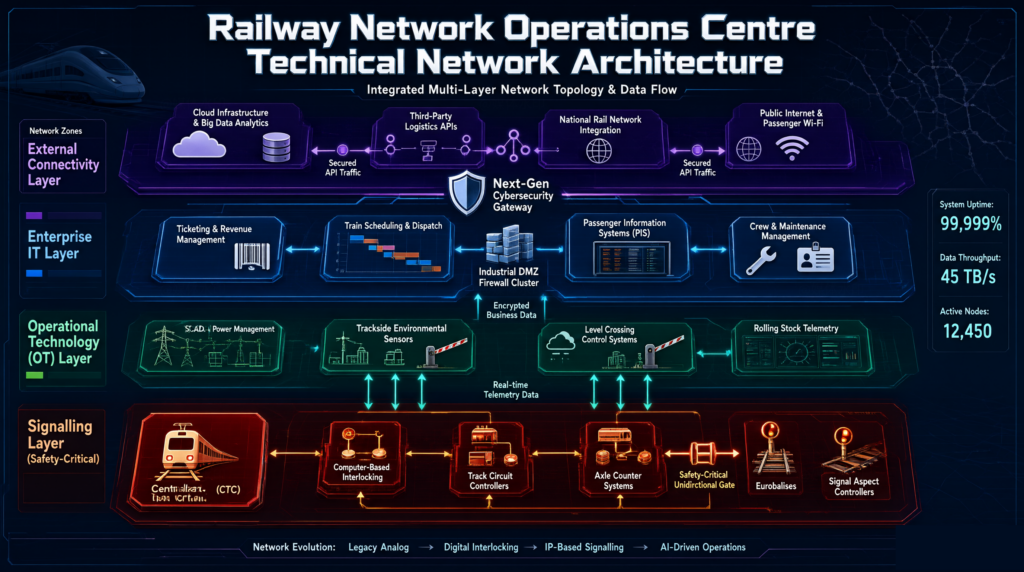
- 3. Main Network Layers in Railway Systems
- 4. The Purdue Model and Its Application to Railways
- 5. Security Zones and Conduits
- 6. DMZs and Controlled Data Exchange
- 7. Segmenting Critical Railway Systems
- 8. Remote Access and Third-Party Connectivity
- 9. Defence in Depth and Zero Trust
- 10. Risk Assessment and Secure Network Design
- 11. Practical Implementation Roadmap
- 12. Common Railway Network Architecture Mistakes
- 13. Future Developments in Railway Network Architecture
- 14. Frequently Asked Questions
- 15. Conclusion
- References and Further Reading
1. What Is Railway Cybersecurity Architecture?
Railway cybersecurity architecture describes how digital systems, networks, devices and communication interfaces are organised and protected across railway infrastructure and operations.
It covers the connections between:
- Corporate information technology (IT) systems.
- Operational technology (OT) and industrial control systems.
- Signalling and train control systems.
- Railway traffic management and control centres.
- Telecommunications and train-to-ground communication networks.
- Rolling stock and onboard networks.
- Station, depot and maintenance systems.
- External service providers, manufacturers and technology suppliers.
The objective is not to disconnect railway systems from one another. Railway operations depend on continuous and reliable information exchange. The objective is to ensure that communication takes place only when required, through defined and controlled interfaces, with appropriate security measures.
A well-designed architecture should achieve five main objectives:
- Availability: Essential railway services must remain operational and recoverable.
- Integrity: Operational data, commands and configurations must not be altered without authorisation.
- Confidentiality: Sensitive operational, commercial and personal information must be protected.
- Segmentation: A compromise in one network area should not automatically expose other systems.
- Resilience: The railway organisation must be able to detect, contain and recover from cyber incidents.
These objectives must be balanced against railway-specific requirements such as real-time performance, availability, legacy equipment, safety-related functions and long system lifecycles.
2. Understanding Railway IT and OT Architecture
One of the most important principles in railway cybersecurity is understanding the difference between IT and OT environments.
2.1 Information Technology (IT)
Information Technology systems primarily process, store and exchange business and administrative information. Typical railway IT systems include:
- Enterprise resource planning (ERP).
- Human resources and payroll systems.
- Financial and procurement applications.
- Corporate email and collaboration platforms.
- Passenger information and customer relationship systems.
- Ticketing and reservation platforms.
- Corporate data centres and business applications.
IT environments generally prioritise information confidentiality, integrity and availability. They commonly use standard enterprise technologies, operating systems and network services.
2.2 Operational Technology (OT)
Operational Technology refers to programmable systems and devices that monitor or control physical processes and equipment.
In railway environments, OT may include:
- Electronic interlocking and signalling equipment.
- Automatic Train Protection (ATP) and train control systems.
- Centralised Traffic Control (CTC) and operational control systems.
- Supervisory Control and Data Acquisition (SCADA) systems.
- Railway power supply and traction energy control systems.
- Platform screen door control systems.
- Industrial control systems in workshops and depots.
- Onboard control and monitoring systems.
OT systems interact with physical railway processes. Their security requirements must therefore consider operational continuity, predictable behaviour, equipment limitations and safety-related dependencies.
2.3 Why IT and OT Must Be Separated
IT and OT environments have different operational requirements, security priorities and risk profiles. A corporate IT incident should not be allowed to propagate directly into signalling, train control or other critical operational systems.
For example, ransomware affecting an office network may interrupt administrative services. If the same network has unrestricted connectivity to operational control systems, the incident could potentially create a much wider operational disruption.
IT/OT separation reduces this exposure by controlling the interfaces between the two environments.
However, separation does not necessarily mean complete physical isolation. Some railway functions require information exchange between operational and business systems. The important requirement is that these connections are explicitly identified, justified, controlled and monitored.
3. Main Network Layers in Railway Systems
A railway network is not a single homogeneous environment. It consists of multiple interconnected systems that support different operational and administrative functions.
The following structure provides a simplified functional overview. Actual railway architectures differ according to the operator, infrastructure, technology supplier and operational model.
| Network or system domain | Typical components | Main cybersecurity concern |
|---|---|---|
| Enterprise IT | ERP, email, HR, finance, corporate servers | Malware, ransomware, identity compromise and data breaches |
| Operational management | Traffic management, operational planning, control centre applications | Unauthorised access, manipulation of operational information and service disruption |
| Signalling and train control | Interlocking, ETCS, ATP, CBTC, RBC and related interfaces | Integrity, availability, unauthorised commands and compromised interfaces |
| Telecommunications | Fibre networks, radio systems, GSM-R and future FRMCS infrastructure | Communication disruption, interception, spoofing and unauthorised connectivity |
| Energy and infrastructure control | Power SCADA, substations, environmental monitoring | Control manipulation, loss of monitoring and operational interruption |
| Rolling stock and depots | TCMS, onboard networks, diagnostic systems and maintenance platforms | Compromised devices, insecure maintenance access and software integrity |
| Stations and passenger services | Passenger information, ticketing, CCTV and access control | Service disruption, privacy breaches and movement between connected systems |
These domains should not automatically be treated as seven separate security zones. The final architecture should be based on a risk assessment, common security requirements, operational dependencies and the actual communication flows between assets.
4. The Purdue Model and Its Application to Railways
The Purdue Enterprise Reference Architecture is widely used to explain industrial control system environments. It organises industrial systems into functional levels, helping organisations understand the relationship between business networks, operational management and field-level control.
Although the model was not developed specifically for railway systems, it can provide a useful starting point for analysing railway OT architecture.
4.1 Overview of the Purdue Levels
| Level | Typical industrial function | Possible railway examples |
|---|---|---|
| Level 0 | Physical process | Trackside equipment, sensors, actuators and physical railway assets |
| Level 1 | Basic control | Controllers and field control devices, depending on the system architecture |
| Level 2 | Supervisory control | Human-machine interfaces, local control and supervisory applications |
| Level 3 | Operations management | OT servers, operational applications, maintenance and engineering systems |
| Level 3.5 | Industrial DMZ | Controlled services between enterprise IT and operational networks |
| Level 4 | Enterprise operations | Corporate applications, business planning and enterprise services |
| Level 5 | External enterprise connectivity | External business services and selected connections beyond the organisation |
Important: This table is an illustrative mapping, not a formal railway system classification. A signalling subsystem, for example, may contain components with different functions and security requirements that cannot be accurately represented by assigning the entire subsystem to one Purdue level.
4.2 Limitations of the Purdue Model in Railways
Railway systems often contain distributed assets, geographically separated control centres, multiple technology generations and safety-related equipment. Their communication architecture may not follow a simple vertical hierarchy.
For example:
- An ETCS architecture may involve onboard equipment, trackside equipment, radio communication and central operational interfaces.
- CBTC systems may connect onboard equipment, wayside equipment, control centres and platform-related subsystems.
- SCADA systems may cover geographically distributed substations and remote infrastructure.
- Rolling stock maintenance systems may connect depots, vehicles, manufacturers and external diagnostic services.
Consequently, the Purdue Model should be used as an architectural reference rather than a rigid template. Railway cybersecurity design should also consider the system-specific risk assessment and the zoning principles described in IEC 62443 and CLC/TS 50701.
5. Security Zones and Conduits
Security zones and conduits are among the most important concepts in modern OT cybersecurity architecture.
The European Union Agency for Cybersecurity (ENISA), working with the European Rail Information Sharing and Analysis Center (European Rail ISAC), published Zoning and Conduits for Railways in February 2022. The report provides railway-specific guidance based on the CENELEC railway cybersecurity specification available at the time of publication.
5.1 What Is a Security Zone?
A security zone is a group of assets that share common security requirements and can be managed under a defined security policy.
Assets may be grouped according to:
- Operational function.
- Security requirements.
- System criticality.
- Trust level.
- Physical or logical location.
- Communication dependencies.
- Potential consequences of compromise.
For example, a railway organisation may define separate zones for corporate IT, traffic management, signalling, power control, rolling stock maintenance and passenger-facing services.
The actual number and boundaries of zones must be determined through system analysis and risk assessment. There is no universal zone structure suitable for every railway organisation.
5.2 What Is a Conduit?
A conduit is a controlled communication path between security zones. It defines how information is exchanged and which security requirements apply to that communication.
A conduit may include:
- Firewalls and network security gateways.
- Routers and managed network devices.
- Industrial communication gateways.
- Unidirectional security gateways or data diodes, where appropriate.
- Authentication and access control mechanisms.
- Monitoring and logging systems.
Conduits should specify which systems are allowed to communicate, for what purpose, under which conditions and through which approved interfaces.
5.3 Why Zones and Conduits Matter in Railway Operations
Without segmentation, an attacker who compromises a less critical system may be able to move towards more sensitive environments.
Consider a simplified example:
- An external attacker compromises a third-party maintenance account.
- The attacker accesses a maintenance workstation connected to a depot network.
- The workstation has unnecessary connectivity to other operational systems.
- The attacker attempts to access additional systems using the compromised credentials.
Appropriate zoning, controlled conduits, restricted privileges and monitoring can limit the attacker’s ability to move between environments.
Segmentation does not guarantee that an attack will be prevented. It reduces unnecessary connectivity and helps contain the consequences of a compromise.
6. DMZs and Controlled Data Exchange
A Demilitarised Zone (DMZ) is a separate network segment used to control communication between networks with different trust levels.
In railway environments, an industrial DMZ is often used between enterprise IT and operational technology networks.
6.1 Why an Industrial DMZ Is Needed
Railway organisations may need to exchange information between corporate and operational systems for activities such as:
- Operational reporting and performance analysis.
- Maintenance planning and asset management.
- Monitoring and cybersecurity event collection.
- Controlled software and configuration distribution.
- Data exchange with approved enterprise applications.
Allowing direct, unrestricted connections between enterprise IT and OT creates unnecessary exposure. An industrial DMZ provides an intermediate security boundary where data exchange can be controlled and monitored.
6.2 Typical Industrial DMZ Services
Depending on the operational requirements and risk assessment, an industrial DMZ may host:
- Data exchange gateways.
- Historian replication or controlled data publication services.
- Secure file transfer services.
- Remote access gateways.
- Monitoring and logging collectors.
- Patch and update distribution services.
- Application proxies and authentication services.
Not every service should be placed in a DMZ simply because it communicates with both IT and OT. Each service requires an explicit security design, access policy and ownership model.
6.3 DMZ Design Principles
A secure railway DMZ should follow several basic principles:
- No unrestricted routing: Enterprise systems should not have unrestricted access to operational networks.
- Explicit communication rules: Only documented and authorised data flows should be permitted.
- Controlled administration: Administrative access must be restricted, authenticated and logged.
- Monitoring: Connections and services within the DMZ should be monitored for suspicious activity.
- Hardening: Unnecessary applications, services and ports should be disabled.
- Resilience: DMZ services should be designed so that their failure does not create an uncontrolled operational dependency.
A DMZ is not a security guarantee by itself. If it is poorly configured or inadequately monitored, it can become another route into critical operational systems.
7. Segmenting Critical Railway Systems
Railway network segmentation should reflect the different operational and security requirements of each system domain.
7.1 Signalling and Train Control
Signalling and train control systems require strict control over communication interfaces, configuration access and system integrity.
Examples include:
- Electronic interlocking systems.
- European Train Control System (ETCS).
- Communications-Based Train Control (CBTC).
- Automatic Train Protection (ATP).
- Radio Block Centre (RBC) interfaces.
These systems should be protected through architecture-specific security controls, restricted engineering access, controlled maintenance interfaces and appropriate monitoring.
They should not share unrestricted network access with general corporate services or passenger-facing applications.
For more information, see our existing Wiki guides on ETCS and CBTC.
7.2 Railway Traffic Management Systems
Traffic management systems support dispatching, timetable management, train regulation, operational coordination and the monitoring of railway network status.
They may exchange information with signalling and train control systems through defined interfaces. Their architecture should distinguish operational functions from general enterprise applications and apply appropriate access and communication controls.
Traffic management systems should not be treated as identical to signalling systems. Their functions, dependencies and security requirements may differ.
7.3 SCADA and Railway Energy Systems
Railway energy infrastructure includes substations, traction power supply, remote monitoring and control systems.
SCADA networks may connect geographically distributed assets to central control facilities. Their security architecture should consider:
- Remote communication links.
- Substation control equipment.
- Engineering workstations.
- Central supervisory systems.
- Remote maintenance access.
- Communication dependencies and loss-of-connectivity scenarios.
SCADA networks should be segmented according to their functions and risk exposure. Their connections to enterprise networks and external service providers should be controlled through approved security boundaries.
7.4 Rolling Stock and Onboard Networks
Modern trains contain interconnected electronic systems for control, monitoring, passenger services, communications and diagnostics.
Examples include:
- Train Control and Management Systems (TCMS).
- Onboard signalling and train protection equipment.
- Passenger information systems.
- Onboard communication networks.
- Remote diagnostic systems.
- Maintenance and software update interfaces.
These functions may have different security requirements. Passenger Wi-Fi, for example, should not have unrestricted access to train control or safety-related networks.
Network separation should also extend to maintenance interfaces and connections used when vehicles are connected to depot infrastructure.
See our existing guide to Train Control and Management Systems (TCMS).
7.5 Stations, Ticketing and Passenger Services
Railway stations contain a broad range of connected technologies, including ticketing, passenger information, CCTV, access control, public Wi-Fi and building management systems.
These systems should not automatically be trusted simply because they are located within railway premises.
Public-facing services and passenger networks should be separated from operational control environments. Where information exchange is necessary, it should take place through defined and monitored interfaces.
8. Remote Access and Third-Party Connectivity
Remote access is essential for many railway maintenance and support activities. Manufacturers, system integrators and specialist service providers may need to access equipment for diagnostics, troubleshooting, software updates or technical support.
However, remote connectivity can create significant security risks if it is permanently available, poorly monitored or based on shared credentials.
8.1 Common Remote Access Risks
- Unrestricted vendor access to operational networks.
- Shared or default accounts.
- Weak authentication mechanisms.
- Unmanaged remote desktop services.
- Uncontrolled maintenance laptops.
- Insufficient logging of external sessions.
- Connections that remain active after a maintenance task.
8.2 Recommended Security Controls
Railway organisations should establish a formal remote access policy covering both employees and external service providers.
Recommended measures include:
- Use named individual accounts rather than shared credentials.
- Apply multi-factor authentication where technically and operationally appropriate.
- Require explicit approval for sensitive maintenance sessions.
- Limit access to the systems and functions required for the task.
- Use controlled gateways rather than direct external connections to critical networks.
- Record and monitor remote access sessions.
- Set time limits and revoke access when the task is complete.
- Maintain an inventory of remote access accounts, devices and service providers.
- Include cybersecurity requirements in maintenance and supplier contracts.
Where legacy equipment cannot support modern authentication or monitoring mechanisms, compensating controls should be selected through a documented risk assessment.
9. Defence in Depth and Zero Trust
9.1 Defence in Depth
Defence in Depth is a security strategy that uses multiple complementary layers of protection rather than relying on a single defensive mechanism.
In railway environments, these layers may include:
- Physical security of control rooms, equipment rooms and communication facilities.
- Network segmentation and access control.
- Firewalls and secure gateways.
- Authentication and privileged access management.
- Endpoint protection and system hardening.
- Security monitoring and anomaly detection.
- Incident response and recovery arrangements.
- Personnel awareness and supplier security management.
If one security control fails, other layers should help prevent or limit the consequences.
9.2 Zero Trust Architecture
Zero Trust is based on the principle that access should not be granted solely because a user, device or application is connected to an internal network.
Access decisions should consider identity, device condition, permissions, context and the sensitivity of the requested resource.
In railway environments, Zero Trust principles can support:
- Strong identity verification.
- Least-privilege access.
- Continuous or repeated verification where appropriate.
- Restricted administrative privileges.
- Micro-segmentation.
- Improved visibility of users and connected devices.
Zero Trust should not be interpreted as a requirement to introduce continuous authentication mechanisms that interfere with real-time control or safety-related functions. Implementation must account for system capabilities, latency, availability and operational constraints.
It is an architectural approach that can strengthen access management, not a replacement for railway-specific safety and cybersecurity engineering.
10. Risk Assessment and Secure Network Design
Network architecture should be based on a documented understanding of assets, operational dependencies, threats and potential consequences.
ENISA’s railway zoning guidance describes a structured approach to identifying assets, understanding process requirements, defining zones and conduits, and assessing cybersecurity risks.
10.1 Identify Assets and System Boundaries
The first step is to establish an accurate inventory of relevant systems and components.
This should include:
- Hardware and software assets.
- Network connections and communication interfaces.
- System owners and responsible organisations.
- Operational functions and dependencies.
- External service providers and maintenance connections.
- Legacy equipment and unsupported components.
An incomplete asset inventory can lead to poorly designed security boundaries and overlooked communication paths.
10.2 Map Communication Flows
Organisations should document which systems communicate with one another and why those connections are required.
For each communication flow, the architecture should identify:
- Source and destination systems.
- Business or operational purpose.
- Information exchanged.
- Communication direction.
- Required availability and performance.
- Security controls and responsible owner.
Unnecessary or undocumented communication paths should be investigated and removed where possible.
10.3 Assess Risks and Define Security Requirements
Risk assessment should consider the likelihood of compromise, potential consequences and the effectiveness of existing controls.
Relevant scenarios may include:
- Compromise of a corporate IT account.
- Unauthorised access through a supplier connection.
- Malware spreading from a maintenance workstation.
- Loss of communication with remote operational assets.
- Manipulation of operational data.
- Compromise of a shared infrastructure service.
The results should inform the security requirements of each zone and conduit. Where risks cannot be eliminated, appropriate mitigation and residual risk acceptance processes should be documented.
11. Practical Implementation Roadmap
Railway organisations do not need to redesign their entire network in one step. A phased programme can improve security while taking account of legacy infrastructure, operational constraints and investment priorities.
| Phase | Main activities | Expected outcome |
|---|---|---|
| 1. Assessment | Asset inventory, network mapping, dependency analysis and risk assessment | Documented understanding of the current architecture |
| 2. Design | Define zones, conduits, security boundaries and access requirements | Approved target security architecture |
| 3. Prioritisation | Identify critical connections, high-risk exposure and quick improvements | Risk-based implementation plan |
| 4. Implementation | Deploy segmentation, controlled gateways, access restrictions and monitoring | Reduced unnecessary connectivity |
| 5. Verification | Test communication rules, operational compatibility and security controls | Evidence that the architecture works as intended |
| 6. Continuous improvement | Monitor changes, review risks, test recovery and update documentation | Maintained and evolving cybersecurity architecture |
11.1 Testing Before Deployment
Changes to railway OT networks must be planned carefully. A security improvement that unintentionally interrupts a required communication path may create operational problems.
Before deployment, organisations should:
- Assess operational and safety-related dependencies.
- Validate proposed changes with relevant system owners and suppliers.
- Test configurations in representative environments where possible.
- Define rollback procedures.
- Schedule implementation within approved operational windows.
- Verify system behaviour after changes.
- Update architecture diagrams and configuration records.
Network segmentation is not a one-time installation project. It requires ongoing configuration management and periodic review.
12. Common Railway Network Architecture Mistakes
Several recurring weaknesses can reduce the effectiveness of railway cybersecurity architecture.
12.1 Treating VLANs as Complete Security Segmentation
Virtual LANs can support logical network separation, but VLAN configuration alone does not guarantee effective security. Access controls, routing policies, firewall rules, monitoring and secure administration are also required.
12.2 Allowing Direct IT-to-OT Connectivity
Unrestricted communication between enterprise networks and critical operational systems increases the potential for lateral movement. Required exchanges should use controlled and monitored interfaces.
12.3 Ignoring Maintenance Connections
Temporary vendor connections, engineering laptops and diagnostic devices can introduce significant exposure. Maintenance access should be included in the architecture and risk assessment.
12.4 Using One Security Policy for Every System
Signalling, SCADA, passenger services and corporate applications do not have identical operational requirements. Security controls must reflect the function and risk profile of each environment.
12.5 Neglecting Legacy Systems
Railway assets often remain in service for many years. Some older devices cannot support modern security mechanisms. These limitations should be documented and addressed through compensating controls and lifecycle planning.
12.6 Failing to Maintain Architecture Documentation
Outdated network diagrams and incomplete asset inventories make it difficult to identify unauthorised connections, assess risk or respond effectively to incidents.
13. Future Developments in Railway Network Architecture
Railway digitalisation is creating new connectivity requirements and changing the security boundaries of railway systems.
13.1 FRMCS and Next-Generation Railway Communications
The Future Railway Mobile Communication System (FRMCS) is intended to succeed GSM-R and support future railway communication requirements.
As railway communications evolve, cybersecurity architecture will need to address identity management, network interfaces, virtualised services, external connectivity and migration between communication generations.
13.2 Cloud and Data Centre Integration
Cloud services and centralised data platforms can support analytics, asset management and business operations. However, cloud connectivity should not create uncontrolled access to safety-critical or operational systems.
Railway organisations should define which data can be transferred, which services may be hosted externally and how access, identity, encryption and service continuity are managed.
13.3 Digital Twins and Connected Maintenance
Digital twins and remote monitoring can improve asset management and maintenance planning. Their security depends on the integrity of source data, controlled interfaces and protection of connected services.
A digital twin should not automatically be treated as a trusted representation of the live railway system. Data quality, update processes and access permissions must be verified.
13.4 Artificial Intelligence and Automated Monitoring
Artificial intelligence can support network anomaly detection, cybersecurity event analysis and operational monitoring.
However, AI-based tools should be introduced with clear limits, validation and human oversight, particularly where their outputs could influence safety-related or operational decisions.
14. Frequently Asked Questions
What is railway cybersecurity architecture?
Railway cybersecurity architecture is the design of networks, systems, security boundaries and communication controls that protect railway operations, infrastructure and digital services against cyber threats.
Why is IT/OT separation important in railways?
IT/OT separation reduces the risk that a cyber incident affecting corporate systems will spread into operational environments such as signalling, train control, SCADA or railway energy systems.
What are security zones and conduits?
Security zones group assets with common security requirements. Conduits define and protect the communication paths between those zones, specifying which exchanges are permitted and under what conditions.
Can the Purdue Model be used for railway networks?
Yes. The Purdue Model can help explain and organise industrial network functions in railway environments. However, it is a reference model rather than a railway-specific standard, and it should not replace system-specific risk assessment.
What is an industrial DMZ in railway cybersecurity?
An industrial DMZ is a controlled network segment that manages communication between enterprise IT and operational technology environments. It can host approved data exchange, monitoring and remote access services.
Does network segmentation guarantee railway cybersecurity?
No. Segmentation reduces unnecessary connectivity and can limit the spread of incidents, but it must be combined with access control, monitoring, secure configuration, incident response and lifecycle management.
Which standards and guidance documents are relevant to railway cybersecurity architecture?
Important references include CLC/TS 50701, the IEC 62443 series, ENISA’s railway zoning and conduits guidance, and NIST SP 800-82. Their applicability depends on the system, organisation and regulatory context.
15. Conclusion
Railway cybersecurity architecture is a foundational element of secure and resilient railway operations. As signalling, communications, traffic management, rolling stock, maintenance and enterprise systems become increasingly interconnected, the ability to control communication between these environments becomes more important.
Effective architecture requires a clear understanding of IT and OT assets, documented communication flows, risk-based security zones, controlled conduits and carefully managed external access.
The Purdue Model can provide a useful reference for understanding industrial network layers, while the zones-and-conduits approach offers a practical method for defining security boundaries. Neither should be applied mechanically. Railway-specific operational requirements, system dependencies and risk assessments must guide the final design.
For railway infrastructure managers, railway undertakings, manufacturers and maintenance organisations, the priority should be to build an architecture that is secure, operationally practical, maintainable and capable of evolving with future railway technologies.
Network segmentation is not simply a technical configuration task. It is a continuing governance, engineering and operational responsibility.
References and Further Reading
- ENISA and European Rail ISAC (2022).
Zoning and Conduits for Railways.
European Union Agency for Cybersecurity. - NIST (2023).
SP 800-82 Rev. 3: Guide to Operational Technology (OT) Security.
National Institute of Standards and Technology. - CENELEC (2023).
CLC/TS 50701:2023 – Railway Applications: Cybersecurity.
Technical specification for railway cybersecurity management in the RAMS lifecycle context. - IEC.
IEC 62443 series.
Security for industrial automation and control systems. - NIST.
Cybersecurity Framework.
National Institute of Standards and Technology. - Railway News Wiki.
Railway OT Cybersecurity: Protecting Operational Technology. - Railway News Wiki.
What Is ETCS? European Train Control System Explained. - Railway News Wiki.
What Is CBTC? Communications-Based Train Control Explained. - Railway News Wiki.
What Is TCMS? Train Control and Management Systems.
Editorial note: This article provides general technical guidance. It does not replace a system-specific cybersecurity risk assessment, safety assessment, engineering specification or applicable regulatory requirement.