Project Overview
| Project item | Details |
|---|---|
| Project name | Ispartakule–Çerkezköy Railway Project |
| Wider railway corridor | Halkalı–Kapıkule Railway Line |
| Country | Türkiye |
| Location | Istanbul and Tekirdağ provinces |
| Project authority | Directorate General of Infrastructure Investments (AYGM) |
| Borrower | Republic of Türkiye, represented by the Ministry of Treasury and Finance |
| Implementing agency | AYGM, Ministry of Transport and Infrastructure |
| Future railway operator | TCDD and TCDD Taşımacılık |
| New railway length | Approximately 67 km |
| Track configuration | Double track |
| Railway type | Electrified high-speed railway |
| Design speed | Up to 200 km/h |
| Signalling | ERTMS Level 1, according to EBRD project documentation |
| Traffic | Passenger and freight |
| Construction start | 2 March 2023 |
| Physical progress | 17.14% at 30 June 2026, according to AIIB monitoring |
| Revised completion timeframe | First quarter of 2029, according to the July 2026 AIIB monitoring report |
| International financiers | European Bank for Reconstruction and Development (EBRD) and Asian Infrastructure Investment Bank (AIIB) |
Role in the Halkalı–Kapıkule Railway Corridor
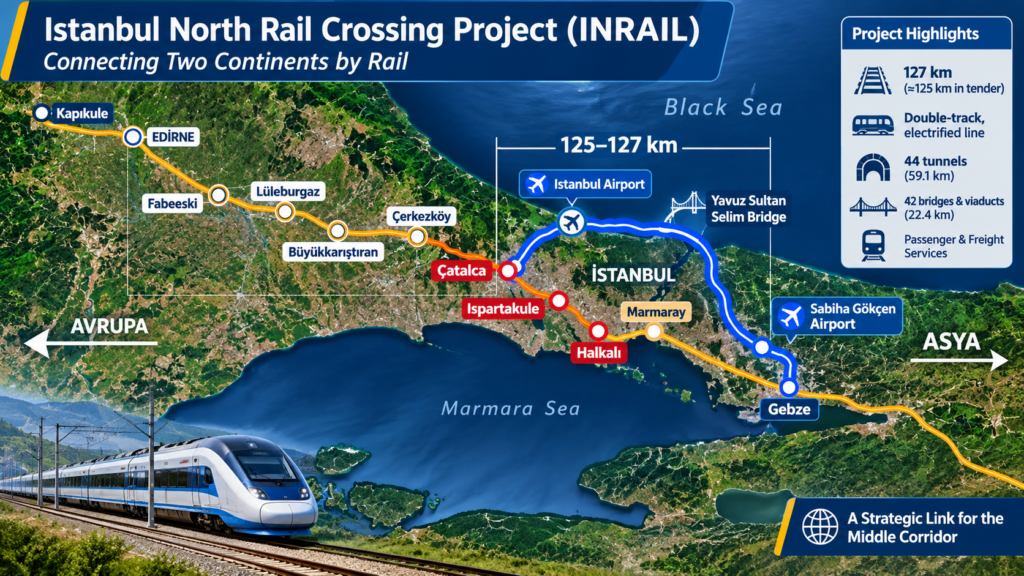
The Ispartakule–Çerkezköy section is part of the broader Halkalı–Kapıkule Railway Line, a strategic railway investment intended to strengthen passenger and freight connectivity between Istanbul, western Türkiye and the European Union.
The wider corridor extends from Halkalı in Istanbul to Kapıkule at the Bulgarian border. It is structured around three main sections:
- Halkalı–Ispartakule: The eastern section connecting the existing Halkalı railway network with Ispartakule.
- Ispartakule–Çerkezköy: The approximately 67 km section financed by EBRD and AIIB and covered by this project profile.
- Çerkezköy–Kapıkule: The western section extending to the Bulgarian border, supported in part by European Union grant financing.
The three sections are intended to form an integrated railway corridor with interoperability between the national railway network and the European rail system. The Ispartakule–Çerkezköy investment is therefore important not only as a new railway line in the Istanbul–Tekirdağ region but also as a missing infrastructure link in the wider connection to Bulgaria and the European railway network.
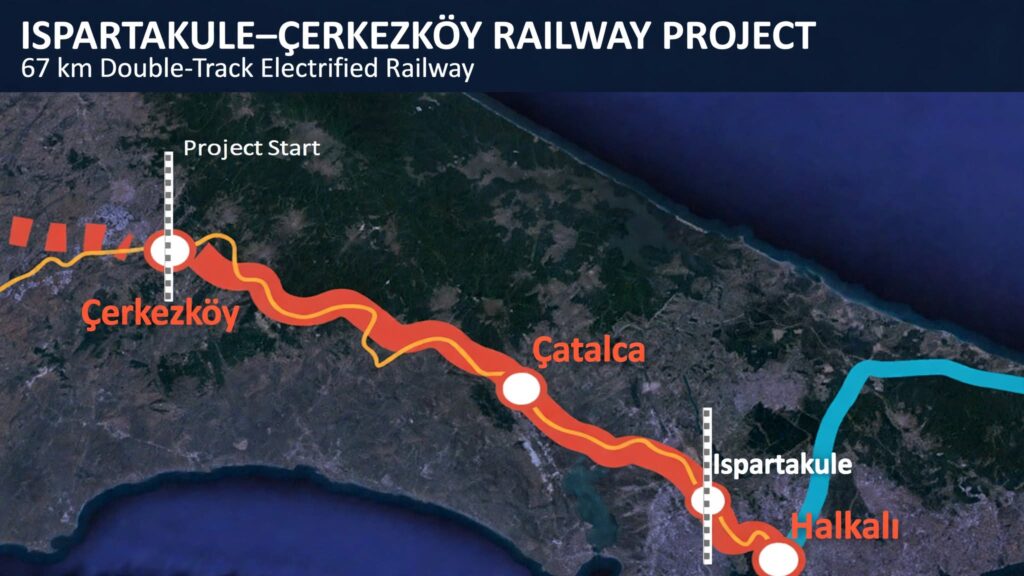
The Ispartakule–Çerkezköy section of the Halkalı–Kapıkule Railway Corridor.
The Çerkezköy–Kapıkule section was officially inaugurated on 9 October 2026. The completion of the remaining eastern links, including Ispartakule–Çerkezköy and Halkalı–Ispartakule, is necessary to establish the full Halkalı–Kapıkule railway connection.
Route and Geographic Coverage
The project is located in north-western Türkiye, crossing areas within Istanbul and Tekirdağ provinces. The new railway starts at Ispartakule and extends westwards to a point adjacent to the eastern side of Çerkezköy Station, approximately one kilometre from Çerkezköy town centre.
The new alignment is designed as a double-track railway and includes a combination of tunnels, bridges, viaducts, overpasses and underpasses. It is intended to provide a modern railway connection for both passenger and freight services while increasing the capacity of the wider railway corridor.
The project documentation also identifies works at existing railway facilities, including station infrastructure, platforms, pedestrian bridges and additional tracks. The exact scope of modifications is defined in the relevant engineering and contract documents.
Technical Scope and Railway Systems
Double-track high-speed railway
The core investment is the construction of approximately 67 kilometres of new double-track railway between Ispartakule and Çerkezköy. The line is designed for a maximum speed of 200 km/h, according to EBRD project documentation.
The railway is intended for mixed passenger and freight operations. Its capacity objective is to improve the movement of both passenger trains and freight services between Istanbul and the European railway network.
Electrification and power supply
The new line will be electrified and supported by overhead contact line equipment and associated power supply infrastructure. The project scope includes power supply systems and substations required to support railway operations.
Electrification is an important element of the corridor’s operational concept, enabling electric traction for passenger and freight services and supporting the wider shift towards lower-emission railway transport.
Signalling and train control
EBRD’s project documentation identifies European Rail Traffic Management System (ERTMS) Level 1 as part of the required railway systems. The project also includes signalling, control and associated telecommunications-related infrastructure.
ERTMS Level 1 is a trackside-based train protection and signalling system designed to support safe train movements and interoperability. Its inclusion is relevant to the integration of the Ispartakule–Çerkezköy section with the wider European railway network.
The precise configuration of the signalling, train detection, interlocking and control systems should be read together with the final approved technical design and contract specifications.
Bridges, viaducts and tunnels
The railway alignment requires a range of civil engineering structures, including bridges, viaducts, tunnels, overpasses and underpasses. These structures form part of the new railway infrastructure and are required to accommodate the alignment within the project’s geographic and engineering constraints.
The works also include associated railway infrastructure at existing stations and other facilities. The design changes reported during implementation have affected substantial parts of the alignment and have required additional engineering review and approvals.
Construction and Implementation
Construction of the Ispartakule–Çerkezköy railway began on 2 March 2023. The project was originally expected to be completed earlier, but implementation has been affected by extensive engineering design changes and related land acquisition and environmental and social requirements.
According to AIIB’s Project Implementation Monitoring Report covering May to July 2026, eight major design changes affected more than 45% of the railway alignment. Five of the eight preliminary designs had been approved by the reporting period, while the remaining changes required further approvals and follow-up.
The report identifies several implementation issues, including:
- Eight major engineering design changes affecting more than 45% of the alignment.
- Additional land acquisition requirements associated with design changes.
- Further environmental and social assessments and updates to relevant management documents.
- Delays in the implementation of the Resettlement Action Plan.
- Outstanding approvals for design changes, including signalling-related scope.
- The need to establish a credible financing plan for additional project costs.
AIIB reported that the project had reached 17.14% physical progress by 30 June 2026. The disbursement ratio under the AIIB financing was 24.58% at the same reporting date.
The monitoring report states that construction acceleration was expected during late 2026 and 2027, subject to the approval of outstanding design changes and the implementation of corrective measures. It identifies the first quarter of 2029 as the revised project completion timeframe.
Financing Structure
The Ispartakule–Çerkezköy Railway Project is co-financed by the European Bank for Reconstruction and Development (EBRD) and the Asian Infrastructure Investment Bank (AIIB), with the Government of Türkiye providing counterpart funding.
EBRD approved a sovereign loan of up to EUR 150 million for the project. AIIB approved EUR 300 million in sovereign financing. The AIIB financing documentation identifies civil works and the construction supervision consultant, project management support and livelihood restoration activities under the Resettlement Action Plan as the principal financing components.
| Financing institution | Published financing | Role |
|---|---|---|
| European Bank for Reconstruction and Development (EBRD) | Up to EUR 150 million | Sovereign loan and lead co-financier |
| Asian Infrastructure Investment Bank (AIIB) | EUR 300 million | Sovereign financing |
| Government of Türkiye | Counterpart contribution | Contribution to project costs and implementation |
AIIB’s July 2026 monitoring report identifies the financing components as follows:
- Civil works and supervision consultant: AIIB EUR 295 million, EBRD EUR 149 million and Government EUR 265 million.
- Project management support: AIIB EUR 1 million and EBRD EUR 1 million.
- Livelihood restoration and Resettlement Action Plan fund: AIIB EUR 4 million.
The figures above describe the financing allocation presented in the AIIB monitoring report. They should not be confused with a single construction contract value or treated as evidence that all project costs have already been disbursed.
The AIIB report records EUR 73.73 million disbursed and EUR 226.27 million undisbursed under its EUR 300 million commitment as of the reporting period. It also notes that additional financing arrangements and a loan extension were being considered in response to the implementation delays and additional costs.
Environmental and Social Management
The project is classified as Category A under the applicable lender environmental and social framework, reflecting the potential for significant environmental and social impacts associated with the construction and operation of a new railway line.
AYGM has published an extensive set of environmental and social documents in Turkish and English. The documents include the Environmental and Social Impact Assessment (ESIA), Environmental and Social Action Plan, Stakeholder Engagement Plan, Resettlement Action Plan, Biodiversity Management Plan, Contractor Management Plan and Emergency Response Framework.
Land acquisition and resettlement
Land acquisition is a significant part of the project’s environmental and social management framework. The Resettlement Action Plan establishes procedures for identifying affected people, assessing impacts, providing compensation and supporting the restoration of livelihoods.
AIIB’s financing includes a EUR 4 million Resettlement Action Plan fund for livelihood restoration activities. This fund is intended to supplement statutory compensation under Turkish law and support affected people in accordance with the applicable lender requirements.
Biodiversity and environmental protection
The published environmental documentation includes biodiversity management measures and an environmental and social action framework. These documents address the management of construction-related impacts and the measures required to protect sensitive environmental receptors along the railway corridor.
Stakeholder engagement and grievance management
AYGM has established a stakeholder engagement and grievance mechanism for people and communities affected by the project. The published project information states that grievances are registered, assessed and followed up through defined procedures.
In its July 2026 monitoring report, AIIB recorded 338 grievances. Of these, 287 (84.9%) had been resolved and closed, while 51 (15.1%) remained open at the reporting date.
These figures illustrate the scale of stakeholder management required during implementation. They are monitoring data for the reporting period and should not be interpreted as a measure of the overall success or failure of the project.
Strategic Importance for Türkiye and the European Union
The Ispartakule–Çerkezköy railway is a key component of the railway connection between Istanbul and the European Union. Together with the Çerkezköy–Kapıkule section, it will connect the railway network in north-western Türkiye with the Bulgarian border and the European railway system.
The project supports the objectives of the Trans-European Transport Network (TEN-T) by addressing an important railway infrastructure link between Türkiye and the EU. It is also associated with the wider TRACECA transport corridor, which aims to strengthen transport and trade connections across Europe, the Caucasus and Asia.
The investment is expected to improve the capacity and reliability of passenger and freight transport in the strategically important Thrace region. It is also intended to support a shift from road to rail, improve cross-border connectivity and strengthen the role of railway transport in international trade.
The corridor’s strategic value has become more visible following the inauguration of the Çerkezköy–Kapıkule section in October 2026. The remaining links towards Istanbul are essential for the full operational continuity of the Halkalı–Kapıkule railway corridor.
Expected Transport Benefits
AIIB’s project results framework identifies the following end targets for the railway once it is completed and operational:
| Performance indicator | End target |
|---|---|
| Annual passenger volume | 4.4 million passengers |
| Annual freight volume | 2 million tonnes |
| Travel time indicator | 29 minutes |
These are project-level end targets in the AIIB results framework, not current traffic volumes or achieved operating results. The expected benefits depend on completion, testing, commissioning and integration with the wider Halkalı–Kapıkule railway corridor.
Once operational, the project is expected to contribute to:
- Increased passenger and freight railway capacity between Istanbul and the European border.
- Improved railway safety and operational performance.
- Better interoperability with the European railway network.
- More efficient cross-border passenger and freight transport.
- Greater potential for shifting freight from road to rail.
- Improved access to the European rail network for logistics operators and industrial users.
Project Timeline and Latest Status
- 25 November 2021: AIIB approved EUR 300 million in sovereign financing for the project.
- 10 November 2021: EBRD approved a sovereign loan of up to EUR 150 million.
- 8 December 2021: AIIB financing agreement signed.
- 2 March 2023: Civil works commenced.
- End of 2025: AIIB’s earlier monitoring report recorded physical progress of 8.5%.
- 30 June 2026: Physical progress reached 17.14%, with AIIB disbursement at 24.58%.
- July 2026: AIIB’s Project Implementation Monitoring Report documented eight major design changes affecting more than 45% of the alignment and identified the first quarter of 2029 as the revised completion timeframe.
- 9 October 2026: The Çerkezköy–Kapıkule section of the wider Halkalı–Kapıkule Railway Line was officially inaugurated.
Project status as of 19 November 2026: The Ispartakule–Çerkezköy section remains under construction. The latest publicly accessible AIIB monitoring data reviewed for this profile records 17.14% physical progress at the end of June 2026. The project is affected by major design changes, additional land acquisition and environmental and social requirements. The revised completion timeframe identified in the July 2026 report is the first quarter of 2029. No later verified physical progress figure was identified in the sources reviewed for this article.
Official Sources and Project Documents
- AYGM – Ispartakule–Çerkezköy Railway Project
- EBRD – Ispartakule–Çerkezköy Railway Line
- AIIB – Ispartakule–Çerkezköy Rail Project
- AIIB – Project Implementation Monitoring Report No. 12, July 2026
- EBRD / AYGM – Non-Technical Summary, English
- Transport Sectoral Operational Programme – Çerkezköy–Kapıkule Section Inauguration, 9 October 2026
Editorial note: This project profile is based on AYGM, EBRD, AIIB and Ministry of Transport and Infrastructure documentation available as of 19 November 2026. Physical progress and revised completion information are based on AIIB’s July 2026 monitoring report. The figures and implementation status should be updated when newer monitoring reports or official construction progress announcements become available.