
Europe’s EN 15302: The Conicity Key to Rail Safety
EN 15302 standardizes equivalent conicity calculation. This vital parameter ensures railway vehicle stability, safe curving, and optimal wheel-rail interaction, preventing dangerous hunting oscillations.
Understanding EN 15302: Equivalent Conicity in Railway Dynamics
EN 15302 is a crucial European standard that specifies the calculation method for determining the equivalent conicity of a wheelset-track system. This parameter is a fundamental measure in railway vehicle dynamics, directly influencing vehicle stability, curving performance, and the interaction forces between the wheel and the rail. The standard provides a unified and repeatable methodology, essential for ensuring safety and interoperability across different railway networks.
Equivalent conicity provides a linearized value that characterizes the steering capability of a wheelset. It quantifies how the difference in rolling radii on the left and right wheels changes as the wheelset moves laterally on the track. This steering action is what allows a railway vehicle to naturally follow curves and maintain a central position on straight track.
The Core Concept: What is Equivalent Conicity?
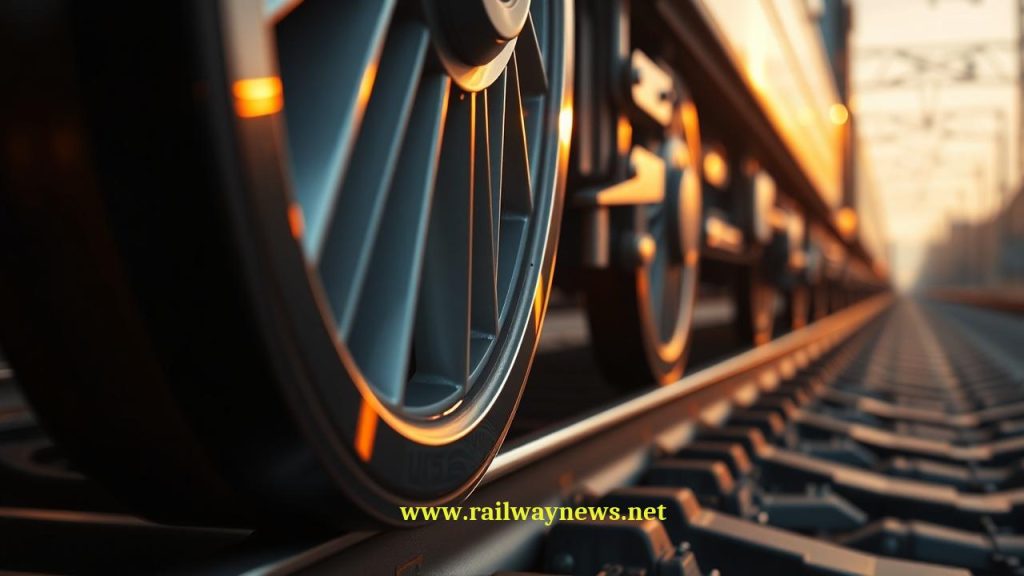
A traditional railway wheelset is composed of two wheels rigidly connected by an axle. The running surface of each wheel, known as the wheel profile, is not cylindrical but conical. This conical shape causes the wheelset to self-center on the track. When the wheelset is displaced laterally, the wheel moving towards the rail’s gauge corner runs on a larger diameter, while the opposite wheel runs on a smaller diameter. This difference in rolling radii causes the wheelset to steer back towards the track’s centerline.
However, modern wheel and rail profiles are not simple cones; they have complex, worn-in shapes. The relationship between the lateral displacement (y) and the rolling radius difference (Δr) is therefore non-linear. Equivalent conicity (tan γe) is the tangent of the angle of a theoretical cone that would produce the same kinematic steering behavior as the actual wheel-rail combination for a given amplitude of lateral displacement.
The Scope and Significance of EN 15302
Why is Equivalent Conicity a Critical Parameter?
The value of equivalent conicity has a direct and significant impact on a vehicle’s performance and safety. It represents a trade-off between stability on straight track and performance in curves.
- Vehicle Stability: High conicity values can lead to a dynamic instability known as “hunting oscillation.” This is a violent, self-sustaining side-to-side movement of the wheelset that can cause excessive wear, passenger discomfort, and, in extreme cases, derailment. Regulations, such as the Technical Specifications for Interoperability (TSI), set limits on equivalent conicity to prevent hunting at operational speeds.
- Curving Performance: Low conicity values reduce a wheelset’s natural steering ability. This can lead to increased flange contact in curves, resulting in higher wear on both wheels and rails, increased noise (squeal), and higher lateral forces on the track.
- Wear and Tear: An optimized conicity value helps to distribute contact points across the wheel and rail profiles, reducing concentrated wear and extending the service life of both components.
Applicability of the Standard
EN 15302 is applied across the railway industry for various purposes, including:
- New Vehicle Design and Authorization: Proving that a new rolling stock design meets stability requirements as per TSIs.
- Track Design and Maintenance: Assessing the impact of rail profiles and track parameters (gauge, inclination) on vehicle behavior.
- Maintenance Planning: Monitoring the evolution of conicity as wheel and rail profiles wear and deciding when reprofiling is necessary.
- Compatibility Studies: Ensuring that a specific vehicle is compatible with the infrastructure it will operate on.
The Calculation Method According to EN 15302
The standard defines a precise numerical simulation method to calculate equivalent conicity. It does not provide a simple formula but rather a process that models the geometric interaction between the specified profiles.
Key Input Parameters
The calculation requires a set of defined geometric inputs:
- Wheel Profile: The cross-sectional shape of the two wheels. Both left and right profiles are required.
- Rail Profile: The cross-sectional shape of the two rails.
- Track Gauge: The distance between the active faces of the rails.
- Rail Inclination (Cant): The inward angle of the rails, typically 1/20 or 1/40.
The Calculation Process
The core of the EN 15302 method involves the following steps:
- The wheelset is numerically positioned on the track model.
- It is then subjected to a series of discrete lateral displacements (y) from the track centerline, typically up to +/- 6 mm.
- At each lateral position, the contact points between each wheel and rail are determined.
- The rolling radii (r1 and r2) at these contact points are calculated for the left and right wheels. The rolling radius difference (Δr = r1 – r2) is then found.
- The equivalent conicity (tan γe) is calculated based on the root-mean-square (RMS) value of the rolling radius difference function over a specified range of lateral displacement amplitudes. For a wheelset with a lateral distance between rolling circles of 2a, the function is Δr / (2a).
The result is not a single value but a function of conicity versus the amplitude of the wheelset’s lateral movement. TSIs often specify the conicity value to be checked at a lateral amplitude of 3 mm.
Interpreting Equivalent Conicity Values
The calculated conicity value allows engineers to predict the dynamic behavior of the vehicle. Different ranges of conicity are associated with distinct performance characteristics.
| Conicity Range | Typical Vehicle Behavior | Advantages | Disadvantages |
|---|---|---|---|
| Low (e.g., < 0.10) | Highly stable on tangent track, even at very high speeds. Poor self-steering in curves. | Excellent high-speed stability. Reduced risk of hunting oscillation. | Poor curving performance, leading to high flange wear, noise, and lateral forces. |
| Moderate (e.g., 0.10 – 0.30) | A balanced performance. Good stability on straight track and adequate steering in curves. | Optimal compromise for mixed-traffic lines. Good wear characteristics. | May not be optimal for dedicated high-speed or sharp-curve applications. |
| High (e.g., > 0.40) | Excellent steering in sharp curves. Prone to instability (hunting) on straight track. | Superior negotiation of tight curves with minimal flange contact. | High risk of hunting oscillation at moderate to high speeds, leading to safety concerns and severe component wear. |
Practical Implications for the Railway Industry
EN 15302 is not just a theoretical document; it has profound practical consequences. Railway operators and manufacturers must actively manage equivalent conicity to ensure safe and efficient operations. This includes:
- Profile Management: The choice of initial wheel and rail profiles is critical. These are often designed together to achieve a target conicity range over their service life.
- Wheel Reprofiling: As wheels wear, their profile changes, which in turn alters the conicity. Maintenance depots use wheel lathes to restore the wheel profile to its original design, thereby restoring the desired dynamic performance.
- Rail Grinding: Similarly, rail wear and defects can change the railhead profile. Rail grinding is performed to correct the profile and manage the wheel-rail interface, directly influencing conicity.
Conclusion
EN 15302 provides the definitive, standardized method for calculating one of the most important parameters in vehicle-track dynamics. Equivalent conicity is a powerful indicator of a railway vehicle’s stability and curving behavior. By providing a common calculation procedure, the standard enables engineers, manufacturers, and operators to design, assess, and maintain rolling stock and infrastructure to the highest standards of safety, performance, and interoperability within the complex European railway system.

Railway infrastructure, rolling stock and transport technologies specialist focused on global rail industry developments, high-speed rail systems, signaling technologies and freight transportation. Covering railway investments, public transport modernization, rail operations and international mobility projects across Europe, Asia and North America.