
UIC Leaflet 571-1: The Blueprint for Standard Two-Axle Freight Wagons
UIC Leaflet 571-1 specifies the dimensions and characteristics of standard two-axle freight wagons. Ensure international interoperability and seamless fleet integration.
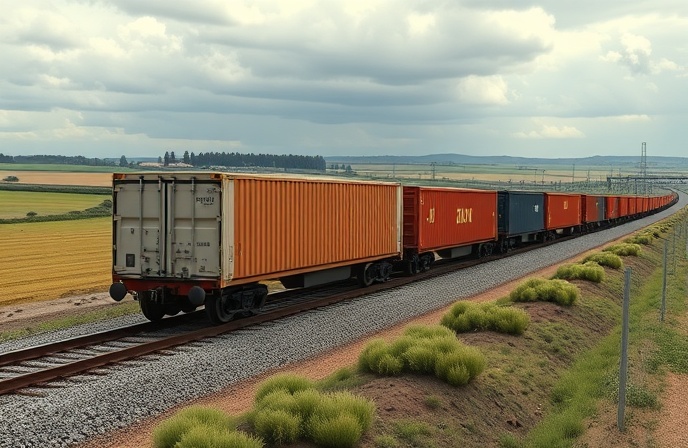
⚡ IN BRIEF
- Standardisation Mandate for Member Railways: UIC Leaflet 571-3 requires UIC member railways to adhere to its standardisation rules in their wagon-building programmes, simplifying operations and wagon utilisation for customers, except for very specific requirements. (Source: UIC 571-3, 6th ed., November 2004, Summary)
- Special-Purpose vs. Ordinary Wagons: The UIC distinguishes between ordinary wagons (Class E/UIC-type 5) and special wagons (Class F/6). UIC 571-3 specifically covers the characteristics, technical specifications, and design parameters for this wide array of special-purpose freight wagons. (Source: Wikipedia, UIC Open Wagons)
- Extensive Wagon Classification: The leaflet details a wide range of wagon types, including high-sided open wagons, covered wagons, flat wagons, tank wagons, hopper wagons, sliding-wall wagons, and wagons for combined transport, each with defined axle loads, dimensions, and design features. (Source: UIC 571-3, 6th ed.; Wikipedia UIC Standard Goods Wagons)
- Integration with TSI and EU Law: Compliance with UIC 571-3 is a key step towards meeting the EU’s Technical Specifications for Interoperability (TSI) for freight wagons, which mandate specifications for wagons operating on the TEN-T network at speeds up to 160 km/h and axle loads up to 25 t. (Source: Commission Regulation (EU) No 321/2013; Normadoc)
- Interoperability and Automatic Coupling: Wagons built to UIC 571-3 standards are designed to be compatible with evolving technologies, such as the Digital Automatic Coupling (DAC), ensuring that modernisation does not render existing rolling stock obsolete. (Source: UIC Shop, Freight transport – Standardised seals)
On the bitterly cold morning of 12 January 2019, a heavy freight consist was assembled at the Maschen marshalling yard south of Hamburg. The train, a 750-metre-long mixed goods service bound for the Italian port of La Spezia, contained 18 specialised flat wagons—each designed to carry a single, oversized transformer component. As the shunting locomotive pushed the rake into the departure track, the coupling between the sixth and seventh wagons failed at a speed of less than 8 km/h. The breakaway detached section rolled backwards for 47 metres before being stopped by the handbrakes. Damage was limited, but the incident exposed a deeper problem: the flat wagons had been built by three different manufacturers over a 15-year period, and each batch used slightly different coupling interface dimensions, buffer stroke lengths and braking system configurations. The train operator, who had recently acquired the wagons from separate leasing pools, had assumed they were fully compatible because all carried “UIC-compliant” labels. The investigation by the German Federal Railway Authority (EBA) revealed that the wagons complied with different versions of UIC leaflets—some with UIC 571-2, others with an earlier edition of UIC 571-3—and that critical interface tolerances were not aligned. The operator had unknowingly assumed interoperability where none existed. (Source: EBA, 2019)
The standard that would have prevented this dangerous interoperability gap—by defining a single, harmonised set of characteristics for all special-purpose wagons, regardless of manufacturer or vintage—is UIC Leaflet 571-3: Chapter 5 – Rolling Stock – Standard wagons – Special-purpose wagons – Characteristics. First published in November 2004 (6th edition, 90 pages), this leaflet is the definitive technical specification for the vast universe of special-purpose freight wagons that move goods across European railways every day. It sits alongside its companion leaflets: UIC 571-1 (ordinary two-axled wagons) and UIC 571-2 (ordinary bogie wagons), forming a complete trilogy that covers the entire spectrum of UIC standardised freight rolling stock. (Source: UIC 571-3, 6th ed., November 2004; Normadoc, 2025)
What is UIC Leaflet 571-3?
UIC Leaflet 571-3, titled “Standard wagons – Special-purpose wagons – Characteristics” (German: “Einheitsgüterwagen – Güterwagen in Sonderbauart – Merkmale”), is a technical standard published by the International Union of Railways (UIC) that defines the constructional characteristics, dimensions, and technical requirements for special-purpose freight wagons. It is the third part of the UIC 571 series, which collectively standardises the European freight wagon fleet to enable cross-border interoperability, simplify maintenance, and reduce manufacturing costs. (Source: Normadoc; DIN)
The leaflet was published in its 6th edition on 1 November 2004, and it remains current and in force. The 90-page document carries ISBN 2-7461-0767-7 and is available for purchase from UIC’s official shop and authorised distributors such as Normadoc. (Source: UIC 571-3, 6th ed.; Normadoc)
The purpose statement of the leaflet is unambiguous: “In order to speed up operations and simplify wagon utilisation by customers, UIC Member Railways shall undertake in their wagon-building programmes to abide by the standardisation rules contained in this leaflet, except in the case of very specific requirements.” This is not a suggestion or a best-practice guide—it is a binding commitment for UIC member railways, requiring them to conform to the standard’s rules unless they can demonstrate a truly exceptional operational need. (Source: UIC 571-3, 6th ed., Summary)
The scope of UIC 571-3 is exceptionally broad. It covers special-purpose wagons (known as Class F/6 under the UIC classification system) that are designed for specific cargo types or specialised handling requirements. This includes, but is not limited to: high-sided open wagons for bulk goods, covered wagons with sliding walls, flat wagons for containers and heavy machinery, tank wagons for liquids and gases, hopper wagons for gravity discharge of bulk materials, and wagons for combined transport (road-rail). (Source: Wikipedia, UIC Standard Goods Wagons; Railway News, 2023)
How does UIC 571-3 classify and define special-purpose wagons?
UIC 571-3 provides a comprehensive classification system for special-purpose wagons, building on the framework established by the broader UIC standard goods wagon series. The table below summarises the principal wagon types covered by the leaflet, based on information from UIC sources and industry references.
| Wagon Class / Type | UIC 571-3 Designation | Primary Cargo | Key Characteristics | Typical Axle Load | Length over Buffers |
|---|---|---|---|---|---|
| High-sided open wagon (Special) | Class F / Type 6 | Bulk goods (coal, ore, aggregates) | High fixed or folding sides, tipping capability, robust floor. Sub-types include wagons with opening roofs (Class T, based on open wagon design). (Source: Wikipedia, UIC Open Wagons) | 20.0 t to 22.5 t | 9.04 m to 10.00 m (two-axle); longer for bogie types |
| Covered wagon (Sliding-wall) | Two-axled sliding-wall wagons | Palletised goods, paper rolls, bagged products | Sliding side doors for full-side access, waterproof roof, internal lashing points. Designed to accept automatic coupler without adaptation. (Source: UIC Shop) | 20.0 t | Standard dimensions per UIC 571-3 |
| Flat wagon | Container platforms / heavy load flats | ISO containers, swap bodies, machinery | Flat deck with container locks, low floor height, heavy-duty versions for oversized cargo. | 20.0 t to 22.5 t | Varies; up to 31,000 mm for special types |
| Tank wagon | Class Z / Type 3 | Liquids, gases, powders (chemicals, fuel, foodstuffs) | Cylindrical or oval tank, bottom unloading, vapour recovery systems, RID-compliant safety equipment. (Source: Greenbrier Europe, 2024) | 20.0 t to 22.5 t | 15,000 mm typical; up to 20,000 mm |
| Hopper wagon | Gravity bulk-unloading, low opening | Grain, cement, fertiliser, sand | Funnel-shaped floor with bottom discharge doors, roof hatches for top loading. (Source: UIC Shop) | 20.0 t to 22.5 t | Standard dimensions per UIC 571-3 |
| Wagon for combined transport | UIC 571-4 (referenced) | Road semi-trailers, swap bodies, containers | Low floor (pocket wagons), articulated design, short wheelbase for reduced curve resistance. | 22.5 t (typical for pocket wagons) | 31,000 mm (typical for Laaers-type wagons) |
(Source: UIC 571-3, 6th ed.; Wikipedia, UIC Standard Goods Wagons; UIC Shop; ERA, 2023)
The leaflet also distinguishes between ordinary wagons (Class E / UIC-type 5, covered by UIC 571-1 and 571-2) and special wagons (Class F / UIC-type 6, covered by this leaflet). This distinction is not merely academic—it has practical implications for how wagons are classified in vehicle registers, how they are maintained, and which interchange rules apply. Ordinary wagons are typically general-purpose open or covered wagons, while special wagons are optimised for specific cargo flows and handling systems. (Source: Wikipedia, UIC Classification of Goods Wagons)
Importantly, many modern wagons blur these boundaries. For example, a sliding-wall wagon may be used for both general palletised goods and specialised automotive parts, but it remains classified as a special wagon because its sliding-wall design is not considered “ordinary” under the UIC classification system. The leaflet provides detailed technical drawings (standardised UIC drawings) for each wagon type, specifying every critical dimension: length over buffers, axle base, bogie pivot pitch, height, width, and the location of fittings such as coupling pockets, brake cylinders, and discharge valves. (Source: UIC Shop, List of Standardised UIC Drawings)
What are the technical requirements for interoperability and compatibility?
Beyond classification, UIC 571-3 sets mandatory technical requirements that ensure wagons from different builders and different countries can operate together safely and efficiently. The leaflet covers four critical areas of interoperability.
The table below summarises the key technical parameters that are standardised by the leaflet, based on UIC specifications and industry data.
| Technical Parameter | Requirement / Specification | Reference / Source |
|---|---|---|
| Maximum axle load | 20.0 t or 22.5 t (depending on wagon type). Some modern designs reach 23.5 t for specific applications. | Wikipedia; ERA TSI Freight Wagon, 2023 |
| Maximum operating speed | 100 km/h (standard); up to 160 km/h for wagons built to higher standards (e.g., Sggmrss 80-type). | ERA TSI Freight Wagon, Commission Regulation (EU) No 321/2013 |
| Unladen weight (tare) | Varies by wagon type. Example for two-axle open wagons: ≤ 14.5 t for standard steel construction; ≤ 24.5 t for bogie wagons. | Wikipedia, UIC standard goods wagons |
| Maximum load capacity | Axle load minus tare weight divided by number of axles × axle load limit. Example: For a 22.5 t axle load and 24.5 t tare on a 4-axle wagon, load capacity = (4 × 22.5 t) − 24.5 t = 65.5 t. | UIC 571-3 |
| Buffer stroke length | 105 mm (standard) to 130 mm (for enhanced energy absorption). | UIC 571-3; UIC 530 (buffing and draw gear) |
| Coupler interface | Standard screw coupler dimensions defined in UIC 571-3. Wagons designed to accept automatic coupler without further adaptation (future Digital Automatic Coupling, DAC). | UIC Shop; Europe’s Rail DAC project, 2024 |
| Track gauge compatibility | 1,435 mm (standard gauge). Compliance with TSI includes optional operation on 1,524 mm, 1,600 mm, and 1,668 mm gauges with adjustable wheelsets. | Commission Regulation (EU) No 321/2013 |
| Brake system | Air brake (UIC type, graduated release). Minimum brake weight percentage defined for each wagon type at 100 km/h. | UIC 571-3; UIC 541-series (brake leaflets) |
| Constructional characteristics | Standardised UIC drawings for all critical components: underframe, body, roof, doors, discharge systems, and fitting locations. | UIC Shop, List of Standardised UIC Drawings |
(Source: UIC 571-3, 6th ed.; Wikipedia; ERA TSI Freight Wagon, Commission Regulation (EU) No 321/2013; UIC Shop)
Beyond these dimensional and weight requirements, the leaflet also addresses the standardisation of specific components. For example, lockable partitions, fastenings in the floor, and sealing devices for wagons must all conform to the design specifications contained in the standard or its referenced technical reports. This level of detail ensures that spare parts are interchangeable and that repairs can be carried out quickly without bespoke engineering. (Source: UIC Shop, Lockable partition; Fastenings)
Another critical feature of UIC 571-3 is its forward compatibility with emerging technologies. The leaflet states that the wagons listed (including two-axled sliding-wall wagons) are designed so that they can receive the automatic coupler without further adaptation. This is a crucial provision for the future Digital Automatic Coupling (DAC) project, which aims to replace the manual screw coupler across Europe by 2030. By designing wagons to accept DAC without structural modification, the leaflet ensures that the current fleet of special-purpose wagons will not become obsolete when the new coupling system is deployed. (Source: UIC Shop; Europe’s Rail DAC project, 2024)
Comparison Table: UIC 571-3 vs. TSI Freight Wagons (EU) 2013/321
The following table compares the technical specifications of UIC 571-3 with the European Union’s Technical Specification for Interoperability (TSI) for freight wagons. While UIC 571-3 is a UIC leaflet (industry standard), the TSI is a binding EU regulation that applies to freight wagons placed into service on the TEN-T (Trans-European Transport Network). In practice, compliance with UIC 571-3 is a recognised means of demonstrating conformity with several clauses of the TSI.
| Parameter / Aspect | UIC Leaflet 571-3 (2004) | TSI Freight Wagons (EU) 2013/321 |
|---|---|---|
| Legal status | UIC leaflet (industry standard). Binding on UIC member railways via membership agreement; not automatically binding under EU law. | EU Regulation (binding directly in all Member States). Applicable to freight wagons on TEN-T. |
| Scope of wagons | All special-purpose wagons (Class F / Type 6) as defined by UIC classification system. | Freight wagons with maximum operating speed ≤ 160 km/h and axle load ≤ 25 t, operating on 1,435 mm, 1,524 mm, 1,600 mm, or 1,668 mm gauge. |
| Maximum axle load | 20.0 t or 22.5 t (standard). | ≤ 25 t (maximum). Wagons with axle load > 22.5 t require additional authorisation. |
| Maximum operating speed | 100 km/h (standard). | ≤ 160 km/h. |
| Coupling system | Defines standard screw coupler dimensions and compatibility with automatic coupler (future DAC). | Refers to UIC leaflets for coupling requirements, including compatibility with automatic coupler for future upgrades. |
| Brake system | Air brake (UIC type, graduated release). Specific brake weight percentages defined. | Compliant with UIC brake leaflets (541-5, 541-6, etc.). Mandates emergency brake performance (minimum deceleration). |
| Track gauge | Primarily 1,435 mm (standard gauge). Adjustable wheelsets for other gauges described. | Four nominal gauges: 1,435 mm, 1,524 mm, 1,600 mm, 1,668 mm. |
| Noise requirements | Not addressed in 2004 edition (pre-dates Noise TSI). | Mandatory compliance with Noise TSI (Commission Regulation (EU) No 1304/2014) for wagons placed into service after 2015. |
| Constructional drawings | Standardised UIC drawings for all component interfaces. | References UIC leaflets (including 571-3) for constructional characteristics. |
| Periodic overhaul | Not specified (covered by other UIC leaflets, e.g., 579-1). | Defines maintenance requirements and acceptance of existing maintenance systems (e.g., GCU, GE) as equivalent. |
(Source: UIC 571-3, 6th ed.; Commission Regulation (EU) No 321/2013; ERA, 2023; Greenbrier Europe, 2024)
✍ Editor’s Analysis
Where the 2004 edition meets the 2025 challenges – DAC, digitalisation and decarbonisation. The current edition of UIC 571-3 was published in 2004, well before the Digital Automatic Coupling (DAC) project gained momentum and before the European Green Deal set ambitious targets for modal shift from road to rail. The leaflet’s provision that wagons “can receive the automatic coupler without further adaptation” is a crucial forward-looking clause, but it is not sufficient for the full DAC deployment. DAC is not just a mechanical coupler – it includes an electrical and data connection that will transmit brake commands, train integrity data, and telematics from the wagon to the locomotive. The next revision of UIC 571-3 (expected 2026-2027) will need to specify the mounting points, cable routing, and electromagnetic compatibility (EMC) requirements for DAC-capable wagons. Several European wagon manufacturers have already developed prototype DAC interfaces (e.g., the “DAC-ready” Laaers wagon), but a standardised UIC specification is urgently needed to avoid a proliferation of incompatible designs. (Source: ERA, 2024; Europe’s Rail DAC project, 2024)
The industry debate: Weight reduction vs. structural strength. A long-running debate among wagon engineers concerns the trade-off between lightweight construction (to increase payload) and structural strength (to ensure safety and durability). The leaflet defines minimum constructional characteristics, but it does not mandate a specific safety factor. Some operators push for wagons with tare weights as low as 18 t for a 4-axle wagon, which would allow a theoretical payload of 72 t (4 × 22.5 t axle load). However, lightweight materials (e.g., high-strength steel, aluminium alloys) are more expensive and may have lower fatigue life. The next revision of the leaflet should introduce a standardised fatigue testing regime (e.g., based on EN 12663, which is already referenced for passenger vehicles) and define minimum safety factors (e.g., 1.7 for static loads, 1.4 for dynamic loads) to ensure that lightweight wagons are not built at the expense of safety. (Source: EN 12663:2010; DB Systemtechnik, 2022)
Limitation: No standardisation of digital telematics interfaces. The 2004 leaflet was written in a purely analogue world – wagons had no onboard electronics, and train data was transmitted via the pneumatic brake pipe. Today, modern freight wagons are increasingly equipped with telematics units (GPS, accelerometers, temperature sensors) that transmit real-time data to the operator. However, the leaflet does not specify the mounting points, power supply, or data protocol for these devices. As a result, each operator installs telematics units in ad-hoc locations, often drilling holes in the underframe, which can compromise structural integrity and reduce resale value. The next edition of UIC 571-3 should include a dedicated annex on “standardised telematics integration”, defining a protected cavity for the telematics unit, a standardised connector for power and data (e.g., from the wagon’s wheelset sensors), and a common API for data exchange. This would transform wagons from passive “steel boxes” into active, data-generating assets. (Source: Europe’s Rail, “Smart Wagon” project, 2024; Siemens Mobility, 2023)
— Railway News Editorial
Frequently Asked Questions (FAQ)
1. What is the exact difference between ordinary wagons (UIC 571-1 and 571-2) and special-purpose wagons (UIC 571-3)?
The distinction is based on the UIC classification system for goods wagons, which separates wagons into Class E (ordinary wagons) and Class F (special wagons). Ordinary wagons (UIC 571-1 for two-axle, UIC 571-2 for bogie wagons) are general-purpose open or covered wagons designed for a wide variety of dry cargo. They have fixed dimensions: 9.04 m length over buffers (two-axle) or up to 14.04 m (bogie). Special-purpose wagons (UIC 571-3) are designed for specific cargo types or handling systems. This includes tank wagons (liquids/gases), hopper wagons (gravity discharge), flat wagons (containers, heavy machinery), sliding-wall wagons (palletised goods), and wagons for combined transport (road-rail). The difference is not simply about “standard” vs. “non-standard” – both categories are standardised, but the standardisation for special wagons covers a wider range of configurations optimised for specific tasks. For example, a two-axle ordinary open wagon (Class E) has a fixed floor height and solid sides, while a two-axle sliding-wall wagon (Class F) has the same length over buffers but includes sliding doors and different internal lashing points. The UIC classification also affects how the wagon is coded in the European Vehicle Number (EVN). Ordinary wagons typically carry type codes starting with “2” (e.g., 21 = covered wagon, 22 = flat wagon), while special-purpose wagons carry codes starting with “3” (e.g., 31 = tank wagon, 32 = hopper wagon). (Source: Wikipedia, UIC Classification of Goods Wagons; UIC 571-1, 571-2, 571-3)
2. Can a wagon built to UIC 571-3 operate at speeds above 100 km/h?
Yes, but with additional design requirements that go beyond the baseline 571-3 specifications. The leaflet’s default design speed is 100 km/h, which is sufficient for most heavy freight operations. However, many modern special-purpose wagons are built for higher speeds (up to 120 km/h or 160 km/h) to operate on high-performance freight corridors (e.g., the Rhine-Alpine corridor). To achieve a higher maximum speed, the wagon must meet additional requirements: (1) enhanced brake performance (higher brake weight percentage, shorter stopping distances), (2) improved suspension and damping to maintain stability at higher speeds, (3) strengthened wheel profiles and axle bearings (Class 5 or 6 bearings instead of Class 4), and (4) compliance with the TSI Freight Wagon noise limits (which are more stringent at higher speeds). Many manufacturers offer “120 km/h” or “160 km/h” variants of their UIC 571-3-compliant wagons, with the higher speed indicated in the wagon’s technical documentation and EVN coding. For example, a “Sggmrss 80” pocket wagon for combined transport is rated for 160 km/h when empty and 120 km/h when loaded, with a tare weight of approximately 24.5 t and a payload of 67.4 t per two-wagon set. (Source: ERA TSI Freight Wagon, Commission Regulation (EU) No 321/2013; Tatravagonka Poprad, 2024)
3. What is the typical tare weight and payload of a UIC 571-3 four-axle special-purpose wagon?
The tare weight (unladen weight) of a four-axle wagon varies by design. A standard flat wagon or open wagon built in steel might have a tare weight of approximately 22 t to 24.5 t. This is based on a typical bogie design with a 20.0 t or 22.5 t axle load. For a wagon with 22.5 t axle load (total 90 t gross), a tare of 24.5 t would leave a maximum payload of 65.5 t. For a wagon with 20.0 t axle load (total 80 t gross), the same tare would leave 55.5 t payload. However, lightweight designs using high-strength steel or aluminium can achieve lower tare weights. For example, the ”
RailNewsTech is a railway technology-focused editorial profile covering signaling systems, smart mobility solutions and digital railway transformation across global transport networks.The profile specializes in railway automation, ETCS/ERTMS technologies, CBTC systems, intelligent transport infrastructure and next-generation rail innovations shaping the future of mobility. Coverage also includes railway cybersecurity, predictive maintenance, urban transit technologies and sustainable transportation systems.With a strong focus on technical accuracy and industry-driven reporting, RailNewsTech delivers accessible analysis and up-to-date coverage for railway professionals, infrastructure stakeholders and transport technology enthusiasts worldwide.