
BNSF Railway Completes $33.2 Million Grade Separation in New Mexico
BNSF Railway completed a $33.2 million grade separation project on Jarales Road in New Mexico, enhancing safety.
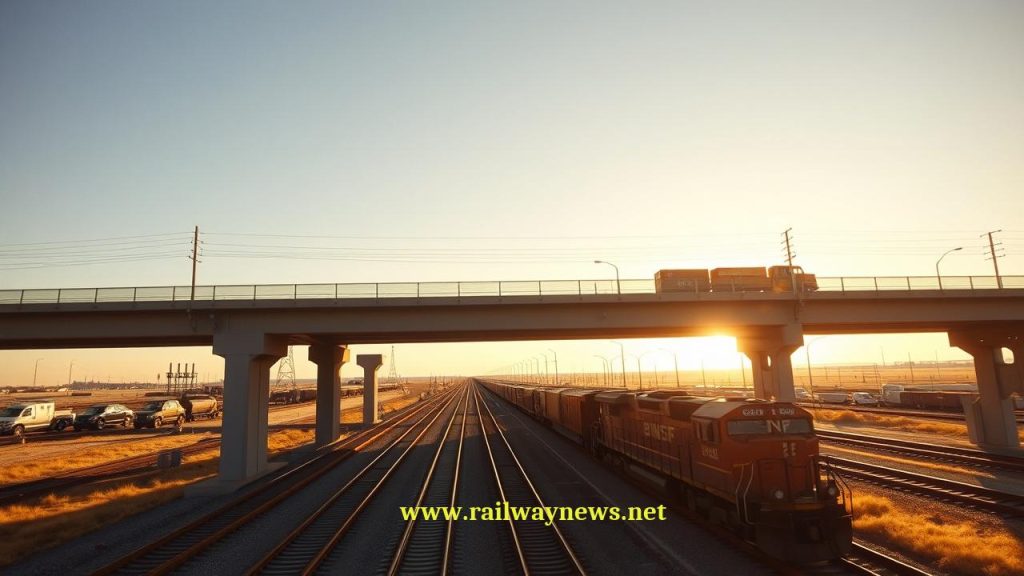
⚡ In Brief: BNSF Railway and the New Mexico Department of Transportation have been recognized for a $33.2 million grade separation project on Jarales Road near Albuquerque, eliminating a crossing used by 1,700 vehicles and nearly 90 trains daily.
ALBUQUERQUE, NM – BNSF Railway and the New Mexico Department of Transportation (NMDOT) have received recognition for the completion of the New Mexico 109 Jarales Road Grade Separation Project. The project, finished approximately one year ago at a cost of $33.2 million, constructed a new overpass to eliminate a busy at-grade crossing south of the city. The crossing previously handled more than 1,700 vehicles and nearly 90 trains per day.
What Is the Full Scope of This Project?
The project’s primary component was the construction of a new bridge carrying state highway NM 109 over three sets of BNSF rail tracks. To facilitate the new structure, the project also involved the realignment of more than a half-mile of the highway. The primary goals were to improve regional mobility and enhance safety by removing conflicts between road traffic and freight trains, some of which are as long as two miles.
Key Project Data
| Parameter | Value |
|---|---|
| Project / Contract Name | New Mexico 109 Jarales Road Grade Separation Project |
| Total Value | $33.2 million |
| Parties Involved | BNSF Railway, New Mexico Department of Transportation (NMDOT) |
| Timeline / Completion | Completed approximately one year ago; specific date not disclosed. |
| Country / Corridor | United States / New Mexico |
How Does This Compare to Similar Projects?
The $33.2 million cost for the Jarales Road overpass represents a significant but targeted infrastructure investment typical for a single-location grade separation. This scale of project contrasts sharply with large-scale urban transit expansions. For example, Sound Transit’s light rail extension to West Seattle is estimated to cost between $4.9 billion and $5.3 billion, even after proposed cost reductions of over $2 billion were considered to address long-term affordability (Source: Sound Transit, 2025). This comparison highlights the financial difference between eliminating a single, high-risk bottleneck and constructing entirely new passenger rail corridors.
Editor’s Analysis
The Jarales Road project exemplifies a crucial strategy for Class I railroads: targeted, collaborative investments with public agencies to improve network fluidity and safety. While less prominent than multi-billion-dollar system expansions, these grade separation projects provide a high return by mitigating operational chokepoints on critical freight corridors. This approach allows freight operators like BNSF to increase velocity and reliability without the capital intensity of building new lines, reflecting a broader industry trend toward optimizing existing infrastructure.
FAQ
Q: Why was the Jarales Road grade separation necessary?
A: The project was required to eliminate severe traffic delays and safety hazards at a crossing where 1,700 vehicles and nearly 90 daily trains intersected. The passage of long freight trains frequently caused extended road closures for local traffic and emergency services.
Q: What was the total cost of the project?
A: The project cost approximately $33.2 million. It was a joint effort between the New Mexico Department of Transportation and BNSF Railway.
Q: What is the primary benefit of an overpass at this location?
A: The primary benefit is the complete separation of road and rail traffic, which eliminates the risk of collisions and removes a source of significant traffic congestion. This improves safety for drivers and enhances operational efficiency for the railroad.

Railway infrastructure, rolling stock and transport technologies specialist focused on global rail industry developments, high-speed rail systems, signaling technologies and freight transportation. Covering railway investments, public transport modernization, rail operations and international mobility projects across Europe, Asia and North America.
RELATED POSTS

October 1, 2026 7:09 am
United States regulators confirmed a September 30 deadline for the...

October 4, 2026 5:14 pm
Alstom secured a CA$4.7 billion order from VIA Rail Canada...

October 1, 2026 12:13 am
Illinois approved $1.5 billion annually for the Northern Illinois Transit...

October 6, 2026 2:14 am
Union Pacific launched export rail shipments with Ferromex to deliver...

October 1, 2026 6:10 am
Amtrak approved a System Expansion Committee on July 30 to...
October 1, 2026 3:12 am
Greenbrier confirmed Brian Comstock as new president and CEO effective...