
The Infinite Track: Continuous Welded Rail (CWR) Explained
Continuous Welded Rail (CWR) eliminates joint gaps to create a seamless track structure. Discover how “ribbon rails” reduce maintenance costs and ensure smoother, faster journeys.
⚡ In Brief
- Continuous Welded Rail (CWR) eliminates the expansion gaps of traditional jointed track by welding individual rail lengths into seamless strings of 300–500 metres or longer — constraining thermal movement internally through compressive and tensile stress in the steel rather than allowing physical expansion.
- CWR is installed at a precisely specified “stress-free temperature” (neutral temperature), typically 25–30°C in temperate climates. Above this temperature the rail develops compressive stress; below it, tensile stress. Excessive compressive stress causes buckling (sun kink); excessive tensile stress causes pull-apart (cold fracture).
- A 100-metre rail length changes in dimension by approximately 1.1 mm per °C of temperature change. A temperature swing of 50°C would create 55 mm of potential movement in a 100 m rail — which in jointed track would be accommodated by gaps, and in CWR must be constrained by the fastening system and ballast resistance.
- The principal maintenance advantage of CWR over jointed track is the elimination of fishplate joints — the weakest link in the track structure, responsible for the majority of track defects including end-batter, bolt-hole cracks, and rail end corrugation.
- Speed limits must be reduced on sections of CWR where buckle risk is elevated — typically when rail temperature exceeds the installation temperature by a defined margin (often 30°C above neutral temperature), or when track geometry has deteriorated and ballast resistance is insufficient to resist buckling forces.
There is a simple test for whether a train is running on jointed track or continuous welded rail: close your eyes and listen. On jointed track, the rhythmic “clickety-clack” of wheels crossing expansion gaps is unmistakable — each joint produces a distinct percussive impact as the wheel flange drops fractionally at the gap, then rises over the next rail end. On CWR, there is near-silence from the track itself. No gaps. No impacts. The rails run continuously for hundreds of metres, and the wheels roll over them without interruption.
This silence is not merely an aesthetic improvement. Each joint in traditional track is a mechanical discontinuity — a point of concentrated stress, accelerated wear, and fatigue cracking. On a busy mainline with a train passing every few minutes, each joint sustains millions of wheel impacts per year. The result is rail end batter (progressive deformation of the rail ends), bolt hole cracking (fatigue cracks propagating from the bolt holes in the fishplates), and track geometry deterioration at joint locations. CWR does not merely eliminate the noise; it eliminates the mechanism of a major category of track defect.
What Is CWR?
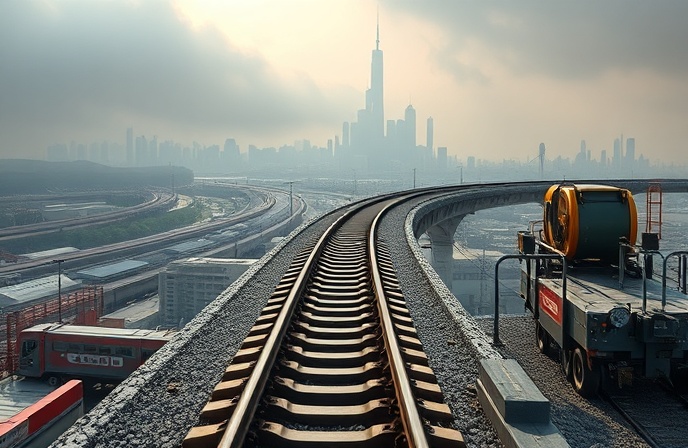
Continuous Welded Rail is a track construction method in which individual rail sections — typically 18–25 metres as rolled at the steel mill — are welded end-to-end to form long continuous strings that are then laid on the track. The welds are made either at a fixed welding depot (producing welded panels of 100–300 metres, delivered to site by rail) or in the field using thermite welding to join the ends of adjacent panels.
The defining characteristic of CWR is that the steel rail has no freedom to expand or contract longitudinally in response to temperature changes. The fastening system, the rail clips, and the ballast resistance together resist the thermal forces that would otherwise cause the rail to move. These forces are not eliminated — they are converted from physical movement into internal stress in the steel, which the rail must accommodate within its elastic range.
The Physics of Thermal Stress in CWR
Steel has a coefficient of thermal expansion of approximately 11.5 × 10⁻⁶ per °C — meaning a 1,000-metre length of steel changes by 11.5 mm for every 1°C of temperature change. In CWR, this movement is prevented by the track restraint system, so the temperature change instead creates internal stress:
Thermal stress in rail = E × α × ΔT
Where: E = Young’s modulus of steel (210 GPa), α = 11.5×10⁻⁶ /°C, ΔT = temperature change from neutral
At ΔT = +30°C: Compressive stress = 210,000 MPa × 11.5×10⁻⁶ × 30 = ~72 MPa (compressive)
At ΔT = −30°C: Tensile stress = ~72 MPa (tensile)
The compressive stress at elevated temperatures is the primary concern for buckling. Rail steel has a yield strength of approximately 700–900 MPa (for heat-treated high-strength rail), so 72 MPa seems modest — but the buckling failure mode is not a simple material yield. A rail under compressive stress will buckle (deflect sideways) at stresses well below yield if the track resistance — the combined resistance of fastening systems, ballast lateral resistance, and rail bending stiffness — is insufficient to resist the lateral force. Track with inadequate ballast consolidation, disturbed by recent tamping or hot dry conditions, is significantly more vulnerable to buckling than well-consolidated, well-drained track at the same temperature.
The Stress-Free Temperature: The Critical Installation Parameter
The stress-free temperature (SFT) — also called the neutral temperature or installation temperature — is the rail temperature at which the rail has zero thermal stress. It is the single most important parameter in CWR installation and management. Getting it wrong has serious consequences:
- SFT too low: The rail was installed cool, and as summer temperatures rise, the compressive stress developed is higher than intended. Buckling risk in summer increases.
- SFT too high: The rail was installed hot, and as winter temperatures fall, the tensile stress developed is higher than intended. Pull-apart (cold fracture) risk in winter increases.
- SFT correct: Summer compressive stress and winter tensile stress are approximately balanced — both are within the safe operating range for the climate of the installation location.
National standards specify the required SFT for different climate zones. In the UK, Network Rail specifies an SFT of 27°C for new CWR installations on most of the network. In Germany (DB Netz), the SFT is typically 23–27°C. In Scandinavia where winter temperatures can reach −40°C, a higher SFT (27–30°C) balances the greater tensile stress risk in winter against increased summer compressive stress.
Jointed Track vs CWR: Full Comparison
| Parameter | Jointed Track (Traditional) | Continuous Welded Rail (CWR) |
|---|---|---|
| Thermal management | Physical expansion in gaps (~6 mm gap between rails) | Internal stress — no physical movement |
| Ride quality | Rhythmic impacts at every joint; noise and vibration | Smooth, quiet; impacts only at welds (minimal) |
| Maximum practical speed | ~160 km/h (joint impacts become damaging above this) | 350+ km/h (speed not limited by track joint impacts) |
| Primary maintenance concern | Joint inspection; bolt tightening; end-batter dressing; bolt-hole cracking | Weld inspection; thermal stress monitoring; ballast condition for buckle prevention |
| Broken rail detection | Track circuit naturally detects rail break at joint gap | Track circuit detects breaks within sections; weld failures create specific failure modes |
| Track circuit requirements | Insulated joints built into fishplate joints — no extra joints needed | Insulated joints must be cut into CWR string — creates mechanical weak points |
| Ballast requirement | Moderate — joints allow slight movement; ballast restraint less critical | High — ballast must resist lateral buckling forces; quality and consolidation critical |
| Suitability for high-speed | No — joint impacts preclude high speed | Yes — standard on all HSR worldwide |
Welding Methods: How Joints Are Made in CWR
Flash-Butt Welding
The preferred method for joining rails in the welding depot or at fixed welding facilities. The ends of two rails are clamped in a machine that passes a very high current through the joint — the ends heat to fusion temperature, are brought together under pressure, and the molten material is extruded from the joint as “flash.” The result is a solid, homogeneous weld with metallurgical properties close to the parent rail steel. Flash-butt welds are the strongest and most reliable weld type — they are used to produce the long welded strings that are delivered to site.
Thermite (Exothermic) Welding
The field welding method for joining rail strings in situ — connecting the ends of adjacent panels laid on the track, or repairing rail breaks in service. Thermite welding uses an exothermic chemical reaction (aluminium powder + iron oxide → aluminium oxide + molten iron, at approximately 2500°C) to produce a quantity of molten steel that fills the joint gap between rail ends. The molten steel solidifies to form the weld. Thermite welds are less strong than flash-butt welds and require careful execution to produce an acceptable joint — poor control of moisture, gap width, preheating, or mould alignment can produce defective welds. Field thermite welds are a significant source of rail defects requiring UT inspection.
Buckling: The Failure Mode That Ends Services
Buckling — the lateral deflection of the rail under excessive compressive thermal stress — is the most operationally significant failure mode specific to CWR. A buckled section of track is immediately dangerous: the track geometry has deviated sufficiently that a train running over it is at risk of derailment. Unlike most track defects that develop gradually and can be scheduled for maintenance, buckling can occur suddenly on a hot summer day, potentially without warning.
The conditions that increase buckling risk:
- Rail temperature significantly above the neutral temperature (>25–35°C above SFT depending on track condition)
- Recently tamped track (ballast disturbed by tamping operation has reduced lateral resistance until it re-consolidates)
- Poor track geometry (existing lateral deviation amplifies compressive buckling force)
- Isolated ballast condition (dry, uncompacted, or washed-out ballast provides less resistance)
- Light track (lighter rail section, wider sleeper spacing, or resilient fastenings reduce lateral stiffness)
Speed restrictions on hot days — applied when rail temperature exceeds a defined threshold — are the primary operational mitigation for buckling risk on the CWR network. Network Rail applies automatic speed restrictions when rail temperature (measured by trackside sensors or calculated from air temperature) exceeds 46°C, with more severe restrictions at higher temperatures. DB Netz and other European operators apply analogous rules calibrated to their specific neutral temperature standards and track conditions.
Insulated Rail Joints in CWR: A Necessary Compromise
CWR’s elimination of mechanical joints creates a problem for track circuits, which require insulated joints at section boundaries to define the electrical limits of each detection block. On CWR track, insulated rail joints (IRJs) must be cut into the continuous rail string at the required locations — an operation that re-introduces a mechanical discontinuity at each IRJ.
IRJs are the weakest points in CWR and a disproportionate source of maintenance issues:
- The insulating material (fibreglass/epoxy composite) is weaker than the surrounding steel and subject to impact loads at every wheel passage.
- IRJ failure — insulating material breakdown, allowing electrical continuity between sections — causes track circuit failures that can affect signalling safety.
- The mechanical discontinuity at the IRJ creates local impact loading that damages the rail ends adjacent to the joint.
Audio-frequency (AF) jointless track circuits address this problem by using frequency coding rather than physical insulation to define section boundaries, eliminating the need for IRJs in the running rails. Modern track circuit systems on CWR track increasingly use AF-coded circuits, with IRJs only where absolutely necessary (at level crossings, certain signal locations, and section boundaries where frequency coding is not applicable).
CWR on High-Speed Lines: Additional Design Requirements
CWR on high-speed lines (above 200 km/h) has more stringent design and maintenance requirements than on conventional lines, because the consequences of rail defects are more severe at higher speeds:
- Higher neutral temperature tolerance: Faster trains generate more heat through wheel-rail friction, raising rail temperature above ambient levels during intense service periods.
- Tighter geometry tolerances: Any lateral geometry deviation is amplified by the higher dynamic forces of high-speed trains. Pre-existing track irregularities must be within tighter limits before compressive stress conditions develop.
- Continuous monitoring: High-speed lines increasingly use continuous track monitoring — instrumented measurement trains, rail temperature sensors, and distributed acoustic sensing — to detect emerging buckle conditions before they reach dangerous levels.
- Rail grade selection: High-speed lines use higher-grade rail steel (head-hardened or premium pearlitic grades) with greater resistance to rolling contact fatigue and corrugation, reducing the rate of geometry deterioration that increases buckle risk.
Editor’s Analysis
CWR is one of the most transformative innovations in railway infrastructure history — as consequential as the move from iron to steel rail in the 19th century. Its adoption was not driven by a single dramatic accident but by the cumulative economics of joint maintenance on busy lines: the cost of inspecting, tightening, renewing, and eventually replacing thousands of fishplated joints per kilometre, year after year, eventually outweighed the engineering complexity of managing thermal stress in a continuous string. The thermal stress management challenge that initially made network engineers cautious about CWR turned out to be manageable with the right installation procedures, neutral temperature standards, and seasonal speed restrictions. What remains difficult is the interaction between CWR and the rest of the track system — specifically the insulated rail joint problem, which AF track circuits have partially but not completely resolved; and the buckling monitoring problem, which is becoming more important as climate change produces more frequent extreme heat events in temperate-climate railway networks. Rail temperatures in the UK in summer 2022 reached 62°C on some exposed track sections — significantly above the conditions for which the CWR neutral temperature standards were calibrated when they were set in the 1990s. Climate adaptation of CWR design — reviewing neutral temperature standards, improving ballast consolidation practices after tamping, deploying real-time rail temperature monitoring more widely — is now an active engineering programme for several European network managers. The infrastructure that seemed to be solved may need revisiting. — Railway News Editorial
Frequently Asked Questions
- Q: Why does jointed track make the “clickety-clack” sound and CWR doesn’t?
- The characteristic “clickety-clack” of traditional railway travel is produced by each wheel striking the small gap — typically 4–8 mm — at the end of each 18-metre rail section. As the wheel rolls to the joint, it briefly loses support as it crosses the gap, then impacts the start of the next rail with a percussive force. This impact is transmitted through the rail and sleeper structure into the ground, producing the rhythmic sound that repeats every rail length (about 18 metres) at a frequency that increases with speed. At 80 km/h on standard 18-metre rail, the clickety-clack repeats approximately 25 times per minute per wheel. CWR eliminates the gap and therefore eliminates the impact — wheels roll continuously over seamless steel without the percussion event, and the main sound source from the track becomes aerodynamic noise and wheel-rail rolling noise, rather than joint impact.
- Q: What happens to a CWR track in very cold weather?
- In very cold weather, a CWR rail tries to contract but is prevented from doing so by the fastening system and the rail’s own mass and inertia. This creates tensile stress in the rail — the rail is being “stretched” by the difference between its natural length at the cold temperature and its constrained length. If the tensile stress exceeds the rail’s tensile strength (approximately 700–900 MPa for standard rail), or if a defect in the rail creates a stress concentration, the rail can fracture — a “pull-apart” or cold-weather break. Rail breaks in cold weather create a gap in the track that can be dangerous for following trains, and they also open the track circuit (which provides automatic protection). In practice, cold-weather breaks are most common at thermite weld locations (where weld quality may be below parent material), at insulated rail joints (where the mechanical discontinuity creates a stress concentration), and at locations of existing rail defects (rolling contact fatigue cracks that become critical under tensile loading). Cold-weather break risk is managed by setting the neutral temperature appropriately for the climate, using higher-grade rail in cold-weather regions, and conducting post-cold-snap inspections after significant temperature drops.
- Q: Why can’t CWR just be installed at the maximum expected summer temperature to prevent buckling?
- Installing CWR at the maximum expected summer temperature would prevent compressive stress in summer (no buckling risk) but create very high tensile stress in winter — because the rail would be contracted far below its installation temperature for much of the year. On a network in a temperate climate with summer rail temperatures of 50°C and winter rail temperatures of −10°C, installing at 50°C would create a tensile stress at −10°C corresponding to a 60°C temperature drop — approximately 145 MPa of tensile stress. This would make cold-weather breaks a frequent and serious problem. The neutral temperature is a deliberate compromise that balances compressive stress risk in summer against tensile stress risk in winter, calibrated to the local climate statistics to minimise the total frequency of both failure modes over the asset’s lifetime. In practice, the asymmetry of consequences also matters: a buckle that develops gradually on a hot day can be detected and protected against by temperature-based speed restrictions; a sudden cold-weather break at 03:00 in January may not be detected before a train reaches it. This asymmetry sometimes argues for a slightly higher SFT than the pure statistical optimum.
- Q: How is the neutral temperature of existing CWR measured or verified?
- The neutral temperature of existing CWR is one of the most challenging parameters to measure directly in the field. The installation records (date, air temperature, rail temperature at time of welding) theoretically provide the as-installed SFT, but records may be incomplete or inaccurate, and the effective SFT can change over time due to rail creep (slow longitudinal movement under traffic), rail replacement in short sections (which may be installed at a different temperature), and the progressive accumulation of small adjustments from maintenance activities. Several indirect measurement methods are used: rail temperature monitoring combined with strain gauge measurements can infer the current SFT from the stress-temperature relationship; acoustic methods (ultrasonic measurement of rail wave velocity, which changes with stress) can detect stress state; and some networks use a reference mark method, drilling precise holes in the rail and measuring their spacing at known temperature to calculate stress state from dimensional changes. None of these is entirely straightforward in operational conditions, which is why the SFT of long-established CWR sections is sometimes poorly known — a source of concern for maintenance planning.
- Q: What is “rail creep” and why does it affect CWR performance?
- Rail creep is the slow longitudinal movement of the rail relative to the sleepers under the influence of repeated traffic loading — essentially, the rail gradually slides in the direction of traffic flow (and sometimes against it, on steep descending gradients) over time. In jointed track, rail creep was managed by rail anchors that gripped the sleeper, and the joints provided a reference that made creep visible. In CWR, creep is a more serious problem because the rail’s continuous length and constrained ends mean that local creep movement in one section displaces stress from the intended SFT distribution, potentially creating local sections of higher compressive or tensile stress than the design intended. If sufficient creep occurs, the rail may “stack” at one end of a long section, creating a zone of high compressive stress in one area and low compressive stress (or tension) in another. Rail anchoring — the installation of elastic clips, anchors, or spring-washers at defined intervals to resist longitudinal rail movement — is the primary creep management measure on CWR. Periodic measurement of rail creep (by checking the position of reference marks relative to sleepers) is part of the CWR maintenance regime.

Railway infrastructure, rolling stock and transport technologies specialist focused on global rail industry developments, high-speed rail systems, signaling technologies and freight transportation. Covering railway investments, public transport modernization, rail operations and international mobility projects across Europe, Asia and North America.
RELATED POSTS

October 8, 2026 1:15 pm
Alstom secured a €1bn contract to build 13 automated trains,...

October 1, 2026 7:09 am
United States regulators confirmed a September 30 deadline for the...

October 8, 2026 12:18 pm
Siemens Mobility signed an agreement with VinSpeed to supply 350...

October 4, 2026 5:14 pm
Alstom secured a CA$4.7 billion order from VIA Rail Canada...

October 5, 2026 6:12 pm
AECOM and Jacobs secured a contract in September 2026 to...

October 1, 2026 12:13 am
Illinois approved $1.5 billion annually for the Northern Illinois Transit...