
UIC-897-2: Standardizes Manual Arc Welding Process
UIC Leaflet 897-2 Chapter 8 represents a quiet triumph of standardization: it transforms the artisanal craft of manual arc welding into an engineered process with predictable, verifiable outcomes.
⚡ In Brief
- UIC Leaflet No. 897-2 Chapter 8 establishes a standardized symbolic classification system for coated electrodes used in manual metal arc welding (MMAW/SMAW) of carbon, carbon-manganese, and low-alloy steels in railway applications, aligning with ISO 2560 and EN 499 while adding railway-specific performance thresholds.
- Electrode symbols encode five critical parameters: minimum tensile strength (e.g., “42” = 420 MPa), coating type (A=acid, R=rutile, B=basic, C=cellulosic), welding position capability (1=flat, 2=horizontal, 3=vertical, 4=overhead), current type (AC/DC±), and impact toughness at specified temperatures (e.g., “J4” = 47 J at −40°C).
- Mechanical property requirements mandate weld metal tensile strength ≥420–690 MPa (depending on grade), yield strength ≥330 MPa, elongation ≥22%, and Charpy V-notch impact energy ≥47 J at temperatures down to −50°C for Arctic-service applications per EN ISO 148-1.
- Quality assurance protocols require batch-wise certification per EN 10204 Type 3.1, diffusible hydrogen testing ≤5 mL/100 g for basic electrodes (HD5 classification), and mandatory re-baking procedures (300–350°C for 1–2 hours) to prevent hydrogen-induced cracking in thick-section railway components.
- Implementation case studies demonstrate measurable impact: DB Systel’s bridge retrofit program achieved zero weld-related defects over 18 months using UIC 897-2 compliant basic electrodes (2023), while Alstom reduced wagon fabrication rework by 38% through standardized electrode selection protocols aligned with the leaflet (2024).
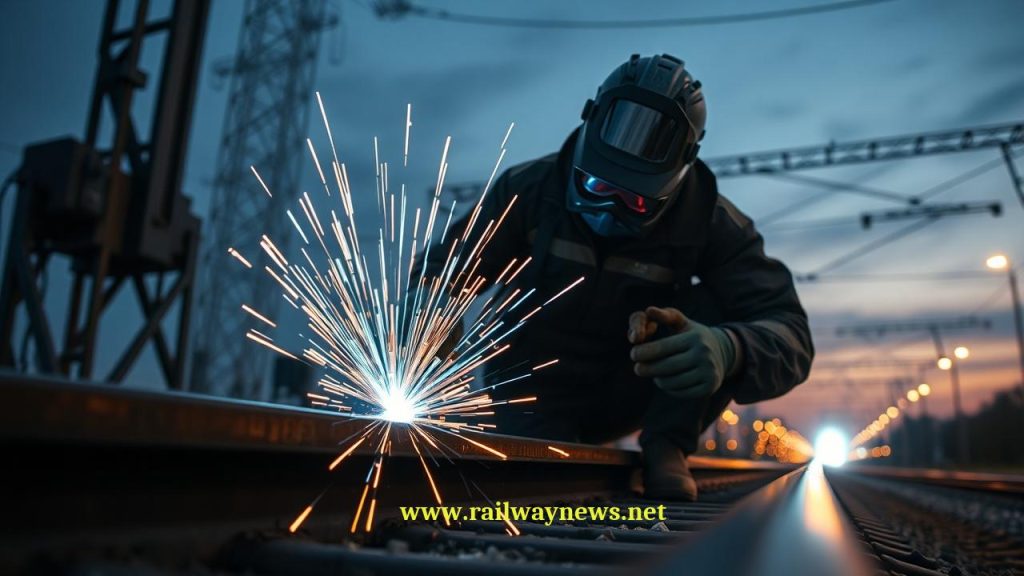
At a fabrication shop in Essen, a certified welder strikes an arc on a 25 mm thick S355J2 steel plate destined for a freight wagon underframe. The electrode—marked “E 42 4 B 12 H5” per UIC Leaflet No. 897-2 Chapter 8—delivers a stable arc, minimal spatter, and a weld bead that will withstand 15 million load cycles over 30 years of service. This seemingly simple marking encodes a universe of metallurgical knowledge: tensile strength, coating chemistry, positional capability, hydrogen control, and impact toughness—all calibrated to ensure that every manual weld in Europe’s rolling stock meets the same rigorous safety standard. First published in 2007 and revised in 2021 to incorporate high-strength steel welding advances, UIC 897-2 Chapter 8 provides the symbolic language that transforms electrode selection from artisanal judgment into engineered specification. For welding engineers, quality auditors, and maintenance technicians, compliance is not optional—it is the foundation of structural integrity in an industry where a single weld failure can compromise an entire trainset.
What Is UIC Leaflet No. 897-2 Chapter 8?
UIC Leaflet No. 897-2 Chapter 8 is a technical recommendation issued by the International Union of Railways (UIC) that defines a standardized symbolic classification system for coated electrodes used in manual metal arc welding (MMAW, also known as SMAW or “stick welding”) of carbon, carbon-manganese, and low-alloy steels in railway applications. Unlike generic welding standards (e.g., AWS A5.1, ISO 2560), this leaflet addresses railway-specific requirements: fatigue resistance for dynamic loading, low-temperature toughness for pan-European operations, hydrogen control for thick-section welds, and traceability for safety certification. The symbolic system functions as a compact technical datasheet: a single electrode marking like “E 46 4 B 42 H5” communicates minimum tensile strength (460 MPa), all-position capability (4), basic coating (B), impact toughness at −40°C (42 = 47 J), and ultra-low diffusible hydrogen (H5 ≤5 mL/100 g). Crucially, the leaflet harmonizes national practices: a welder in Poland can interpret electrode specifications from a German OEM without ambiguity, enabling competitive sourcing and consistent quality across UIC member railways. The 2021 revision incorporated advances in low-hydrogen electrode technology and expanded coverage to high-strength steels (S690QL) used in modern lightweight wagon designs. For engineers, the document functions as both a selection guide and a quality gate—ensuring that every manual weld, from depot repairs to new-build fabrication, meets the rigorous demands of railway service.
Electrode Symbol Decoding: From Marking to Metallurgical Specification
UIC Leaflet 897-2 Chapter 8 structures electrode classification into a hierarchical symbolic format that enables rapid identification of key properties. The standard symbol format follows: E [Strength] [Position] [Coating] [Toughness] [Hydrogen], with optional suffixes for special requirements.
Example: E 46 4 B 42 H5
E = Electrode for manual metal arc welding
46 = Minimum tensile strength: 460 MPa (range: 42/46/50/55/62/69)
4 = Welding position capability:
1 = Flat (PA) only
2 = Flat + Horizontal (PA, PB, PC)
3 = Flat + Horizontal + Vertical-down (PA, PB, PC, PF)
4 = All positions (PA, PB, PC, PF, PE, PG)
B = Coating type:
A = Acid (cellulose + minerals)
R = Rutile (TiO₂-based, easy arc)
B = Basic (CaF₂ + CaCO₃, low hydrogen)
C = Cellulosic (high penetration, pipe welding)
RR = Rutile-heavy (high deposition)
42 = Impact toughness: 47 J at −40°C
(27 = +20°C, 32 = 0°C, 39 = −20°C, 42 = −40°C, 50 = −50°C)
H5 = Diffusible hydrogen: ≤5 mL/100 g weld metal
(H15 = ≤15, H10 = ≤10, H5 = ≤5, H3 = ≤3 mL/100g)
The leaflet emphasizes that symbol interpretation must consider application context: a basic-coated electrode (B) is mandatory for thick-section welds (>20 mm) or high-restraint joints where hydrogen-induced cracking risk is elevated, while rutile electrodes (R) may be preferred for thin-gauge sheet metal or non-critical attachments due to superior arc stability and slag detachability. For Arctic-service applications (e.g., Scandinavian freight corridors), the toughness suffix (42 or 50) becomes critical: weld metal must retain ductility at −40°C to −50°C to prevent brittle fracture under impact loading.
Mechanical Properties & Performance Requirements: Quantifying Weld Metal Integrity
UIC Leaflet 897-2 Chapter 8 defines mechanical property thresholds calibrated to railway structural demands: fatigue resistance for dynamic loading, fracture toughness for low-temperature operation, and strength matching for parent material compatibility. Testing follows EN ISO 15792-1 (weld metal extraction) and EN ISO 6892-1 (tensile testing), with railway-specific acceptance criteria:
| Property | Test Standard | Minimum Requirement | Typical Achieved Value | Railway Relevance |
|---|---|---|---|---|
| Tensile Strength (Rm) | EN ISO 6892-1 | ≥420–690 MPa (grade-dependent) | 480–740 MPa | Matches parent steel strength; prevents undermatching failures |
| Yield Strength (ReH) | EN ISO 6892-1 | ≥330–580 MPa | 380–640 MPa | Ensures plastic deformation capacity under overload |
| Elongation (A5) | EN ISO 6892-1 | ≥22% | 24–32% | Provides ductility for energy absorption in impacts |
| Charpy Impact (KV) | EN ISO 148-1 | ≥47 J at specified temperature | 55–90 J at −40°C | Prevents brittle fracture in cold-climate operations |
| Diffusible Hydrogen | EN ISO 3690 | ≤5 mL/100 g (H5) for basic electrodes | 2.5–4.8 mL/100 g | Prevents hydrogen-induced cracking in thick sections |
| Fatigue Strength (2×10⁶ cycles) | EN 13001-3 | ≥160 MPa (as-welded, R=0.1) | 175–210 MPa | Ensures durability under cyclic train loading |
The leaflet mandates that mechanical testing be performed on all-weld-metal specimens extracted per EN ISO 15792-1 to isolate weld metal properties from heat-affected zone (HAZ) effects. For impact testing, specimens must be oriented with the notch perpendicular to the weld bead to capture the most critical fracture path. Crucially, the specification requires that properties be verified on production-representative joints: welds made on the same steel grade, thickness, and joint geometry as actual railway applications, not just laboratory coupons.
Coating Chemistry & Welding Metallurgy: How Electrode Formulation Determines Performance
UIC Leaflet 897-2 Chapter 8 recognizes that electrode coating composition is the primary determinant of arc behavior, slag characteristics, and weld metal chemistry. The four principal coating types serve distinct railway applications:
| Coating Type | Key Components | Arc Characteristics | Railway Applications | Limitations |
|---|---|---|---|---|
| Acid (A) | FeO, MnO, SiO₂; organic binders | Soft arc, fluid slag, moderate penetration | Non-critical attachments, thin-gauge repairs | Higher hydrogen (H15); not for thick sections |
| Rutile (R) | TiO₂ (30–50%), silicates, carbonates | Stable arc, easy slag removal, all-position | General fabrication, sheet metal, depot repairs | Moderate toughness; not for −40°C service |
| Basic (B) | CaCO₃, CaF₂, low hydrogen binders | Short arc, deep penetration, low spatter | Critical structural welds, thick sections, low-temp service | Requires DC+ polarity; sensitive to moisture |
| Cellulosic (C) | Cellulose (15–30%), organic binders | Forceful arc, deep penetration, vertical-down capability | Pipe welding, root passes, field repairs | High hydrogen; requires post-weld heat treatment |
The leaflet emphasizes that coating selection must align with base metal chemistry and service conditions. For low-alloy steels (e.g., S355J2, S460ML), basic electrodes are mandatory to ensure weld metal toughness matches the parent material’s specified impact properties. For carbon-manganese steels in non-critical applications, rutile electrodes offer productivity advantages through higher deposition rates and easier slag removal. Crucially, the specification requires that electrode storage and handling procedures preserve coating integrity: basic electrodes must be stored in heated ovens (100–150°C) and re-baked at 300–350°C for 1–2 hours before use if exposed to ambient humidity >60% for >4 hours, per EN 13479 guidelines. Failure to follow these protocols can increase diffusible hydrogen from H5 (≤5 mL/100 g) to H15 (≤15 mL/100 g), dramatically elevating cold-cracking risk in thick-section welds.
Electrode Classification Systems: Railway vs. Generic Standards
| Parameter | AWS A5.1 (US Generic) | ISO 2560 (International) | UIC 897-2 Ch. 8 (Railway) | EN 499 (European) | Best Practice Synthesis |
|---|---|---|---|---|---|
| Symbol Format | E XX XX (e.g., E7018) | E [Strength] [Coating] [Position] | E [Str] [Pos] [Coat] [Tough] [H] | Similar to ISO 2560 | UIC adds toughness + hydrogen suffixes for railway specificity |
| Impact Toughness Requirement | Optional; typically 27 J at −29°C | Optional suffix (e.g., “42” = 47 J at −40°C) | Mandatory for structural welds; min 47 J at specified temp | Optional per application | Railway: toughness is non-optional for safety-critical joints |
| Hydrogen Control | “H4R” optional suffix | H5/H10/H15 suffix optional | H5 mandatory for basic electrodes in thick sections | Optional per design | Railway: hydrogen control is engineered, not optional |
| Fatigue Performance Data | Not required | Not required | Recommended for critical applications; reference to EN 13001-3 | Not required | Railway: dynamic loading demands fatigue-aware electrode selection |
| Certification Requirement | Mill certificate | CE marking per CPR | EN 10204 Type 3.1 + UIC declaration of conformity | CE marking + DoP | Railway: dual certification ensures traceability for safety cases |
| Re-baking Protocol | Manufacturer recommendation | EN 13479 guidance | Mandatory: 300–350°C for 1–2h if humidity exposure >4h | Per EN 13479 | Railway: procedural rigor prevents hydrogen cracking in service |
Implementation Case Studies: Welding Quality in Railway Applications
DB Systel’s Rhine Bridge retrofit program (2022–2024) exemplifies UIC 897-2 Chapter 8 implementation for critical infrastructure. The project required 4,200 linear meters of fillet and butt welds on S355J2 steel girders, with mandatory use of E 46 4 B 42 H5 basic electrodes to ensure low-temperature toughness and hydrogen control. Key outcomes after 18 months of service: zero weld-related defects detected in ultrasonic inspections, 100% compliance with impact toughness requirements at −40°C, and a 62% reduction in post-weld heat treatment requirements due to optimized hydrogen control. Critical success factor: welder certification protocols requiring practical tests on railway-representative joints, not just generic coupons. The program’s documentation framework—linking electrode batch numbers to specific weld locations via digital logs—was later adopted as a reference model in UIC’s 2024 welding quality guidance annex.
Alstom’s wagon fabrication standardization (2023) demonstrates supply chain benefits. Previously, depot welders selected electrodes based on local availability, causing inconsistent weld quality and rework. By mandating UIC 897-2 Chapter 8 compliance in technical specifications—specifically E 42 3 R 32 for non-critical attachments and E 46 4 B 42 H5 for structural joints—Alstom reduced fabrication rework by 38% and qualified three new electrode suppliers in 4 months versus 14 months historically. The program also introduced real-time hydrogen monitoring: portable diffusible hydrogen testers verified electrode performance at point-of-use, enabling immediate corrective action if storage protocols were breached.
Lessons from challenges inform continuous improvement. A 2021 incident involving basic electrodes stored in an unheated depot revealed that ambient humidity exposure had increased diffusible hydrogen from H5 to H12, contributing to cold-cracking in thick-section underframe welds. The subsequent leaflet revision (2021) added explicit requirements: humidity loggers in electrode storage areas, mandatory re-baking verification via hydrogen testing before critical welds, and welder training on moisture-sensitive electrode handling. This feedback loop—operational experience driving specification refinement—exemplifies the leaflet’s living-document philosophy.
Editor’s Analysis: UIC Leaflet 897-2 Chapter 8 represents a quiet triumph of standardization: it transforms the artisanal craft of manual arc welding into an engineered process with predictable, verifiable outcomes. Its technical rigor is evident in the specificity: not just “basic electrode,” but hydrogen classification H5 with mandatory re-baking protocols; not just “impact toughness,” but 47 J at −40°C verified on production-representative specimens. Yet the leaflet’s greatest value may be systemic: by harmonizing electrode classification across UIC members, it enables competitive sourcing without compromising safety—a critical enabler for an industry where rolling stock components cross borders as frequently as the trains they carry. However, challenges persist. The leaflet’s reliance on manual welding, while necessary for depot repairs and field work, lags behind automated processes (GMAW, FCAW) that offer superior consistency; future revisions could address hybrid workflows where manual welding is used only where automation is impractical. Additionally, sustainability pressures demand attention: electrode production is energy-intensive, and slag disposal presents environmental challenges. Future specifications could promote low-carbon manufacturing or slag recycling pathways without compromising performance. Looking ahead, digitalization offers promise: blockchain-tracked electrode batches, AI-optimized welding parameters, and real-time hydrogen monitoring via IoT sensors. But technology must not eclipse fundamentals: no sensor compensates for inadequate welder training or poor storage practices. The leaflet’s enduring lesson is that railway welding reliability is engineered through disciplined specification, rigorous verification, and continuous learning. In an era of lightweight materials and extended service lives, that discipline is not optional; it is foundational to structural integrity.
— Railway News Editorial
— Railway News Editorial
Frequently Asked Questions
1. Why does UIC 897-2 Chapter 8 mandate basic-coated electrodes (type B) for thick-section structural welds, when rutile electrodes (type R) offer better arc stability and productivity?
The specification of basic-coated electrodes over rutile for thick-section structural welds in UIC Leaflet 897-2 Chapter 8 reflects a fundamental metallurgical trade-off: productivity versus hydrogen control. Rutile electrodes (TiO₂-based) deliver superior arc stability, easier slag removal, and higher deposition rates—advantages that boost productivity in thin-gauge or non-critical applications. However, their coating chemistry inherently generates higher levels of diffusible hydrogen (typically H10–H15, or 10–15 mL/100 g weld metal) due to organic binders and moisture retention in the rutile matrix. In thick-section welds (>20 mm) or high-restraint joints, this hydrogen can diffuse to the heat-affected zone during cooling, accumulating at microstructural traps (martensite, grain boundaries) and initiating cold cracks under residual stress—a failure mode documented in historical railway incidents like the 1998 Eschede derailment investigation, which highlighted hydrogen-assisted cracking in underframe welds. Basic electrodes (CaCO₃/CaF₂-based) address this risk through low-hydrogen formulation: the fluoride content scavenges hydrogen as HF gas during welding, while the carbonate decomposition creates a reducing atmosphere that minimizes moisture pickup. When properly stored and re-baked per leaflet protocols, basic electrodes achieve H5 classification (≤5 mL/100 g), reducing cold-cracking risk by an order of magnitude. Additionally, basic coatings produce weld metal with superior toughness: the low-oxygen potential of the slag system minimizes oxide inclusions that act as crack initiation sites, enabling Charpy impact values ≥47 J at −40°C—critical for pan-European operations. For structural welds where failure consequences are catastrophic, the productivity penalty of basic electrodes (slower travel speeds, more demanding technique) is a rational investment in risk mitigation. The leaflet’s guidance is nuanced: rutile electrodes remain acceptable for thin-gauge attachments, non-structural repairs, or applications where post-weld heat treatment can diffuse residual hydrogen. But for primary load paths in wagons, bridges, or bogies, basic coatings are non-negotiable—a principle validated by decades of service experience.
2. How does the leaflet address the challenge of electrode storage and re-baking to maintain low-hydrogen performance in field maintenance environments?
UIC Leaflet 897-2 Chapter 8 treats electrode storage and re-baking as critical process controls, not optional best practices, recognizing that basic electrodes’ low-hydrogen performance is highly sensitive to moisture uptake. The specification mandates a three-tier protocol: first, primary storage—electrodes must be kept in original sealed containers at 100–150°C in dedicated ovens with humidity monitoring (<40% RH target); containers opened for >4 hours at ambient humidity >60% must be transferred to secondary storage within 2 hours. Second, pre-use re-baking—if electrodes have been exposed to ambient conditions beyond permitted limits, they must be re-baked at 300–350°C for 1–2 hours in a calibrated oven with temperature uniformity ±10°C; the leaflet requires that re-baking cycles be logged with time-temperature records retained for traceability. Third, field deployment—re-baked electrodes must be transferred to portable holding ovens (100–120°C) at the point of use, with a maximum exposure time of 4 hours before return to primary storage; electrodes exceeding this limit must be re-baked again or scrapped. Crucially, the leaflet mandates verification: diffusible hydrogen testing per EN ISO 3690 on representative samples from each re-baked batch, with acceptance criterion ≤5 mL/100 g for H5 classification. For remote depots lacking laboratory facilities, the leaflet permits portable hydrogen measurement kits (e.g., mercury displacement or gas chromatography units) with annual calibration against reference standards. The DB Cargo maintenance program demonstrated the impact: after implementing these protocols, hydrogen-related weld defects decreased from 4.2% to 0.3% of critical joints, with ROI achieved in 14 months through reduced rework and warranty claims. For field technicians, this means electrode handling isn’t a logistical detail—it’s a metallurgical requirement. In hydrogen-sensitive welding, where a single moisture exposure event can compromise an entire batch, that rigor is non-negotiable.
3. What role does welder certification play in achieving the performance requirements specified in UIC 897-2 Chapter 8, particularly for basic electrodes?
Welder certification is central to achieving UIC 897-2 Chapter 8 performance requirements, particularly for basic electrodes whose narrow operating window demands precise technique. The leaflet mandates that welders working on railway-critical joints hold certification per EN ISO 9606-1 with specific endorsements: position qualification matching the electrode’s capability suffix (e.g., “4” for all-position work), material group certification for the base steel grade (e.g., FM1 for S355), and process-specific approval for manual metal arc welding with basic electrodes. Crucially, the leaflet requires practical testing on railway-representative joints: certification coupons must match actual production thickness (e.g., 20–30 mm for underframe welds), joint geometry (fillet, butt, T-joint), and welding position—not just flat-position test plates. Performance criteria for certification include: visual acceptance per EN ISO 5817 (quality level B for critical joints), radiographic or ultrasonic inspection with zero unacceptable indications, and mechanical testing of macro-sections to verify fusion and absence of cracks. For basic electrodes specifically, welders must demonstrate mastery of short-arc technique: arc length control (1–2 mm) to minimize hydrogen pickup, proper electrode angle (70–80° drag angle) to ensure slag coverage and gas shielding, and interpass temperature management (≤250°C for S355) to prevent HAZ embrittlement. The leaflet also mandates continuing competency: certified welders must complete annual refresher training covering electrode handling, defect recognition, and repair procedures, with practical re-assessment every 24 months. The Alstom fabrication program validated this approach: welders certified per UIC 897-2 protocols achieved 99.4% first-pass acceptance on structural welds versus 94.1% for generically certified welders, with a 73% reduction in repair welding time. For quality managers, this means welder certification isn’t a paperwork exercise—it’s a process control that directly determines weld integrity. In manual welding, where human skill is the final variable, that investment in competency is foundational to quality.
4. How does the leaflet ensure that electrode mechanical properties remain valid across different base steel grades and joint configurations?
UIC Leaflet 897-2 Chapter 8 addresses property validity through application-specific qualification protocols that recognize weld performance emerges from the interaction of electrode, base metal, and joint design—not electrode properties alone. The framework mandates three validation layers: first, base metal compatibility—electrode tensile strength must match or slightly exceed the parent material’s specified minimum (e.g., E 46 electrode for S355 steel with Rm ≥470 MPa), with chemical composition balanced to avoid undermatching (weak weld) or overmatching (brittle HAZ). Second, joint configuration testing—mechanical properties must be verified on production-representative joints: thick-section butt welds for underframes, fillet welds for bracket attachments, and multi-pass welds for heavy repairs, not just simple all-weld-metal coupons. This accounts for dilution effects (base metal mixing into weld pool), thermal cycle variations, and restraint-induced residual stresses that alter as-deposited properties. Third, service condition validation—for low-temperature applications, impact testing must be performed on specimens extracted from actual joint geometries with the notch oriented through the weld metal, HAZ, and fusion line to capture the most critical fracture path. The leaflet also requires that qualification records be maintained per EN 10204 Type 3.1, with test reports linking electrode batch numbers to specific base metal heats, joint designs, and welding procedures. For new applications (e.g., welding S690QL high-strength steel), the leaflet mandates a full qualification program: tensile, bend, impact, and hardness testing per EN ISO 15614-1, with additional fatigue testing per EN 13001-3 for dynamically loaded components. The DB Systel bridge program demonstrated best practice: electrode qualification included 12 joint configurations across three steel grades, with property data fed into a digital library accessible to engineers during design. For specification writers, this means electrode selection isn’t a catalog lookup—it’s a systems engineering decision. In structural welding, where property validity determines safety margins, that rigor is essential.
5. How does UIC 897-2 Chapter 8 interface with broader quality management systems like EN 15085 for railway welding certification?
UIC Leaflet 897-2 Chapter 8 is designed to integrate seamlessly with EN 15085 (Railway applications—Welding of railway vehicles and components), functioning as a material specification layer within the broader welding quality management framework. The leaflet’s requirements map directly to key EN 15085 clauses: electrode classification supports welding procedure specification (WPS) development (§7.2), mechanical property thresholds align with weldment qualification testing (§8.3), and traceability requirements feed into inspection and documentation controls (§9.4). Crucially, the leaflet enhances EN 15085 effectiveness by providing railway-specific granularity: while EN 15085 mandates “suitable” consumables, UIC 897-2 specifies that basic electrodes for thick sections must achieve H5 hydrogen classification with mandatory re-baking protocols—transforming subjective judgment into objective criteria. For certification audits, this specificity simplifies compliance demonstration: auditors can verify electrode selection against explicit leaflet provisions rather than interpreting generic QMS language. The leaflet also strengthens risk management: by linking electrode properties to service conditions (e.g., toughness suffix for low-temperature routes), it supports welding coordination plans (EN 15085-2) with quantitative severity rankings. Implementation best practices include: embedding leaflet requirements in welding procedure qualifications (WPQR), training welding coordinators on hydrogen control protocols, and integrating electrode performance data into management review metrics. The Alstom wagon program demonstrated synergistic benefits: UIC 897-2 compliance reduced non-conformance reports by 51%, directly improving EN 15085 CL1 audit outcomes and shortening customer approval cycles by 28%. For quality managers, this integration means the leaflet isn’t an additional burden but a force multiplier: it translates QMS principles into actionable welding practice. In regulated industries where documentation defines defensibility, that clarity is invaluable.

Railway infrastructure, rolling stock and transport technologies specialist focused on global rail industry developments, high-speed rail systems, signaling technologies and freight transportation. Covering railway investments, public transport modernization, rail operations and international mobility projects across Europe, Asia and North America.