
Grounding the Danger: UIC Leaflet 792 Earthing Devices
Secure the line before you climb. A technical guide to UIC Leaflet 792, defining the construction and usage standards for portable earthing and short-circuiting devices in railway electrification.
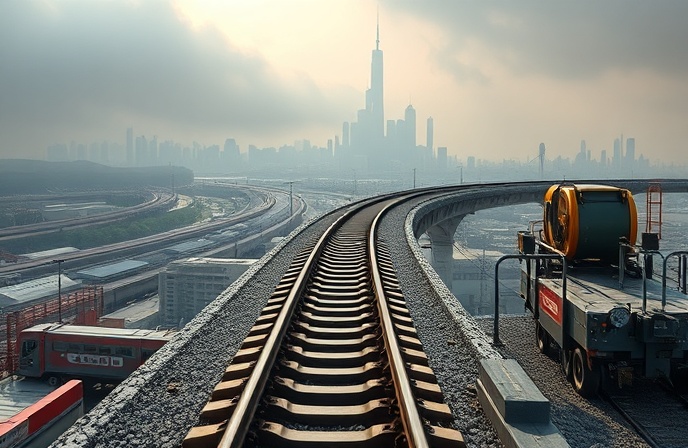
Introduction to UIC Leaflet 792
Before a technician climbs a ladder to repair a 25,000 Volt overhead wire, turning off the switch at the control center is not enough. To guarantee safety against accidental re-energization or induced voltages, the line must be physically connected to the ground (the rail). UIC Leaflet 792, titled “Principles for the construction and use of portable earthing and short-circuiting devices for electric traction overhead lines,” sets the standards for the life-saving poles and cables used in this process.
In railway terms, “Earthing” usually means “connecting to the rail,” as the running rail acts as the return conductor. This device ensures that if the power is accidentally switched on, a massive short circuit occurs immediately, tripping the substation circuit breakers within milliseconds and saving the worker from electrocution.
Snippet Definition: What is UIC 792?
UIC Leaflet 792 is a technical guideline specifying the design, mechanical strength, and electrical rating of portable earthing and short-circuiting devices used in railway maintenance. It defines the requirements for the connection clamps (catenary hook and rail clamp), the flexible copper cable cross-section, and the insulating pole to ensure they can safely withstand the mechanical and thermal shock of a full short-circuit current without failing.
The “Make Safe” Procedure
UIC 792 supports the “Five Safety Rules” of electrical work, specifically the “Earth and Short-Circuit” step.
- Step 1: Verify the line is dead using a voltage detector (often integrated or separate).
- Step 2: Clamp the cable to the Rail (Earth) first. This ensures the cable is at earth potential before it comes near the live wire.
- Step 3: Use the insulating pole to hook the other end onto the Catenary Wire (Phase).
Technical Construction Requirements
The device is not just a wire; it is a safety fuse that must not blow.
1. The Cable (The Conductor)
The flexible copper cable must be thick enough to carry the maximum short-circuit current of the line (e.g., 25 kA or 40 kA) for the duration it takes the breaker to trip (e.g., 100ms to 300ms). If the cable is too thin, it will vaporize instantly in an arc flash explosion. UIC 792 (and related IEC 61230 standards) specifies the cross-section (typically 50mm² to 120mm²).
2. The Clamps (The Connection)
The contact resistance must be extremely low.
- Line Hook: Must bite through oxidation on the contact wire to make a solid electrical connection.
- Rail Clamp: Must attach securely to the rail foot. It requires a specific shape to prevent slipping off due to the violent electromagnetic forces (“whipping”) generated during a short circuit.
3. The Pole (The Insulation)
The telescopic stick used to raise the hook must have high dielectric strength to protect the user in case they accidentally touch a live wire while trying to apply the earth.
Comparison: Earthing to Rail vs. Earthing to Soil
In railways, “Earthing” has a specific meaning.
| Feature | Mise au Rail (UIC 792 Standard) | Mise à la Terre (General Grid) |
|---|---|---|
| Connection Point | To the Running Rail. | To a copper spike driven into the soil. |
| Purpose | Creates a metallic short circuit to the traction return path. | Drains static or induced voltage to the ground. |
| Tripping Speed | Instant: High current triggers impedance protection. | Slow/Uncertain: Soil resistance limits current, might not trip the breaker. |
| Safety Level | Highest (for DC and AC railways). | Secondary (or used where rails are not available). |
Operational Relevance
Double Earthing: UIC 792 guidelines often recommend placing earthing devices on both sides of the worksite. This protects the team regardless of which direction power might accidentally be fed from (e.g., from a distant station or a regenerative braking train entering the section).

Railway infrastructure, rolling stock and transport technologies specialist focused on global rail industry developments, high-speed rail systems, signaling technologies and freight transportation. Covering railway investments, public transport modernization, rail operations and international mobility projects across Europe, Asia and North America.