
South Korea’s GTX-A: Hyundai Rotem’s High-Speed Rail Impact
Hyundai Rotem’s GTX-A rolling stock contract represents a significant investment in modernizing South Korea’s rail infrastructure, specifically enhancing commuter transport in Seoul through cutting-edge technology and design to optimize speed, passenger comfort, and operational efficiency.
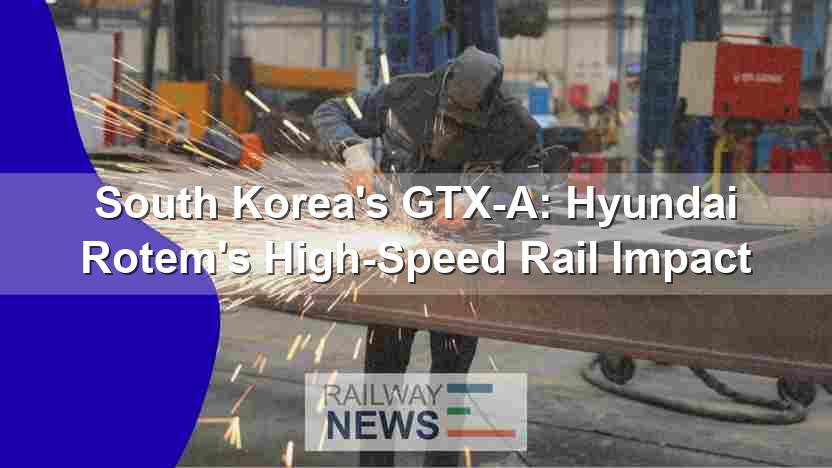
This article examines the significant contribution of Hyundai Rotem to the development of South Korea’s high-speed commuter rail network, specifically focusing on its role in supplying rolling stock for the GTX-A (Great Train Express Line A) project. The KRW 119.2 billion ($983.3 million USD) contract awarded to Hyundai Rotem highlights the substantial investment in modernizing South Korea’s rail infrastructure. This project is not merely an expansion of existing capacity; it represents a strategic move towards enhanced commuter transport in and around Seoul, utilizing cutting-edge technology and design to optimize speed, passenger comfort, and operational efficiency. The subsequent sections will delve into the specifics of the contract, the technological advancements incorporated into the train design, and the broader implications for South Korea’s railway system. We will also analyze the potential for future expansion and the overall significance of this project within the context of national transportation strategies.
Hyundai Rotem’s GTX-A Rolling Stock Contract
Hyundai Rotem’s contract encompasses the delivery of 40 eight-car electric multiple units (EMU) for the GTX-A line, totaling 320 individual carriages. This includes an earlier order of 120 carriages, bringing the total to 160 cars for this phase of the project. The trains will operate on the 83.1 km line connecting Unjeong in the north to Dongtan in the south, serving ten stations, including a crucial interchange at Seoul Station. The trains’ design prioritizes high-speed operation, reaching speeds up to 180 km/h, significantly exceeding conventional subway speeds. The capacity of each train is 1,090 passengers. The manufacturing of these EMUs will take place at Hyundai Rotem’s Changwon Plant.
Technological Advancements in GTX-A Train Design
The GTX-A trains incorporate several notable technological advancements. The short, thick doors, similar to those found on high-speed trains like the KTX (Korea Train Express) and SRT (Super Rapid Train), are a key feature. These doors contribute to superior noise reduction, particularly crucial for underground sections, ensuring a more comfortable passenger experience. The integration of advanced HVAC (Heating, Ventilation, and Air Conditioning) systems also enhances passenger comfort. Additionally, the potential for incorporating Internet of Things (IoT) technologies, such as railway traffic navigation systems and heat recycling within the HVAC, suggests a commitment to operational efficiency and environmental sustainability. The precise details of these IoT implementations, however, are not elaborated in the provided information.
Strategic Implications for South Korea’s Rail Network
The GTX-A project is a critical component of South Korea’s broader strategy to improve urban and intercity transportation. The increased speed and capacity of the GTX-A line will alleviate congestion on existing rail lines, improving commute times for residents of Seoul and surrounding areas. The success of this project, coupled with Hyundai Rotem’s anticipated involvement in the future GTX-B and GTX-C lines, signifies a significant investment in modern, high-speed rail infrastructure. This forward-looking investment positions South Korea favorably in terms of efficient and environmentally-conscious public transportation. The emphasis on high-speed capabilities demonstrates a commitment to attracting commuters away from private vehicles, reducing traffic congestion, and lowering carbon emissions.
Conclusions
Hyundai Rotem’s substantial contract for the supply of 40 eight-car EMUs for the GTX-A line represents a pivotal moment in South Korea’s railway modernization. The project signifies a considerable financial commitment—KRW 119.2 billion ($983.3 million USD)—to upgrading the nation’s commuter rail system. The focus on high-speed operation (up to 180 km/h) and increased passenger capacity (1,090 passengers per train) demonstrates a clear intention to enhance efficiency and alleviate traffic congestion, particularly in the densely populated Seoul metropolitan area. The incorporation of advanced technological features such as noise-reducing doors and potentially sophisticated IoT-based systems underscore a commitment to both passenger comfort and operational optimization. The success of this project, coupled with Hyundai Rotem’s projected involvement in subsequent GTX lines (B and C), indicates a long-term strategy aimed at transforming South Korea’s rail infrastructure into a world-class, high-speed commuter network. This represents not only a significant boost to Hyundai Rotem’s business but also a substantial step towards improving the quality of life for millions of South Koreans, reducing reliance on private vehicles, and fostering sustainable transportation practices. The GTX-A project serves as a model for other nations seeking to upgrade their urban rail systems with modern, efficient, and passenger-centric approaches.

Railway infrastructure, rolling stock and transport technologies specialist focused on global rail industry developments, high-speed rail systems, signaling technologies and freight transportation. Covering railway investments, public transport modernization, rail operations and international mobility projects across Europe, Asia and North America.
RELATED POSTS

October 8, 2026 1:15 pm
Alstom secured a €1bn contract to build 13 automated trains,...

October 1, 2026 7:09 am
United States regulators confirmed a September 30 deadline for the...

October 8, 2026 12:18 pm
Siemens Mobility signed an agreement with VinSpeed to supply 350...

October 4, 2026 5:14 pm
Alstom secured a CA$4.7 billion order from VIA Rail Canada...

October 5, 2026 6:12 pm
AECOM and Jacobs secured a contract in September 2026 to...

October 4, 2026 11:08 pm
Sound Transit confirmed the September 30 opening of Seattle Pinehurst...