
São Paulo Opens 6.7 km Monorail Congonhas Airport Link
São Paulo inaugurated its 6.7 km, eight-station Monorail Line 17 section, providing the first direct rail connection to Congonhas Airport with 14 automated trains.
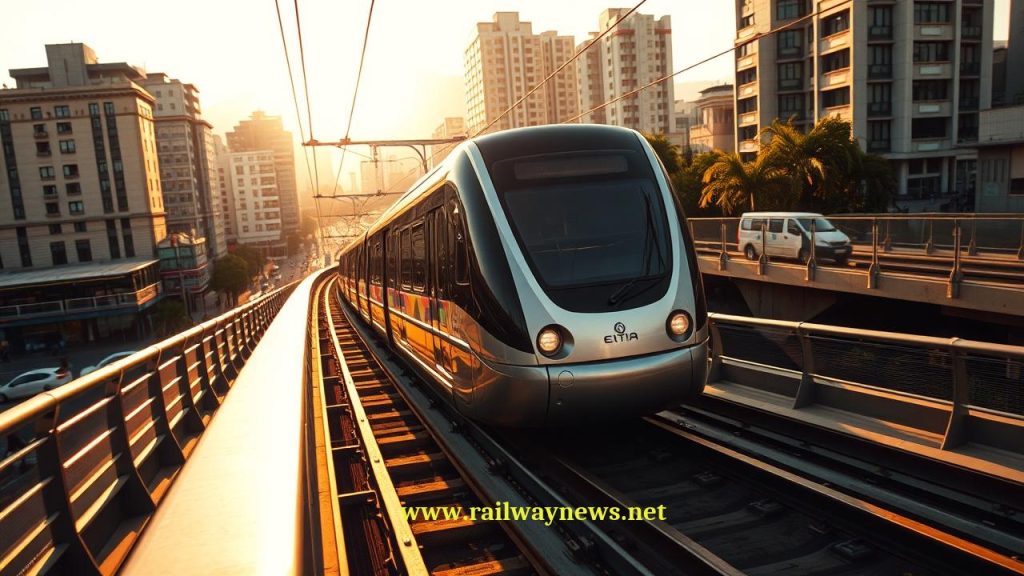
⚡ In Brief: BYD SkyRail has completed a 6.7 km, eight-station section of São Paulo’s Monorail Line 17, connecting Congonhas Airport to the city’s rail network with 14 automated trains.
SÃO PAULO, BRAZIL – The first 6.7 km section of São Paulo’s Monorail Line 17 (Golden Line) was officially inaugurated by Governor Tarcísio de Freitas. The new line provides the first direct rail connection to Congonhas Airport, integrating it with the city’s wider subway and rail network. The initial service is operated by 14 five-car automated trains supplied by BYD SkyRail.
What Is the Full Scope of This Project?
The completed project phase consists of a 6.7 km elevated dual-track monorail with eight fully accessible stations. The full scope of the Line 17 project involves a total length of 17 km with 18 stations, connecting the Morumbi and Jabaquara districts and providing a projected daily capacity of 250,000 passengers. The contract, signed in 2020 with BYD SkyRail, included the delivery of 14 trains equipped with CBTC for automated operation and a new depot with capacity for 39 trains.
Key Project Data
| Parameter | Value |
|---|---|
| Project / Contract Name | São Paulo Monorail Line 17 (Golden Line) |
| Total Value | Not disclosed |
| Parties Involved | Government of São Paulo, BYD SkyRail |
| Timeline / Completion | Initial 6.7 km section inaugurated; full 17 km completion date not specified |
| Country / Corridor | Brazil / São Paulo (Congonhas Airport – Morumbi/Jabaquara) |
How Does This Compare to Similar Projects?
The São Paulo monorail project focuses on enhancing urban mobility, a contrast to other major contemporary rail investments driven by resource logistics and long-distance travel. For example, Zambia is investing $1.3 billion in its critical minerals rail infrastructure to create an export corridor for copper, directly competing with established Chinese-backed routes (Source: Discovery Alert, 2026). In Australia, Rio Tinto’s investment in Western Australia is centered on constructing new heavy-haul rail lines to support iron ore mining operations, with first production expected in 2027 (Source: Rio Tinto, 2024). Meanwhile, Saudi Arabia’s Qiddiya high-speed rail project is a passenger-focused development on a much larger scale, attracting significant international interest for its EPC contracts (Source: Meed, 2024).
Editor’s Analysis
The inauguration of Line 17, attended by Governor Tarcísio de Freitas, highlights the political importance of delivering high-visibility urban infrastructure projects in Brazil. This investment aligns with a global trend of modernizing urban transport in emerging economies, often leveraging automated technologies like CBTC to boost efficiency and safety. The expansion of rail systems is a key driver for the railway signalling market, which is projected to grow at a CAGR of 5-7% over the next decade, with developing nations as primary growth areas (Source: OpenPR, 2024). This project demonstrates a strategic focus on integrating key transport hubs like airports into municipal public transit networks, a critical step for megacities managing congestion.
FAQ
Q: What specific new connections does Line 17 create?
A: The monorail provides a direct connection to Congonhas Airport for the first time. It integrates with the broader rail system via connections to Line 5-Lilás at Campo Belo station and Line 9-Esmeralda at Morumbi station.
Q: What is the technology used for the monorail’s automation?
A: The line uses a Communications-Based Train Control (CBTC) system for fully automated, driverless operation. Additionally, the trains feature onboard batteries that allow them to operate for up to 8 km in the event of a power failure.
Q: What is the total planned size of the Line 17 project?
A: When all expansion phases are complete, the Golden Line will have a total length of 17 km and feature 18 stations. The network is designed to handle a projected daily capacity of 250,000 passengers.

Railway infrastructure, rolling stock and transport technologies specialist focused on global rail industry developments, high-speed rail systems, signaling technologies and freight transportation. Covering railway investments, public transport modernization, rail operations and international mobility projects across Europe, Asia and North America.
RELATED POSTS

October 8, 2026 1:15 pm
Alstom secured a €1bn contract to build 13 automated trains,...

October 1, 2026 7:09 am
United States regulators confirmed a September 30 deadline for the...

October 8, 2026 12:18 pm
Siemens Mobility signed an agreement with VinSpeed to supply 350...

October 4, 2026 5:14 pm
Alstom secured a CA$4.7 billion order from VIA Rail Canada...

October 5, 2026 6:12 pm
AECOM and Jacobs secured a contract in September 2026 to...

October 1, 2026 12:13 am
Illinois approved $1.5 billion annually for the Northern Illinois Transit...