
Sao Paulo Monorail Project: System Overview, Technology, and Impact
BYD SkyRail’s 6.7km, eight-station elevated monorail (14 CBTC-equipped trains) opens, providing first direct rail link to Congonhas Airport and integrating with Metro Lines 5 & 9 in São Paulo.
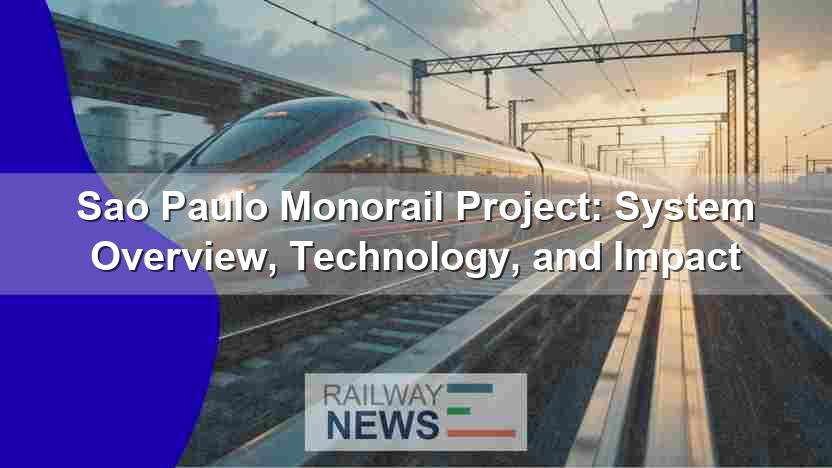
This article explores the technological advancements and logistical considerations behind the construction of the São Paulo monorail system, a significant expansion to the city’s existing metro network. The project aims to drastically improve public transportation, alleviating congestion and providing efficient, rapid transit for a substantial portion of the population. The focus will be on the innovative technology employed, including the Bombardier INNOVIA 300 system, its capacity and operational efficiency, and the implementation of cutting-edge signaling and communication systems. Additionally, we will examine the project’s impact on São Paulo’s broader transportation infrastructure, considering its integration with existing lines and its potential for future expansion. The analysis will also consider the consortium responsible for the project’s delivery, highlighting the roles played by international and domestic companies in its successful implementation.
System Overview and Project Scope
The São Paulo monorail project, a 24km extension of Metro Line 2, significantly expands the city’s public transport capabilities. This elevated system connects Vila Prudente to Cidade Tiradentes, adding 17 new stations to the existing network. The project’s primary goal is to reduce travel time between these two points from approximately two hours to 50 minutes, catering to an estimated 500,000 daily passengers. This substantial increase in transport capacity aims to ease congestion and provide a more reliable and efficient commuting experience for residents. The project leverages advanced technologies to achieve these ambitious targets, focusing on high passenger capacity, automated operation, and seamless integration with existing infrastructure.
Technology and Rolling Stock
The heart of the project is Bombardier’s INNOVIA 300 monorail system. This system boasts a capacity of 40,000 passengers per hour per direction, utilizing 54 seven-car trains capable of transporting 1,000 passengers per trip. The trains’ design incorporates several innovative features, including an inter-car walkway for enhanced passenger flow and safety, flexible seating arrangements, and an aluminum body for lightweight yet durable construction. The system’s operational efficiency is further enhanced by Bombardier’s CITYFLO 650 automatic train control technology, enabling driverless operation and allowing for headways (the time interval between trains) as low as 75 seconds. The trains operate at a top speed of 80km/h utilizing 750V DC power. Manufacturing is split between Bombardier’s facilities in Canada (engineering, design, and testing), Pittsburgh, USA (initial car manufacturing), and Hortolândia, Brazil (subsequent car production). The use of slender guide beams minimizes the visual impact of the elevated structure and streamlines construction.
Signaling and Communication Systems
The sophisticated signaling and communication infrastructure plays a critical role in ensuring the safe and efficient operation of the monorail system. The CITYFLO 650 system integrates several key technologies: Communications-Based Train Control (CBTC), a moving block system that dynamically adjusts train spacing; Vehicle Automatic Train Protection (VATP) and Automatic Train Protection (ATP) for enhanced safety; and Automatic Train Operation (ATO) for driverless operation. Real-time train monitoring is provided by the EBI Screen control system, which can be further enhanced by the integration of Supervisory Control and Data Acquisition (SCADA) for detailed system management. This system also integrates with passenger information displays, CCTV, public announcement systems, and radio/telecommunications networks for seamless passenger experience and operational control. This detailed approach ensures high system reliability and availability.
Project Consortium and Financial Aspects
The Express Monotrilho Leste Consortium (Eastern Express Monorail Consortium), led by Bombardier Transportation, has been awarded the project. The consortium comprises Bombardier, Queiroz Galvão (Brazilian civil construction), and Construtora (Brazilian civil construction). The total project cost is estimated at $1.44 billion USD, with Bombardier holding a substantial share of $1.4 billion USD. This collaborative approach brings together the expertise of a leading international railway technology provider and established Brazilian civil construction companies, ensuring the successful implementation of this complex infrastructure project. The project demonstrates a strong public-private partnership model for large-scale infrastructure development in emerging markets.
| Project Parameter | Value |
|---|---|
| Project Length | 24 km |
| Project Budget | $1.44 billion USD |
| Project Type | Monorail System Extension |
| Connection of Cities | Vila Prudente to Cidade Tiradentes, São Paulo |
| Number of Stations | 17 |
| Rolling Stock Supplier | Bombardier Transportation |
| Number of Trains | 54 (seven-car trains) |
Conclusions
The São Paulo monorail project represents a significant advancement in urban rail transit, showcasing the capabilities of modern railway technology to address the challenges of rapid urbanization and increasing passenger demand. The implementation of Bombardier’s INNOVIA 300 system, coupled with the sophisticated CITYFLO 650 automatic train control, delivers a high-capacity, efficient, and safe transportation solution. The project’s successful execution demonstrates the benefits of a strong public-private partnership, combining the expertise of international technology providers with the local knowledge and resources of Brazilian construction firms. The reduced travel times, increased capacity, and improved passenger experience will significantly enhance the quality of life for residents of São Paulo, setting a benchmark for future urban rail development projects globally. The project’s success hinges on not just the technological innovations but also on meticulous project management, seamless integration with existing infrastructure, and ongoing maintenance to ensure long-term operational efficiency and reliability. The integration of advanced signaling and communication systems is crucial for optimizing operational efficiency and maximizing passenger safety. The project’s lasting impact will depend on continued investment in infrastructure maintenance and system upgrades to adapt to future growth and technological advancements.
Company Information:
Bombardier Transportation: A leading global provider of rail technology, offering a wide range of products and services for the rail industry.
Queiroz Galvão: A major Brazilian civil construction company with extensive experience in large-scale infrastructure projects.
Construtora: A Brazilian civil construction firm, part of the consortium responsible for the São Paulo monorail project.

Transport and railway industry editor covering global rail infrastructure, sustainable mobility, urban transit systems and next-generation railway technologies with a focus on accessible and industry-focused reporting.
RELATED POSTS
September 12, 2026 3:13 pm
Utah Transit Authority opened public comment until Sept. 9, 2026,...
COTPA approved free transit for the Oklahoma City Streetcar in...