
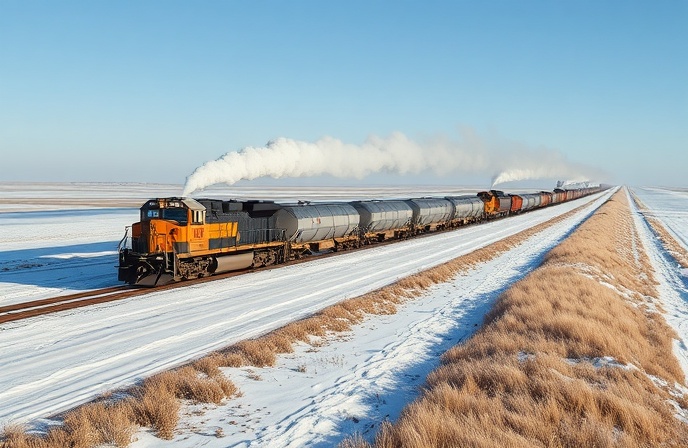
When the temperature drops below zero and the first snowflakes fall, commuters around the world often ask the same question: “Why are the trains delayed by just a little snow?”
Most people assume the problem is simply physical snow blocking the line. However, the real battle is not against the snow itself, but against Physics. It is a battle fought with fire rising from the tracks, blue lightning flashing above the trains, and millions of tons of steel struggling against thermal contraction.
In the industry, this is called “Winterization.” Here is the science behind the burning tracks and the engineering marvels that keep the world moving when “General Winter” attacks.
🔥 1. The Mystery of “Burning Tracks” (Point Heating)
Every winter, photos of “tracks on fire” go viral on social media. While it looks like a disaster scene, it is actually a controlled safety measure essential for railway winterization.
The most vulnerable part of any railway network is the Switch (or Point)—the movable section of track that allows trains to change lines. If ice or compacted snow gets between these moving blades, the switch will freeze solid. A frozen switch means the signaling system cannot verify the route, bringing the entire network to a halt.
To prevent this, engineers use Point Heating Systems:
- Gas Heaters: These run along the rails and ignite to create open flames. This heats the steel directly to melt the ice. This creates those dramatic, cinematic images of “burning railways.”
- Electric Heaters: Similar to the rear window defroster in your car, these are electric strips clipped to the rail to keep the switch warm without open flames.
⚡ 2. Blue Lightning: What Causes Pantograph Arcing?
Have you ever seen bright blue flashes illuminating the night sky as a train speeds past? It looks like a sci-fi movie, but it is a phenomenon known as Pantograph Arcing.
Electric trains draw power from the overhead wires (catenary). In freezing fog or rain, a thin layer of ice coats these wires. Since ice is an excellent electrical insulator, it tries to block the current. However, the train is pulling 25,000 Volts. This massive energy forces its way through the ice layer, ionizing the air and creating a plasma arc. The result is a loud crackling sound and intense blue sparks.
❄️ 3. The Physics of Steel: Why Do Rails Break in Cold?
Basic physics teaches us that heat expands and cold contracts. Railway tracks are no exception. Kilometers of continuous welded rail want to shrink when the temperature plummets. However, because they are securely fastened to the sleepers (ties), they cannot shrink.
This creates immense internal tension within the steel. If the tension becomes too great, the rail can snap at its weakest point, causing a “Rail Break.” Modern signaling systems use track circuits to detect these breaks immediately, turning signals red to stop approaching trains.
🚜 4. The Heavy Artillery: Rotary Snow Ploughs
Sometimes, heaters and chemicals are not enough. When snow drifts reach several meters in height, the railway deploys its “tanks”: The Rotary Snow Ploughs. Unlike a standard wedge plough that pushes snow aside, a Rotary Plough features a massive spinning turbine at the front. It chews through the snowpack and shoots it far away from the tracks.
🚦 Technology Meets the Elements
Keeping the railway running in winter isn’t just about mechanical brute force; it’s about intelligence. Advanced signaling systems are crucial when visibility is low. To understand how these digital brains work, check out our deep dive into the transition from Bombardier to Alstom signaling technologies.
❓ FAQ: Winter on the Rails
Do the fires on the tracks damage the trains?
No. Gas point heaters are designed to heat only the specific section of the rail (the switch points). The flames are kept low and are perfectly safe for trains passing over them.
Do trains have winter tires?
No, trains run on steel wheels. To prevent slipping (wheel spin) on icy rails, trains are equipped with sanders. These automatically spray sand directly onto the rails in front of the wheels to increase traction (adhesion).
How cold is too cold for trains?
Standard trains operate efficiently down to -25°C. However, trains designed for Nordic or Russian climates feature special insulation and heating systems to operate in temperatures as low as -50°C.






