
DB ÖBB Launches ICE 4 Steiermark with Koralmbahn Service
DB and ÖBB named an ICE 4 “Steiermark” train, reducing Graz-Klagenfurt journey time to 41 minutes via the Koralmbahn.
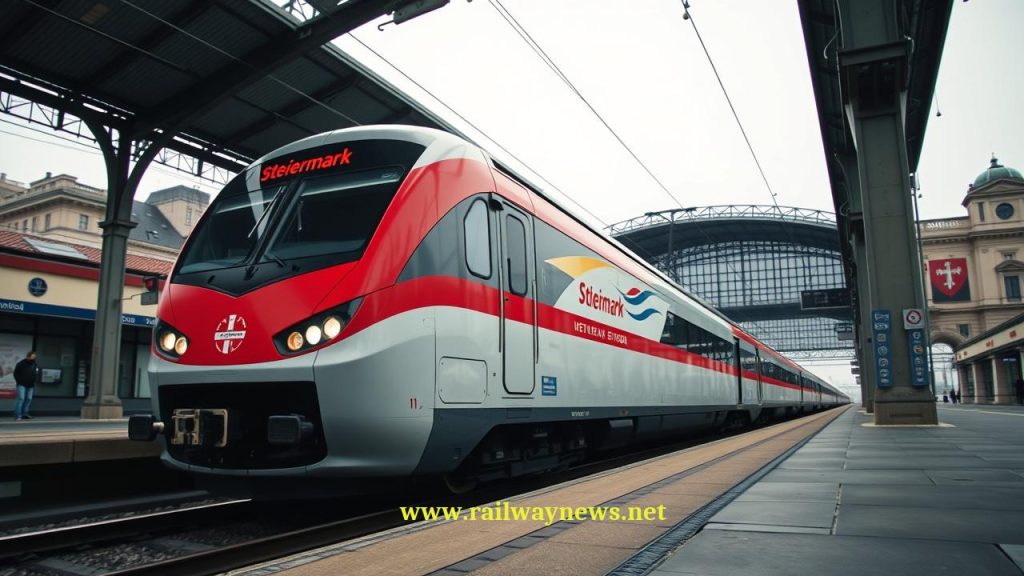
⚡ In Brief: Deutsche Bahn and ÖBB have named an ICE 4 high-speed train “Steiermark” in Graz, Austria, celebrating improved international services enabled by the new Koralmbahn line, which has cut the Graz-Klagenfurt journey time to just 41 minutes.
GRAZ, AUSTRIA – German operator Deutsche Bahn (DB) and Austrian Federal Railways (ÖBB) have officially named an ICE 4 high-speed train “Steiermark” at Graz Central Station. The event highlights enhanced cross-border services, including five daily trains between Graz and Munich with a travel time under 5 hours and 40 minutes. This service improvement is a direct result of the commissioning of sections of the new Koralmbahn high-capacity line.
What Is the Full Scope of This Project?
The project centers on integrating the Austrian state of Styria more closely with the German high-speed network through a symbolic and operational partnership. This involves deploying DB’s ICE 4 trains, which offer a capacity of 444 seats, on the route and leveraging the new Koralmbahn infrastructure to reduce travel times in southern Austria. The naming of the train, which will bear the Styrian coat of arms, serves as a marketing initiative to promote the improved connections between key economic and tourist regions in Austria and Germany.
Key Project Data
| Parameter | Value |
|---|---|
| Project / Contract Name | Graz-Munich ICE Service Enhancement / “Steiermark” Train Naming |
| Total Value | Not disclosed |
| Parties Involved | Deutsche Bahn (DB), Austrian Federal Railways (ÖBB), Province of Styria |
| Timeline / Completion | Service is operational; Koralmbahn full opening set for December 2025 |
| Country / Corridor | Austria / Germany (Graz – Munich) |
How Does This Compare to Similar Projects?
The Koralmbahn, which underpins this service enhancement, is a key component of Austria’s broader high-speed rail investment strategy for 2025. The full line’s opening in December 2025 will improve rail travel not only to Germany but also across Austria and into north-eastern Italy, Slovenia, and Croatia (Source: Travel Weekly, 2025). By comparison, the UK government’s recently updated Infrastructure Pipeline outlines £718 billion in public and private investment to address long-term national needs, highlighting the significant capital required for such strategic upgrades (Source: Railway Pro, 2026).
Editor’s Analysis
This collaboration between DB and ÖBB is a practical application of shifting passenger traffic from road to rail for environmental and efficiency benefits. While the train naming is a marketing exercise, the real substance lies in the Koralmbahn infrastructure investment that enables these faster, more attractive services. The project demonstrates how targeted spending in one corridor can unlock network-wide benefits, a strategy supported by a documented rise in consumer interest in cross-border European rail travel (Source: Eurail, 2025).
FAQ
Q: What is the Koralmbahn?
A: The Koralmbahn is a new 130 km high-capacity railway line in southern Austria connecting the cities of Graz and Klagenfurt. Its full commissioning in December 2025 will significantly cut travel times and improve international connections to Italy and Slovenia.
Q: How many seats does the ICE 4 “Steiermark” train have?
A: The train has a total capacity of 444 seats. This is divided into 77 seats in first class and 367 in second class, and the train is also equipped with four dedicated wheelchair spaces.
Q: Are there other new international routes resulting from this investment trend?
A: Yes, the wider Austrian rail investment has enabled other new direct services, including a Railjet from Vienna to Trieste and reinstated Eurocity trains between Munich and Zagreb. The specific cost for launching these new services has not been disclosed.

Railway infrastructure, rolling stock and transport technologies specialist focused on global rail industry developments, high-speed rail systems, signaling technologies and freight transportation. Covering railway investments, public transport modernization, rail operations and international mobility projects across Europe, Asia and North America.
RELATED POSTS

October 8, 2026 12:18 pm
Siemens Mobility signed an agreement with VinSpeed to supply 350...

October 5, 2026 6:12 pm
AECOM and Jacobs secured a contract in September 2026 to...

October 4, 2026 11:08 pm
Sound Transit confirmed the September 30 opening of Seattle Pinehurst...
October 6, 2026 9:17 am
Illinois approved $1.1M in state funds to upgrade two McHenry...
October 6, 2026 12:16 am
FTA awarded $233 million in grants to eight US rail...

October 5, 2026 3:13 pm
DART launched a 90-day fare enforcement pilot across 5 light-rail...