
Paris Suburban Light Rail Project: Tramway Developments, France
Paris expands its suburban light rail network, boosting commuter services and urban revitalization. New lines and extensions improve connectivity across the Île-de-France region.
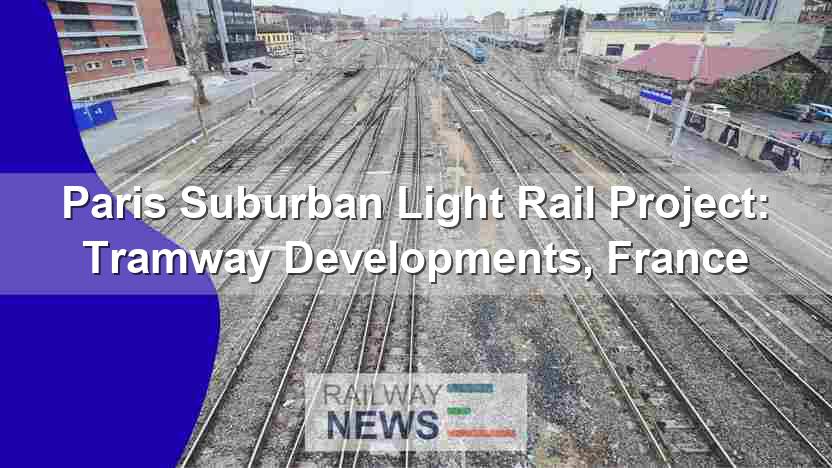
This article explores the significant development and expansion of the Parisian light rail network, focusing on the strategic planning, infrastructure implementation, rolling stock choices, and future expansion plans. The project aims to analyze the evolution of light rail in Paris, highlighting its role in urban revitalization, improved commuter services, and its integration with the existing heavy rail (RER) and metro systems. The analysis will cover the key lines (T1, T2, and T4) examining their individual characteristics, technological choices, and contributions to the overall efficiency and accessibility of the Parisian public transport system. Additionally, the study will investigate the future expansion projects, assessing their potential impact on the city’s transport network and urban development. This detailed overview intends to provide insights into the challenges and successes encountered during the implementation of these significant light rail projects within the context of a major European metropolis.
Evolution of Parisian Light Rail Systems
The inauguration of Line T1 (Tramway 1) in 1992 marked a resurgence of tramways in Paris after a long hiatus. Initially focusing on revitalizing neglected northeastern neighborhoods, T1 served as a proof-of-concept for surface light rail’s urban regeneration capabilities. Unlike T1, Line T2 (Tramway 2) largely utilized pre-existing heavy rail alignments. Its primary aim was service improvement, particularly for the growing La Défense business district, serving primarily established, affluent areas. Line T4 (Tramway 4), similar to T1 and T2, emphasizes orbital routes with RER (Réseau Express Régional – Suburban Express Network) connections at both termini, addressing the high commuter traffic and the limited reach of the Paris Metro in outer districts. The conversion of a heavy rail line between Bondy and Aulnay-sous-Bois RER stations for T4 exemplifies the integration of light rail within the broader Île-de-France regional transportation plan.
Infrastructure and Design Considerations
T1’s initial 9km route, with a subsequent 3km extension, showcases a more traditional tramway infrastructure, featuring tight curves, frequent stops, and intersections with road traffic resulting in comparatively longer journey times. This contrasts with T2 and T4, which leverage existing heavy rail infrastructure, inheriting characteristics like larger station spacing and higher speeds. While these lines underwent modernization for enhanced accessibility, they retained some original structures and track designs. The conversion of existing railway lines for T2 and T4 demonstrates a cost-effective approach to expanding light rail networks, yet it also presented unique engineering and operational challenges due to the inherent differences between light and heavy rail systems.
Rolling Stock and Technological Choices
Initially, T1 and T2 employed the partially low-floor TFS-2 trams (Tramway Français Standard), a second generation of a modern French tram design. Following the discontinuation of the TFS model, T2 was refitted with 100% low-floor Alstom Citadis 302 trams. The entire TFS-2 fleet was eventually transferred to T1. For T4, a two-system (dual voltage) five-unit Siemens Avanto tram-train was selected, capable of operating on both the 750V DC tramway network and the 25kV AC mainline system. This choice reflects a pragmatic approach, leveraging existing infrastructure while allowing for potential future extensions onto conventional tramway lines.
Signalling, Ticketing, and Future Expansions
All three lines utilize line-of-sight signaling principles, with T4 operating under mainline signaling during depot transfers. Tram priority is implemented at intersections with traffic signals. T1-T4 are integrated into the RATP (Régie Autonome des Transports Parisiens – Autonomous Transport Authority of Paris) ‘t+’ ticketing system, ensuring seamless travel across modes. RATP’s multilingual website facilitates cross-modal journey planning. Future expansion plans include extensions to T2 and T1, adding new stations and connections to existing rail lines, improving connectivity and service frequency. A long-term project envisions a “Rocade Grand Tram,” a light rail loop connecting several lines. Additional projects are underway, including guided busways (Bus Rapid Transit systems) integrating into the network, further emphasizing the commitment to a detailed and interconnected public transport strategy.
Conclusions
The development of the Paris suburban light rail network demonstrates a multi-faceted approach to improving urban mobility. The projects showcase various strategies, including the creation of new lines (T1), the repurposing of existing heavy rail infrastructure (T2 and T4), and the strategic integration of different rolling stock technologies to accommodate varied operational requirements. The adoption of tram-trains (T4) reflects an innovative approach to seamlessly connecting light and heavy rail systems, enhancing operational flexibility. The ongoing extensions and the planned “Rocade Grand Tram” project highlight a long-term vision for a detailed and interconnected light rail system, improving access to various neighborhoods and commercial centers. The successful integration of these light rail lines into the existing public transport network, along with the sophisticated ticketing system, underlines the Parisian commitment to building a convenient, efficient, and sustainable urban transportation system. Challenges encountered during implementation, such as the integration of light rail into existing road networks and the need for significant investment, underscore the complexity of large-scale infrastructure projects in densely populated areas. However, the long-term benefits, in terms of improved mobility, environmental sustainability, and urban development, justify the considerable investment and effort devoted to these projects.
The success of these initiatives lies not only in engineering prowess and effective project management but also in the strategic planning and seamless integration into the broader urban landscape. Future considerations should include continued investment in innovative technologies, ongoing maintenance and upgrades, and thorough engagement with community stakeholders to guarantee projects remain aligned with evolving transportation needs and urban development strategies. This case study serves as a valuable example for other cities grappling with the challenges of sustainable urban transport development, highlighting the importance of adaptable strategies and a long-term perspective in planning efficient and user-friendly public transportation systems.
| Line | Type | Length (km) | Stations | Connections | Budget (estimated) |
|---|---|---|---|---|---|
| T1 | Tramway | 13.9 (initial) + ongoing extensions | Numerous (initial) + ongoing extensions | RER Lines D & E, Metro Line 13 | Not specified in provided text |
| T2 | Tramway (partially on former heavy rail) | Initial length + ongoing extensions | Numerous (initial) + ongoing extensions | RER, Transilien lines | Not specified in provided text |
| T4 | Tram-train | Initial length | Initial number + potential future extensions | RER | Not specified in provided text |
Companies Mentioned:
- RATP (Régie Autonome des Transports Parisiens): The main public transport operator in Paris.
- SNCF (Société Nationale des Chemins de fer Français): The national railway company of France.
- Alstom: A major player in the rail industry, supplying rolling stock for T2.
- Siemens: A global technology company that supplied the Avanto tram-trains for T4.

Railway infrastructure, rolling stock and transport technologies specialist focused on global rail industry developments, high-speed rail systems, signaling technologies and freight transportation. Covering railway investments, public transport modernization, rail operations and international mobility projects across Europe, Asia and North America.