
Guardia ETCS: Stadler’s BLS FLIRT Upgrade
Upgrade your railway with Guardia, Stadler’s cutting-edge ETCS solution. Discover how it boosts safety and efficiency for a smoother, safer future!
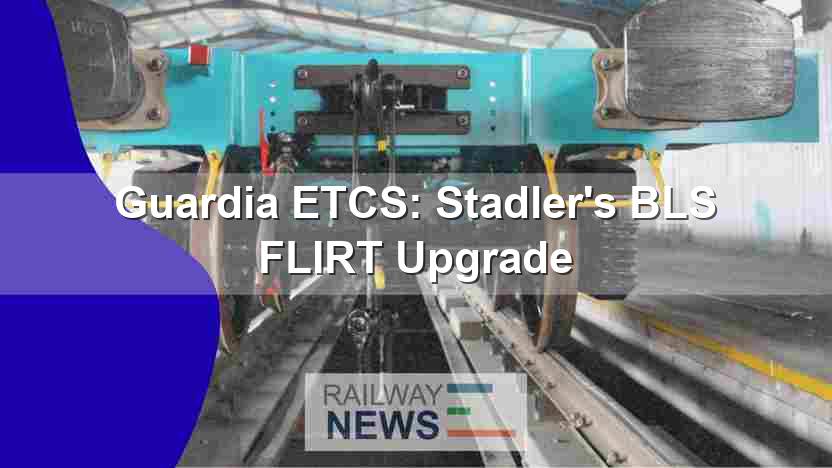
This article explores the integration of Guardia, a cutting-edge European Train Control System (ETCS), into the BLS (Bern-Lötschberg-Simplon) railway company’s fleet of FLIRT (Fast Light Innovative Regional Train) trains. The implementation of Guardia represents a significant advancement in railway safety and operational efficiency for BLS, showcasing Stadler’s commitment to developing independent signaling solutions. The adoption of this system signifies a pivotal shift towards digitalization in the Swiss railway sector and provides a case study for other railway operators considering similar upgrades. We will examine the technical aspects of Guardia, its benefits for BLS, and the broader implications of its deployment for the future of railway technology in Europe. The discussion will cover the system’s functionalities, the approval process, and the projected timeline for its full integration into the BLS network.
Guardia: A New Era in ETCS Technology
Guardia, developed by Stadler and its joint venture Angelstar (a partnership with Mermec), is a state-of-the-art ETCS (European Train Control System) designed to enhance train safety and operational efficiency. Unlike traditional signaling systems that rely on trackside infrastructure, ETCS leverages digital communication (GSM-R (Global System for Mobile Communications – Railway)) between the train and a Radio Block Centre (RBC). This allows for more flexible train control and increased line capacity. Guardia provides real-time data visualization for drivers, including vehicle position, speed, and other crucial parameters, enhancing situational awareness and contributing to preventative safety measures. This data is also relayed to the central control center, facilitating improved monitoring and management of the railway network.
Benefits for BLS and the Swiss Railway Network
The adoption of Guardia by BLS offers several key advantages. Firstly, it significantly enhances safety by providing an advanced automatic train protection (ATP) system meeting the stringent SIL4 (Safety Integrity Level 4) standard. This level ensures an extremely low probability of system failure, maximizing the safety of passengers and crew. Secondly, Guardia optimizes operational efficiency. By enabling more precise train control, it allows for improved scheduling, reduced delays, and increased vehicle availability. The system’s digital nature also contributes to lower annual system operating costs compared to traditional systems. Finally, the implementation of ETCS level 2 (SRS 3.4.0) using GSM-R technology positions BLS at the forefront of modern railway technology, paving the way for seamless interoperability with other European railway systems using the same standard.
Stadler’s Strategic Investment in Signaling Technology
Stadler’s investment in the development of Guardia demonstrates a strategic commitment to expanding its capabilities beyond train manufacturing. By developing its own signaling solutions, Stadler secures its independence and strengthens its position in the railway industry. The establishment of a dedicated engineering facility in Wallisellen, Switzerland, underlines the company’s long-term commitment to innovation in this field. The creation of Angelstar further underscores Stadler’s dedication to providing detailed railway solutions, integrating train manufacturing with advanced signaling technologies.
Deployment and Future Outlook
BLS has ordered 52 FLIRT trains, with an option for 90 more, to be equipped with Guardia. The system is currently undergoing field tests and the approval process in Switzerland. Simultaneous launches are planned in other European countries, highlighting the system’s adaptability and international potential. Approval testing will commence in 2019, with the trains gradually entering service between 2021 and 2025. The successful integration of Guardia into the BLS network will not only modernize its operations but also serve as a blueprint for other railway operators looking to adopt advanced ETCS solutions, showcasing the benefits of a holistic approach to railway technology that integrates train manufacturing and signaling systems.
Conclusion
The introduction of Guardia on BLS’s FLIRT trains marks a substantial step forward in railway technology. This advanced ETCS system, developed by Stadler and Angelstar, offers significant improvements in safety, operational efficiency, and cost-effectiveness. The system’s adoption by BLS demonstrates a forward-thinking approach to railway modernization and underscores the increasing importance of digitalization in the industry. The successful implementation of Guardia will not only benefit BLS through enhanced safety and efficiency but also serve as a compelling example for other railway operators across Europe considering similar upgrades. The long-term implications are significant, potentially leading to increased interoperability, improved network capacity, and a safer, more efficient railway system. Stadler’s strategic investment in signaling technology positions them as a leader in providing integrated solutions for the modern railway industry, fostering a future where advanced train control systems are the norm, not the exception. The phased rollout from 2021 to 2025 ensures a manageable transition, minimizing disruption to services while maximizing the benefits of this innovative technology. The success of this project will undoubtedly influence the adoption of similar ETCS solutions globally, contributing to a safer and more efficient future for rail transport worldwide.

Railway infrastructure, rolling stock and transport technologies specialist focused on global rail industry developments, high-speed rail systems, signaling technologies and freight transportation. Covering railway investments, public transport modernization, rail operations and international mobility projects across Europe, Asia and North America.
RELATED POSTS

October 8, 2026 1:15 pm
Alstom secured a €1bn contract to build 13 automated trains,...

October 1, 2026 7:09 am
United States regulators confirmed a September 30 deadline for the...

October 4, 2026 5:14 pm
Alstom secured a CA$4.7 billion order from VIA Rail Canada...

October 5, 2026 6:12 pm
AECOM and Jacobs secured a contract in September 2026 to...

October 1, 2026 12:13 am
Illinois approved $1.5 billion annually for the Northern Illinois Transit...

October 4, 2026 11:08 pm
Sound Transit confirmed the September 30 opening of Seattle Pinehurst...