
Europe’s EN 13715: Standardizing Rail Wheel Profiles for Safety
EN 13715 standardizes railway wheel profiles for critical safety, stability, and wear management. This European standard ensures seamless interoperability across the network.
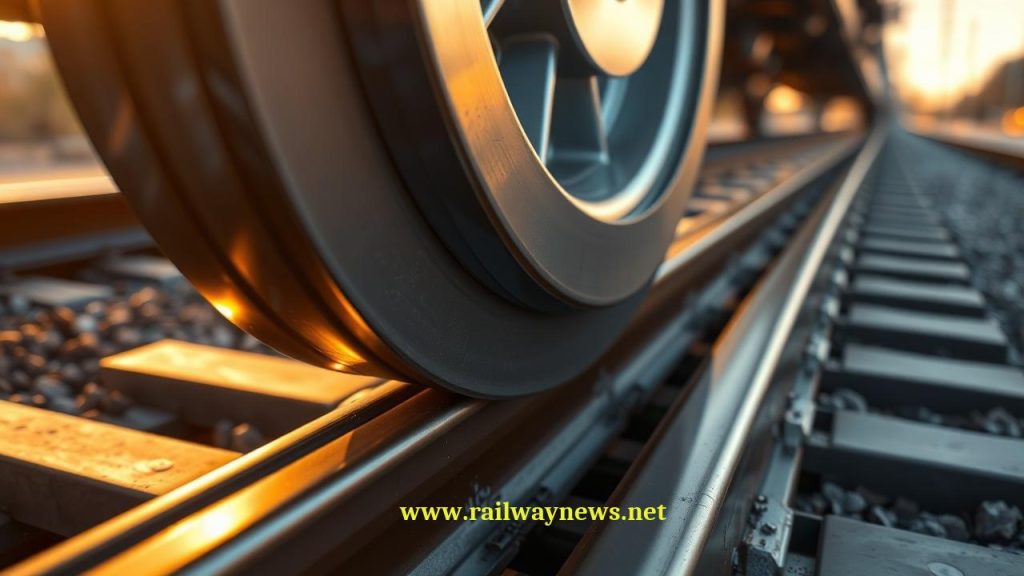
What is EN 13715: Railway Wheel Tread Profiles?
EN 13715 is a critical European standard that defines the geometric requirements for the tread profile of wheels used in railway applications. The standard specifies the shape, dimensions, and tolerances of the wheel’s running surface and flange, which together form the wheel-rail interface. This interface is fundamental to the safe, stable, and efficient operation of any rail vehicle.
The primary goal of EN 13715 is to ensure technical compatibility and interoperability between vehicles and infrastructure across the European railway network. By standardizing the wheel profile, the standard facilitates consistent dynamic behavior, predictable wear patterns, and reliable guidance through switches and crossings.
The Core Principles and Importance of the Tread Profile
The wheel tread profile is not merely a simple shape; it is an engineered surface designed to perform several crucial functions simultaneously. The principles governed by EN 13715 are vital for overall railway system performance.
- Vehicle Guidance and Stability: The conical shape of the wheel tread, known as conicity, provides a self-centering action on the track. This inherent steering capability is essential for negotiating curves smoothly and maintaining stability at high speeds, preventing a phenomenon known as “hunting oscillation.”
- Wear Management: An optimized profile, as defined by the standard, distributes contact stresses evenly across the wheel and rail. This minimizes localized wear, reduces the frequency of re-profiling (maintenance), and extends the service life of both components.
- Safety and Derailment Prevention: The wheel flange is the ultimate safety feature, preventing the wheel from climbing over the rail. EN 13715 strictly defines the flange height, thickness, and angle (flange gradient) to ensure it provides effective guidance without causing excessive wear or risk of derailment at turnouts.
- Operational Performance: A compliant tread profile contributes to lower rolling resistance, reduced noise generation, and improved passenger comfort by ensuring a smooth and stable ride.
Key Technical Specifications of EN 13715
The standard is highly technical, providing precise geometric definitions and parameters that must be met during wheel manufacturing and maintenance.
Profile Geometry Explained
The wheel tread profile is a complex curve composed of several distinct regions, each with a specific purpose:
- Flange: The inner part of the wheel that provides lateral guidance against the rail head. Its key features are the flange tip, flange face, and the root fillet radius connecting it to the tread.
- Tread: The primary running surface of the wheel that makes contact with the rail head during tangent (straight) track operation. Its conical shape is a defining characteristic.
- Fillet Radius (Root Radius): The smooth, curved transition between the flange face and the tread. This area is critical for stress distribution and navigating through switches. A poorly designed fillet can lead to high contact stresses and premature failure.
- Chamfer: The outer edge of the wheel, which typically does not contact the rail under normal conditions but is shaped to prevent damage to trackside equipment.
Critical Parameters Defined by the Standard
EN 13715 specifies a set of symbols and values for key profile dimensions to ensure uniformity. The most important of these include:
- Sh (Flange Height): The vertical distance from the tread circle (nominal rolling diameter) to the tip of the flange.
- Sd (Flange Thickness): The horizontal thickness of the flange, measured at a specific height from the tread circle.
- qR (Flange Gradient): The steepness or angle of the active face of the flange, which is critical for steering action in curves.
- AR (Rim Width): The total width of the wheel rim.
- Equivalent Conicity: While not a single dimension, this is a critical performance parameter derived from the profile’s geometry. It describes the wheelset’s steering capability and is a key indicator of dynamic stability. The standard’s profiles are designed to maintain an optimal equivalent conicity when interacting with standard rail profiles.
Standard Reference Profiles: S1002 and P8
While EN 13715 provides a framework for defining profiles, it also references specific, widely adopted profiles. The most common of these is the S1002 profile, which is harmonized with UIC (International Union of Railways) standards. A comparison with an older or alternative profile like the P8 illustrates the evolution and application-specific nature of tread designs.
| Feature | S1002 Profile | P8 Profile |
|---|---|---|
| Primary Application | General purpose for mainline passenger and freight traffic. Widely used in Europe for interoperable rolling stock (high-speed, conventional). | An older profile, often found on freight wagons and specific national networks. Less common for new-build interoperable vehicles. |
| Profile Characteristics | A ‘worn’ profile design, meaning its shape mimics a naturally worn wheel. This provides stable contact from the outset and a consistent equivalent conicity over its service life. | A more traditional ‘new’ profile design with simpler geometric sections. Its performance characteristics can change more significantly as it wears. |
| Flange Geometry | Optimized flange root radius and gradient (qR) for modern infrastructure, reducing wear in switches and crossings. | Features a generally simpler flange geometry that may be less optimized for high-speed operation and modern track components. |
| Performance Focus | Balanced performance between stability on tangent track and good curving behavior. Designed for low wear and long maintenance intervals. | Primarily focused on robust guidance, especially for lower-speed, heavy-axle-load freight applications. |
Role in European Railway Interoperability
EN 13715 is a harmonized standard, meaning it is officially recognized by the European Union to support the Technical Specifications for Interoperability (TSIs). Specifically, it is referenced in the TSI for ‘Rolling Stock’ (RST) and is essential for any manufacturer or operator wishing to have their vehicles certified for use across different European countries. Adherence to this standard guarantees that a vehicle’s wheels will be geometrically compatible with the vast majority of European rail infrastructure, a cornerstone of creating a seamless, integrated railway network.

Railway infrastructure, rolling stock and transport technologies specialist focused on global rail industry developments, high-speed rail systems, signaling technologies and freight transportation. Covering railway investments, public transport modernization, rail operations and international mobility projects across Europe, Asia and North America.