
CPKC Gulf Grain Haulage: STB Upholds Rail Competition
STB affirms Canadian Pacific’s grain haulage rights, boosting Gulf Coast competition. Decision ensures competitive shipping options for farmers.
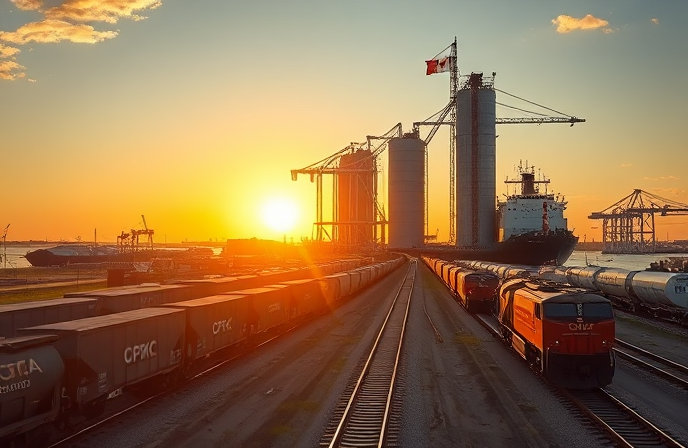
STB Upholds Haulage Rights, Bolstering Grain Competition in the Gulf
In a decision crucial for the grain transportation sector, the Surface Transportation Board (STB) confirmed yesterday that Canadian Pacific Kansas City (CPKC), formerly Kansas City Southern Railway Co. (KCSR), can continue utilizing haulage rights to move grain over Union Pacific Railroad (UP) tracks between Beaumont, Texas, and the strategically vital ports of Houston and Galveston. This ruling, made effective immediately, ensures shippers maintain competitive options for transporting grain through Kansas City, Missouri, to the Gulf Coast. The STB, a U.S. government agency responsible for regulating the freight rail industry, upheld rights originally established in 1988 by its predecessor, the Interstate Commerce Commission (ICC). The decision, announced in a press release, is vital because it reaffirms existing operational agreements and fosters a competitive environment within the critical grain supply chain. This article explores the specifics of the STB’s ruling, its origins, and its implications for the rail industry.
The Genesis of Competitive Rail Access
The history of these haulage rights is deeply rooted in the 1988 merger of Union Pacific and the Missouri-Kansas-Texas Railroad Co. (MKT). In approving this merger, the ICC mandated that UP negotiate with KCSR certain haulage rights, eventually convertible to trackage rights, over UP’s rail lines between Beaumont and the Gulf ports. This measure, known as the “South End rights,” was implemented to protect competitive options for grain shippers. This agreement was made a condition of the UP-MKT merger, underscoring the regulatory body’s commitment to preventing monopolies and promoting fair market access within the rail industry. This proactive stance ensured that KCSR (now CPKC) could continue to compete effectively, preventing a single carrier from dominating the transport of grain from the Midwest to the Gulf Coast ports.
Understanding Haulage Rights and Their Significance
Haulage rights differ from trackage rights, as they allow a carrier to utilize another railroad’s tracks, but the owning railroad operates the train. In this scenario, KCSR (CPKC) pays UP for the use of its tracks, while KCSR (CPKC) provides the locomotives, crew and owns the cargo. Trackage rights, on the other hand, grant a carrier the right to operate its own trains on another railroad’s tracks. The preservation of haulage rights for CPKC is critical because it allows the railway to maintain control over the transportation of grain, ensuring service flexibility and competitive pricing for shippers. These rights offer KCSR access to crucial ports, preserving access to the Gulf and therefore maintain their competitive edge. The STB’s recent decision emphasizes the importance of these existing agreements in supporting competition and preventing potential bottlenecks in grain transport.
The Impact on Grain Shippers and the Supply Chain
The confirmation of CPKC’s haulage rights has a direct positive impact on grain shippers. By maintaining competitive options, shippers can negotiate more favorable rates and service levels, decreasing transportation costs. The ruling facilitates more efficient transportation routes, improving overall supply chain performance. This benefits farmers and agricultural businesses, who rely on timely and cost-effective transport to market their grain. Additionally, enhanced competition encourages both UP and CPKC to continually optimize their service, investing in infrastructure and implementing operational efficiencies. This commitment to improvements benefits the entire industry and the end user, allowing them to maintain their competitive edge.
Company Summary
Canadian Pacific Kansas City (CPKC) is a major North American rail carrier. It operates a rail network that connects ports and markets across Canada, the United States, and Mexico. CPKC is known for its efficient operations and innovative approaches to freight transportation, particularly in the grain and intermodal sectors. Union Pacific Railroad (UP) is one of the largest freight railroad networks in North America. It operates in the western two-thirds of the United States, serving ports, industrial areas, and agricultural regions. UP plays a critical role in the transportation of a wide range of commodities.
Conclusion
The Surface Transportation Board’s decision to uphold CPKC’s haulage rights on the Gulf Coast is a crucial victory for competition within the rail industry and a win for grain shippers across the Midwest. This ruling reinforces the importance of regulatory oversight in preventing monopolistic practices and ensuring fair market access. The STB’s actions effectively safeguard against potential market dominance by a single carrier. The ability to compete effectively on price and service is crucial in the grain industry, a major contributor to the North American economy, as well as its ability to sustain its long-term growth. Looking ahead, this decision could have further implications for other haulage agreements across the country. It reinforces the importance of preserving competitive options within the rail sector. The ruling underscores the need for continued monitoring and enforcement of competitive practices to ensure the efficient and cost-effective movement of goods, particularly those vital to the agricultural sector, that are moved by rail.

Railway infrastructure, rolling stock and transport technologies specialist focused on global rail industry developments, high-speed rail systems, signaling technologies and freight transportation. Covering railway investments, public transport modernization, rail operations and international mobility projects across Europe, Asia and North America.
RELATED POSTS

October 1, 2026 7:09 am
United States regulators confirmed a September 30 deadline for the...

October 8, 2026 1:15 pm
Alstom secured a €1bn contract to build 13 automated trains,...

October 4, 2026 5:14 pm
Alstom secured a CA$4.7 billion order from VIA Rail Canada...

October 8, 2026 12:18 pm
Siemens Mobility signed an agreement with VinSpeed to supply 350...

October 1, 2026 12:13 am
Illinois approved $1.5 billion annually for the Northern Illinois Transit...
October 6, 2026 2:14 am
Union Pacific launched export rail shipments with Ferromex to deliver...