
Amtrak Borealis Service Reports 416,000 Riders Chicago St Paul
Amtrak’s Borealis service launched May 2024 and transported over 416,000 passengers between Chicago and St. Paul, exceeding initial projections by 36 percent.
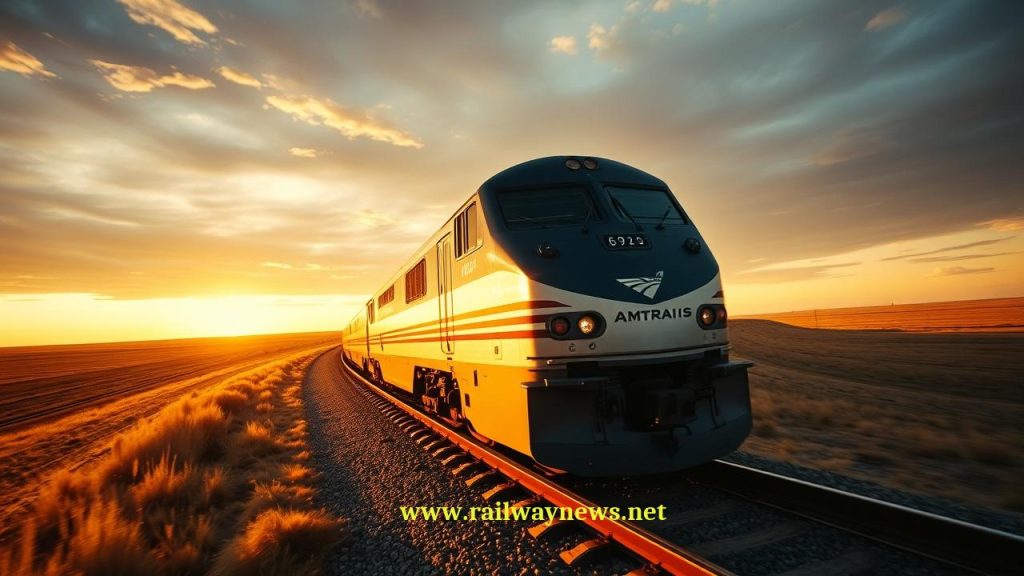
⚡ In Brief: Amtrak’s Borealis passenger rail line, connecting Chicago and St. Paul, has surpassed 416,000 riders since its 2024 launch, outperforming initial annual feasibility projections by more than 36 percent in its first year.
ST. PAUL, United States – Amtrak’s newly established Borealis passenger rail service has transported more than 416,000 passengers along the Chicago-to-Twin Cities corridor since its launch in May 2024. The line’s first-year ridership reached 212,000 passengers, significantly exceeding the original 2015 feasibility study projection of 155,000 annual riders. This surge has elevated total annual ridership across the wider Chicago-Milwaukee-St. Paul corridor to approximately 1.8 million passengers.
What Is the Full Scope of This Project?
The Borealis service project adds a second daily round-trip passenger rail connection between Chicago, Illinois, and St. Paul, Minnesota, complementing the pre-existing long-distance Empire Builder route. Operating on tracks owned by host railroad Canadian Pacific Kansas City (CPKC), the service departs St. Paul at midday and Chicago in the late morning, with intermediate stops including Milwaukee, Wisconsin. This service expansion leverages the existing Hiawatha corridor infrastructure, which already provides multiple daily round-trips between Chicago and Milwaukee. To support broader regional modernization, Amtrak is also introducing new Siemens-built “Airo” trainsets to its Pacific Northwest Cascades line for testing in late 2025, indicating a broader fleet overhaul that may eventually benefit Midwestern corridors.
Key Project Data
| Parameter | Value |
|---|---|
| Project / Contract Name | Amtrak Borealis Service Expansion |
| Total Value | Not disclosed |
| Parties Involved | Amtrak, Federal Railroad Administration (FRA), Wisconsin Department of Transportation, Minnesota Department of Transportation, Illinois Department of Transportation, Canadian Pacific Kansas City (CPKC) |
| Timeline / Completion | Service launched May 2024; corridor ridership updated through late 2025 |
| Country / Corridor | United States / Chicago-Milwaukee-St. Paul Corridor |
How Does This Compare to Similar Projects?
Mid-distance corridor expansions in the United States face divergent funding environments compared to high-speed rail projects. While the Borealis line achieved immediate ridership success using existing freight infrastructure, the California High-Speed Rail project continues to face severe delivery hurdles, including a $4 billion federal funding reduction and rising estimated costs (Source: Construction Dive, 2025). On a legislative level, a $580 billion surface transportation bill approved by a US House committee guarantees substantial funding for Amtrak’s conventional national network but explicitly prohibits federal grants to California’s high-speed initiative for two years (Source: US House Committee, 2025). Globally, the ridership growth on the Chicago-St. Paul corridor mirrors trends in Europe, where cross-border routes like Munich–Zurich and Frankfurt–Paris have experienced double-digit passenger increases driven by expanded frequencies (Source: Tourism Review, 2025).
Editor’s Analysis
The rapid success of the Borealis service demonstrates that incremental frequency additions on established regional corridors yield higher immediate return on investment than capital-intensive greenfield projects. This model of state-supported, multi-frequency regional service is becoming the primary driver of Amtrak’s ridership recovery, especially as federal policy shifts toward funding proven conventional routes over speculative high-speed infrastructure (Source: Construction Dive, 2025). Consequently, operators are likely to prioritize low-cost track-sharing agreements with freight railroads to quickly expand capacity in dense midwestern and coastal corridors.
FAQ
Q: What is the current ridership of the Amtrak Borealis line?
A: The Borealis line has carried over 416,000 passengers since its launch in May 2024. This performance represents a significant increase over the 155,000 annual passengers originally projected in a 2015 feasibility study.
Q: When will the new Amtrak Cascades Airo trains begin service?
A: The new Amtrak Cascades Airo trainsets are scheduled to arrive in Seattle for testing with the goal of entering revenue service as early as autumn 2025. This deployment is part of Amtrak’s broader fleet modernization initiative.
Q: What was the total capital cost to launch the Borealis service?
A: The exact capital costs and track-access fee agreements between Amtrak and host railroad CPKC were not publicly disclosed. However, the service relies heavily on pre-existing infrastructure along the Hiawatha and Empire Builder routes.

Railway infrastructure, rolling stock and transport technologies specialist focused on global rail industry developments, high-speed rail systems, signaling technologies and freight transportation. Covering railway investments, public transport modernization, rail operations and international mobility projects across Europe, Asia and North America.
RELATED POSTS

October 8, 2026 1:15 pm
Alstom secured a €1bn contract to build 13 automated trains,...

October 1, 2026 7:09 am
United States regulators confirmed a September 30 deadline for the...

October 8, 2026 12:18 pm
Siemens Mobility signed an agreement with VinSpeed to supply 350...

October 4, 2026 5:14 pm
Alstom secured a CA$4.7 billion order from VIA Rail Canada...

October 5, 2026 6:12 pm
AECOM and Jacobs secured a contract in September 2026 to...

October 1, 2026 12:13 am
Illinois approved $1.5 billion annually for the Northern Illinois Transit...