
China’s 600km/h Maglev: A New Era of Rail Travel
China’s 600 km/h maglev train by CRRC SRI: novel braking system, articulated coupler, 5G & wireless charging. 6-month testing, 1000 km/h line planned.
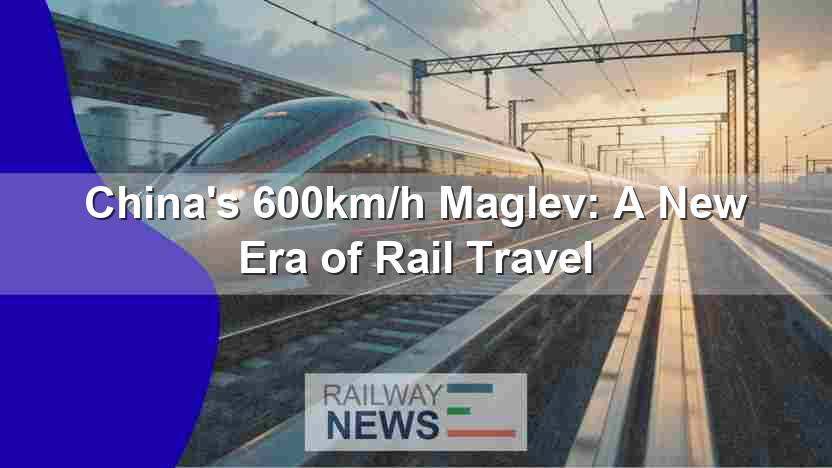
This article focuses into the groundbreaking advancements in high-speed Maglev (magnetic levitation) train technology achieved by China. Specifically, we will examine the recently unveiled 600 km/h Maglev train, a system touted as the world’s fastest. This technological leap represents a significant stride in rail transportation, promising dramatically reduced travel times and enhanced passenger comfort. We will explore the key technological innovations incorporated into this system, focusing on its braking system, power supply, coupling mechanisms, and environmental considerations. The development and testing phases will also be examined, highlighting the rigorous process involved in bringing such a complex system to fruition. Additionally, the article will discuss the broader implications of this advancement for the future of high-speed rail and its potential impact on global transportation networks. The integration of cutting-edge technologies such as 5G connectivity and wireless charging further emphasizes the advanced nature of this project and positions China as a leader in this field.
High-Speed Maglev Train Technology
The 600 km/h Maglev train, developed by CRRC Qingdao Sifang Rolling Stock Research Institute (CRRC SRI), represents a significant achievement in Maglev technology. The train’s ability to reach such high speeds is a result of several key technological innovations. Crucially, the development of a novel braking system, utilizing magnetic poles for whirlpool brakes, allows for safe and reliable deceleration even at extremely high velocities. These magnetic poles, capable of withstanding temperatures ranging from -25°C to 170°C, are also designed for recyclability, addressing environmental concerns. The system’s effectiveness has been rigorously tested and optimized over a six-month period, ensuring its reliability and safety.
Power Supply and Train Control Systems
Powering such a high-speed train presents unique challenges. The 600 km/h Maglev train employs a sophisticated power supply system that seamlessly transitions between contact and non-contact power modes depending on speed. Below 100 km/h, a contact power supply is used, while above this threshold, the system switches to a non-contact power supply, ensuring continuous operation. This intricate power management system, combined with a robust train receiver system, provides reliable power even under varying environmental conditions, with operational temperature ranges from -25°C to 45°C, demonstrating excellent environmental adaptability.
Coupling and Passenger Amenities
The design of the train’s coupler is another notable achievement. CRRC SRI engineers developed an articulated coupler utilizing forged aluminum alloys. This design minimizes relative motion between carriages to less than 1 mm, crucial for maintaining stability and passenger comfort at high speeds. The compact design, measuring only 280 mm in length and weighing under 30 kg, meets the stringent spatial requirements of the Maglev train. The passenger experience is further enhanced by features such as 5G connectivity for Wi-Fi access and wireless charging options, providing modern conveniences during travel.
Development and Testing
The development of the 600 km/h Maglev train was a multi-year endeavor. Initiated in October 2016, a prototype was completed by 2019, followed by extensive testing in 2020. The final technical specifications were finalized in January following optimization efforts, and the complete system underwent a rigorous six-month testing period before being deemed operational. This rigorous approach to testing and optimization underscores China’s commitment to safety and reliability in high-speed rail technology. Additionally, the parallel development of a test line in Shanxi Province designed to accommodate even faster 1000 km/h Maglev trains demonstrates China’s ambitious vision for the future of high-speed rail.
Conclusions
The unveiling of China’s 600 km/h Maglev train marks a significant milestone in high-speed rail technology. This achievement, a testament to extensive research and development efforts by CRRC SRI, showcases remarkable innovations in braking systems, power supply, and coupling mechanisms. The train’s ability to operate safely and reliably at such high speeds, combined with advanced passenger amenities like 5G connectivity and wireless charging, significantly enhances the overall travel experience. The rigorous testing and optimization process, spanning several years and culminating in a six-month trial run, underscores a commitment to safety and reliability. The development of this technology also presents substantial economic benefits, by potentially reducing travel times between major cities significantly. The project’s success further positions China at the forefront of Maglev technology, setting a new benchmark for future high-speed rail development worldwide. This advancement, beyond its immediate impact, signals a future where long-distance travel is faster, more comfortable, and environmentally more responsible. The ongoing development of even faster 1000 km/h Maglev trains suggests a continued pursuit of excellence and innovation in this critical sector, promising even more remarkable developments in the years to come. The focus on sustainability through the use of recyclable materials and efficient power systems also highlights the integration of environmental considerations into this ambitious technological endeavor. To summarize, the 600 km/h Maglev train represents a powerful demonstration of China’s technological prowess and its dedication to advancing rail transportation into a new era of speed and efficiency.

Transport and railway industry editor covering global rail infrastructure, sustainable mobility, urban transit systems and next-generation railway technologies with a focus on accessible and industry-focused reporting.
RELATED POSTS

October 1, 2026 7:09 am
United States regulators confirmed a September 30 deadline for the...

October 8, 2026 1:15 pm
Alstom secured a €1bn contract to build 13 automated trains,...

October 4, 2026 5:14 pm
Alstom secured a CA$4.7 billion order from VIA Rail Canada...
October 1, 2026 10:14 am
HS2 installed a 55-metre steel span in Birmingham, completing phase...

October 4, 2026 11:08 pm
Sound Transit confirmed the September 30 opening of Seattle Pinehurst...

October 5, 2026 6:12 pm
AECOM and Jacobs secured a contract in September 2026 to...