Table of Contents
- 1. Why Remote Access Is Important in Railway Operations
- 2. Where Remote Access Is Used in Railway Systems
- 3. Main Cybersecurity Risks of Railway Remote Access
- 4. Secure Remote Access Architecture
- 5. Identity, Authentication and Privileged Access
- 6. Managing Manufacturers and Third-Party Maintenance Providers
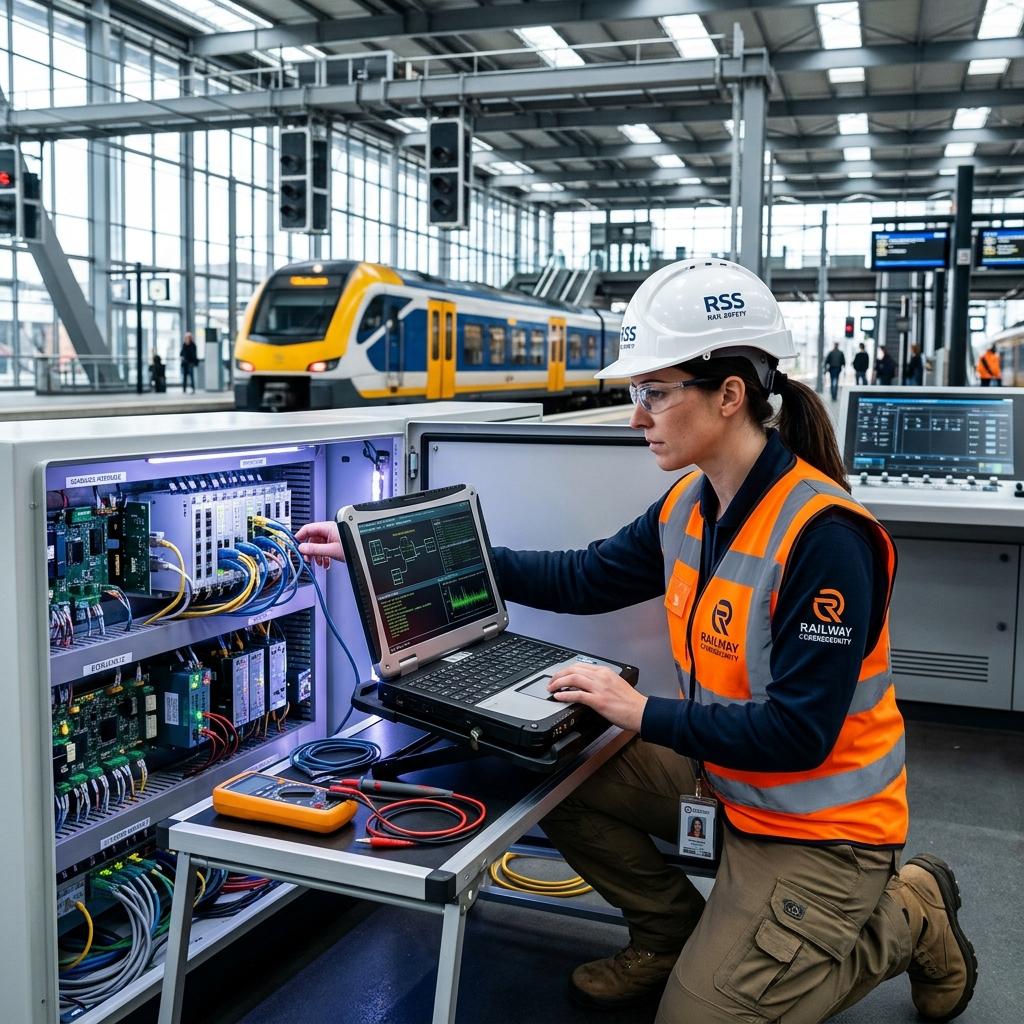
- 7. Secure Remote Maintenance Procedures
- 8. Session Monitoring, Logging and Detection
- 9. Legacy Railway Systems and Compensating Controls
- 10. Remote Access and Railway Functional Safety
- 11. Standards and Cybersecurity Guidelines
- 12. Practical Implementation Roadmap
- 13. Common Remote Access Security Mistakes
- 14. The Future of Remote Maintenance Security
- 15. Frequently Asked Questions
- 16. Conclusion
- References
1. Why Remote Access Is Important in Railway Operations
Modern railway systems depend on geographically distributed infrastructure and increasingly connected equipment. Signalling installations, telecommunications networks, traction power systems, train control equipment, stations and rolling stock may be spread across hundreds or thousands of kilometres. Maintaining these assets often requires technical specialists to diagnose faults and support equipment without travelling to the installation site.
Remote access can reduce maintenance response times, support specialist engineering teams and improve equipment availability. A manufacturer may need to investigate a software fault in an onboard train control system. A signalling supplier may assist an infrastructure manager with a configuration issue. An energy systems contractor may need to examine a traction power substation controller.
However, every remote connection introduces a potential pathway between an external device or network and railway infrastructure. If credentials are compromised, a maintenance workstation is infected or a remote access gateway is misconfigured, an attacker may attempt to move beyond the intended maintenance environment.
The objective is therefore not to eliminate all remote access. It is to ensure that every connection is justified, authorised, limited, monitored and terminated when the task is complete.
2. Where Remote Access Is Used in Railway Systems
Remote access is used across several railway engineering and operational domains. The level of risk depends on the function of the equipment, its connectivity, the permissions granted and the potential consequences of unauthorised activity.
| Railway domain | Typical remote access activities | Security considerations |
|---|---|---|
| Signalling and train control | Diagnostics, configuration review, software maintenance and technical support | Strict access restrictions, change approval and protection of safety-related functions |
| ETCS infrastructure | Diagnostics and maintenance support for relevant trackside equipment and associated systems | Controlled access to engineering and maintenance interfaces |
| CBTC and metro systems | System diagnostics, software support and maintenance of control infrastructure | Separation of maintenance access from operational control functions |
| Rolling stock | Remote diagnostics, fleet monitoring and troubleshooting of onboard equipment | Protection of onboard networks and controlled access to train systems |
| TCMS | Analysis of train control and monitoring data, fault investigation and software support | Role-based access and separation between diagnostic and control functions |
| Railway SCADA | Monitoring and maintenance of traction power, substations, ventilation and station infrastructure | Industrial network segmentation and restrictions on remote commands |
| Telecommunications | Network configuration, performance monitoring and equipment maintenance | Secure administration of network devices and management interfaces |
| Stations and depots | Maintenance of CCTV, access control, passenger information and building management systems | Separation of business, passenger and operational networks |
Remote access requirements should be determined individually for each system. Access to a passenger information display does not carry the same operational consequences as access to a signalling engineering workstation or a traction power control system.
For further technical background, see Railway OT Cybersecurity, Railway Cybersecurity Architecture and The Role of SCADA in Railway Infrastructure.
3. Main Cybersecurity Risks of Railway Remote Access
3.1 Compromised credentials
Stolen usernames, passwords, authentication tokens or session credentials can allow unauthorised individuals to use legitimate remote access services. Phishing, password reuse, credential theft and compromised contractor accounts are common ways in which attackers may obtain access.
3.2 Permanently enabled vendor connections
Some maintenance arrangements rely on persistent VPN connections or supplier accounts that remain active even when no maintenance work is being performed. These connections increase the period during which an attacker may exploit compromised credentials or vulnerable remote access software.
3.3 Insecure remote access software
Remote desktop applications, support tools and third-party access platforms can become attack vectors when they are poorly configured, outdated or exposed directly to external networks. Legitimate remote administration software can also be misused by attackers who have gained access to an organisation.
3.4 Compromised maintenance devices
Engineering laptops, diagnostic computers and portable maintenance devices may connect to several systems and locations. If a device is infected outside the railway environment, it may introduce malicious software or compromised credentials when connected to railway equipment.
3.5 Excessive privileges
A maintenance engineer may need to read diagnostic data but should not necessarily have permission to modify system configurations. Providing broad administrative privileges increases the potential impact of mistakes, compromised accounts or malicious activity.
3.6 Uncontrolled third-party access
Railway operators frequently depend on manufacturers, system integrators and specialist contractors. If an organisation cannot identify which external parties have access, which systems they can reach and how their sessions are monitored, it may have limited visibility over a significant part of its operational environment.
3.7 Unmonitored maintenance sessions
A remote session that is not recorded or monitored can make it difficult to determine which actions were performed, whether an authorised engineer made a configuration change or whether an account was misused.
4. Secure Remote Access Architecture
Remote access should be designed as a controlled pathway rather than a direct connection from the internet or a supplier network to a railway operational asset.
4.1 Network segmentation
Railway IT and OT environments should be separated according to operational function and risk. External connections should not bypass the security boundaries protecting critical railway systems.
Network segmentation limits the systems that a remote user can reach and reduces the possibility of lateral movement if an account or device is compromised. The architecture should define security zones, communication paths and the controls applied between them.
4.2 Industrial demilitarised zone
An industrial demilitarised zone (IDMZ) provides a controlled boundary between enterprise networks, external connections and operational technology environments. Remote maintenance traffic can be routed through security gateways and approved intermediary systems rather than being allowed to connect directly to control equipment.
4.3 Jump servers and bastion hosts
A jump server, also known as a bastion host, is a hardened intermediary system used to control access to protected network environments. Remote engineers first authenticate to the approved gateway and then access only the systems authorised for their task.
In an appropriate architecture, jump servers should:
- Be located in a dedicated, controlled network segment.
- Require strong authentication, including multi-factor authentication.
- Restrict access to approved destinations and protocols.
- Record privileged activities and session information.
- Be regularly patched and hardened.
- Disconnect or suspend inactive sessions.
- Prevent unnecessary file transfers, clipboard sharing and drive redirection.
4.4 VPN and secure communication channels
Virtual private networks can protect communications between remote users and railway networks through encryption and authentication. However, a VPN alone does not provide complete security. It must be combined with access restrictions, endpoint security, network segmentation and continuous monitoring.
4.5 Brokered and outbound-initiated connections
Where technically feasible, remote access architectures can use brokered connections initiated from within the protected OT environment. An intermediary gateway establishes and controls the communication without exposing the operational device directly to external networks.
This approach can reduce the need for inbound connections to OT network boundaries. The broker itself must be securely configured, maintained and monitored.
4.6 Example of a controlled remote access pathway
- The maintenance provider submits a request identifying the engineer, purpose, target system and required access period.
- The railway operator reviews and approves the request.
- The engineer connects through an approved and secured remote access gateway.
- Identity and device security checks are completed.
- The engineer reaches the authorised maintenance environment through a jump server or equivalent controlled mechanism.
- The session is monitored and recorded according to the system’s risk classification.
- Any configuration change follows the railway operator’s change management procedure.
- Access is terminated after the approved maintenance task.
- Logs and maintenance records are retained for review.
5. Identity, Authentication and Privileged Access
Remote access security depends on knowing who is connecting, which organisation they represent, what they are authorised to do and which systems they may reach.
5.1 Unique user accounts
Each engineer or contractor should use an individually assigned account. Shared accounts make it difficult to establish accountability and investigate suspicious activity. Where legacy equipment cannot support individual accounts, compensating controls should be applied at the remote access gateway and session management layer.
5.2 Multi-factor authentication
Multi-factor authentication (MFA) requires more than one form of verification. It helps reduce the risk of unauthorised access when passwords are stolen or reused. MFA should protect remote access gateways and privileged accounts, using phishing-resistant methods where supported and appropriate.
5.3 Role-based access control
Role-based access control (RBAC) assigns permissions according to job responsibilities. A diagnostic engineer, software developer, signalling maintainer and system administrator should not automatically receive identical access rights.
5.4 Privileged access management
Privileged access management (PAM) controls the use of accounts capable of making significant changes to systems. PAM solutions can support credential vaulting, approval workflows, temporary privileges and session recording.
5.5 Just-in-time access
Just-in-time (JIT) access provides permissions only when they are needed and for a defined period. Instead of maintaining permanent supplier access, the railway operator activates the required connection for an approved maintenance window and disables it afterwards.
5.6 Emergency access
Emergency or break-glass access may be necessary when normal authentication or approval processes are unavailable during a critical incident. Such access should be narrowly defined, protected by additional controls and reviewed after use. Emergency access must not become a routine alternative to normal maintenance procedures.
6. Managing Manufacturers and Third-Party Maintenance Providers
Remote maintenance often involves organisations outside the railway operator’s direct control. Manufacturers may provide long-term technical support, while specialist contractors may maintain signalling, telecommunications, rolling stock or power systems.
The railway operator remains responsible for defining and controlling access to its operational environment, even when technical work is performed by an external supplier.
6.1 Supplier access inventory
Operators should maintain an up-to-date record of external organisations and individuals with remote access. The inventory should identify:
- The supplier and responsible contract owner.
- Named engineers and authorised accounts.
- Systems and network zones that can be accessed.
- Permitted activities and privileges.
- Approved connection methods and devices.
- Access start and expiry dates.
- Session monitoring and logging arrangements.
- Incident notification and escalation contacts.
6.2 Contractual security requirements
Maintenance and support contracts should define cybersecurity responsibilities as clearly as technical service obligations. Relevant provisions may include:
- Mandatory MFA and individual user accounts.
- Use of operator-approved remote access gateways.
- Restrictions on subcontracting and account sharing.
- Security requirements for engineering devices.
- Notification of suspected security incidents.
- Approval requirements for software and configuration changes.
- Access termination when employment or contractual responsibilities end.
- Cooperation with audits and incident investigations.
6.3 Supplier device security
Devices used by third-party engineers should meet defined security requirements. These may include supported operating systems, endpoint protection, encryption, secure configuration, patch management and device identity verification.
Where possible, railway operators should provide managed engineering workstations or require suppliers to demonstrate that their devices meet equivalent security standards.
6.4 Subcontractor visibility
Suppliers may use subcontractors for specialist maintenance activities. The railway operator should understand whether subcontractors can access its systems, how their identities are verified and whether the same security requirements apply throughout the service chain.
7. Secure Remote Maintenance Procedures
Technical controls must be supported by an operational procedure that connects cybersecurity with railway maintenance management.
7.1 Before maintenance
- Define the maintenance objective and affected assets.
- Identify the engineer and verify their authorisation.
- Assess the operational and cybersecurity risks.
- Confirm the maintenance window with the responsible railway team.
- Approve the required access permissions and duration.
- Check that suitable backups and recovery arrangements exist where changes may affect system configuration or software.
- Confirm the communication and escalation arrangements.
7.2 During maintenance
- Use only the approved remote access route.
- Restrict activities to the authorised scope.
- Monitor the session and record relevant actions.
- Do not introduce unapproved software, scripts or removable media.
- Document configuration changes and maintenance findings.
- Stop the session if unexpected system behaviour or suspicious activity is detected.
7.3 After maintenance
- Verify that the maintenance task has been completed.
- Review and approve configuration changes.
- Confirm that the system remains in its intended operational state.
- Terminate remote access and disable temporary accounts or permissions.
- Store maintenance records and relevant session logs.
- Record outstanding vulnerabilities or follow-up actions.
For safety-related systems, maintenance changes must also follow the applicable engineering assurance, verification, validation and operational acceptance procedures. A successful remote connection does not constitute approval to make a technical change.
8. Session Monitoring, Logging and Detection
Remote access should be observable. Operators need sufficient records to determine who connected, when the connection occurred, which systems were accessed and what actions were performed.
8.1 Essential log information
- User identity and organisation.
- Authentication method and result.
- Source device and connection origin.
- Connection start and end times.
- Target system and network segment.
- Privileges granted and activities performed.
- File transfers and software deployment events, where applicable.
- Configuration changes and administrative actions.
- Failed login attempts and unusual session behaviour.
8.2 Session recording
Session recording can support accountability and incident investigation, particularly for privileged maintenance activities. Recording methods should be selected according to system capability, privacy requirements, operational constraints and the sensitivity of the information being handled.
8.3 Security monitoring
Remote access logs can be correlated with network monitoring, identity systems and operational technology security monitoring. Detection rules may identify unusual access times, unexpected source devices, repeated authentication failures, access to unauthorised assets or activity outside an approved maintenance window.
8.4 Incident response
Operators should have procedures for disabling compromised accounts, terminating suspicious sessions, isolating affected gateways and notifying relevant engineering and operational teams. Response actions must consider the operational consequences of disconnecting remote access or isolating equipment.
Logs should be protected against unauthorised modification and retained according to legal, contractual and organisational requirements.
9. Legacy Railway Systems and Compensating Controls
Many railway systems have long service lives. Equipment installed years or decades ago may not support modern authentication methods, individual user accounts, encrypted communication or detailed activity logging.
Replacing every legacy component immediately is rarely practical. However, legacy limitations should not justify uncontrolled remote access.
Possible compensating controls include:
- Placing legacy equipment behind a hardened gateway or jump server.
- Disabling direct internet connectivity and unnecessary network services.
- Allowlisting approved source devices and communication paths.
- Restricting access to specific maintenance windows.
- Using unique identities and MFA at the gateway layer.
- Monitoring network traffic and remote sessions externally.
- Applying physical controls where technical controls are not supported.
- Maintaining tested backups and documented recovery procedures.
Where equipment cannot be patched or modernised, the operator should document the residual risk, identify compensating measures and establish a longer-term replacement or mitigation plan.
10. Remote Access and Railway Functional Safety
Remote access security has a direct relationship with railway operational safety, but cybersecurity and functional safety are different engineering disciplines.
Functional safety focuses on preventing unacceptable risks caused by system failures and hazardous behaviour. Cybersecurity addresses threats arising from malicious or unauthorised actions that may affect the confidentiality, integrity or availability of systems.
A remote maintenance connection to a signalling system, train control platform or traction power installation may therefore have both cybersecurity and safety implications.
10.1 Protecting safety-related functions
Remote maintenance permissions should distinguish between diagnostic activities and actions that can modify safety-related configurations or operational behaviour. Access to read diagnostic information should not automatically provide the ability to change control logic, parameters or software.
10.2 Change management and engineering assurance
Changes made through remote connections should be subject to formal change management. Depending on the system and the nature of the change, this may require impact assessment, configuration control, verification, validation, testing and approval before the system returns to service.
10.3 Safe operational arrangements
Maintenance procedures should define when remote work is permitted, which operational restrictions apply and who has authority to approve changes. If remote activity creates uncertainty about system status or integrity, the relevant operational and engineering teams should assess whether additional restrictions or a return to a known configuration are necessary.
Safety Integrity Levels (SIL) and cybersecurity Security Levels (SL) are distinct concepts. A system’s SIL classification does not automatically demonstrate that its remote access arrangements are secure.
11. Standards and Cybersecurity Guidelines
Several railway and industrial cybersecurity standards provide a basis for designing and managing secure remote access. Their application depends on the system, organisation, contractual requirements and applicable national legislation.
| Standard or guidance | Relevance to remote access security |
|---|---|
| CLC/TS 50701:2023 | Railway cybersecurity guidance integrated with the railway RAMS lifecycle, including system security management and risk treatment. |
| IEC 62443-2-1 | Security programme requirements for industrial automation and control system asset owners. |
| IEC 62443-2-4 | Security requirements for service providers involved in industrial automation and control systems. |
| IEC 62443-3-2 | Security risk assessment and the definition of zones and conduits. |
| IEC 62443-3-3 | System security requirements, including access control and system integrity. |
| NIST SP 800-82 Rev. 3 | Security guidance for operational technology environments, including remote access considerations. |
| CISA remote access guidance | Practical recommendations for managing remote connections to industrial control systems. |
| ENISA and European Rail ISAC guidance | Railway-specific security architecture recommendations, including zoning and conduits. |
These documents should not be interpreted as interchangeable or as automatic certification requirements for every railway system. Organisations should identify the applicable editions, national adoptions and contractual obligations.
12. Practical Implementation Roadmap
Railway operators and infrastructure managers can strengthen remote access security through a phased programme.
| Phase | Key activities | Expected outcome |
|---|---|---|
| 1. Discovery | Identify remote connections, users, suppliers, devices and accessible railway assets. | Documented remote access inventory. |
| 2. Risk assessment | Classify systems, evaluate consequences and identify uncontrolled access paths. | Prioritised risk register. |
| 3. Architecture | Implement segmentation, secure gateways, jump servers and approved communication paths. | Controlled remote access architecture. |
| 4. Identity and privileges | Introduce unique accounts, MFA, RBAC, PAM and temporary access. | Improved identity and privilege management. |
| 5. Supplier governance | Update contracts, supplier requirements, subcontractor controls and access expiry procedures. | Accountable third-party access management. |
| 6. Monitoring | Centralise logs, record privileged sessions and establish anomaly detection. | Improved visibility and incident investigation capability. |
| 7. Testing and improvement | Review configurations, test incident procedures and reassess risks periodically. | Continuously improved remote access security. |
12.1 Key performance indicators
Organisations can monitor the effectiveness of their programme using measurable indicators, such as:
- Percentage of remote access connections included in the central inventory.
- Percentage of remote accounts protected by MFA.
- Number of permanently enabled third-party accounts.
- Percentage of privileged sessions recorded or otherwise auditable.
- Percentage of supplier accounts with defined expiry dates.
- Number of unauthorised or unapproved remote access attempts.
- Time required to revoke access after contract termination or staff departure.
- Percentage of remote maintenance activities with documented approval and change records.
- Frequency of remote access security reviews and incident exercises.
These indicators should be interpreted alongside operational constraints and system risk. A high percentage alone does not prove that remote access is secure.
13. Common Remote Access Security Mistakes
- Permanent vendor access: Keeping supplier connections active when no maintenance activity is required.
- Shared accounts: Allowing several engineers to use the same credentials.
- Direct OT connectivity: Exposing control devices or engineering workstations directly to external networks.
- VPN-only protection: Assuming an encrypted VPN connection is sufficient without identity, device and privilege controls.
- Excessive permissions: Giving diagnostic users administrative privileges without a justified need.
- Unmanaged engineering laptops: Allowing devices with unknown security status to connect to railway systems.
- Missing session records: Failing to retain sufficient evidence of remote maintenance activity.
- Uncontrolled subcontractors: Not identifying all external organisations and personnel that can reach railway systems.
- Unverified changes: Allowing remote software or configuration changes without engineering approval and validation.
- Untested emergency procedures: Having no practical process for revoking access or responding to a compromised supplier connection.
14. The Future of Remote Maintenance Security
Railway maintenance is becoming more data-driven and digitally connected. Remote diagnostics, predictive maintenance, connected rolling stock, cloud-based engineering platforms and next-generation railway communications are changing how technical support is delivered.
14.1 Remote diagnostics and predictive maintenance
Connected trains and infrastructure equipment can transmit condition and performance data to maintenance organisations. This can help engineers identify faults before they cause service disruption. However, data collection and diagnostic access should be separated from permissions that allow changes to operational systems.
14.2 FRMCS and connected railway systems
The Future Railway Mobile Communication System (FRMCS) is intended to succeed GSM-R as the next-generation railway communication framework. As railway connectivity evolves, operators will need to assess how remote diagnostics, maintenance services and connected applications are authenticated, segmented and monitored.
14.3 Zero Trust principles
Zero Trust approaches require continuous consideration of identity, device and access context rather than automatically trusting a user because they are connected to an internal network. In railway OT environments, these principles must be adapted to legacy equipment, real-time requirements and operational safety constraints.
14.4 Artificial intelligence in security monitoring
AI-assisted monitoring may help identify unusual remote access patterns, suspicious account activity and deviations from normal maintenance behaviour. However, automated detection should support qualified security and engineering personnel. Decisions that could affect safety-related railway functions require appropriate human oversight and formal engineering controls.
14.5 Digital twins and remote engineering
Digital twins and virtual engineering environments may allow maintenance teams to analyse system behaviour and test proposed changes before deployment. Their security depends on protecting model integrity, engineering data, access credentials and the connections between simulation environments and operational assets.
15. Frequently Asked Questions
What is remote access security in railway systems?
Railway remote access security is the set of technical, organisational and operational controls used to protect railway systems when engineers, suppliers or maintenance contractors connect from external locations. It includes authentication, network segmentation, access permissions, monitoring and secure maintenance procedures.
Why is remote access a cybersecurity risk for railways?
Remote access can create a pathway into railway IT and OT networks. Compromised credentials, insecure devices, vulnerable remote access software or excessive permissions may allow unauthorised users to reach systems that support signalling, rolling stock, power infrastructure or other railway services.
Should railway operators allow manufacturers to access systems remotely?
Remote manufacturer access can be operationally useful, particularly for specialist diagnostics and maintenance. It should be permitted only through approved and monitored connections, with named users, limited privileges, defined access periods and clear contractual responsibilities.
Is a VPN sufficient to secure railway remote access?
No. A VPN can protect communications, but it does not independently provide complete security. It should be combined with MFA, endpoint security, network segmentation, least-privilege permissions, session monitoring and formal approval procedures.
What is a jump server in railway cybersecurity?
A jump server is a hardened intermediary computer that provides controlled access to protected network environments. It can help enforce authentication, restrict accessible systems and record privileged maintenance sessions without exposing railway control equipment directly to external networks.
What is just-in-time access?
Just-in-time access grants a user the permissions required for a specific task and for a limited period. It reduces the need for permanently enabled supplier accounts and helps limit the time during which a remote connection can be misused.
How should remote access to legacy railway systems be managed?
Legacy equipment should be isolated behind secure gateways or jump servers, with access restricted to approved users, devices, systems and maintenance windows. Additional monitoring, physical controls, backups and documented risk assessments may be necessary where modern security features are unavailable.
Does railway functional safety guarantee secure remote access?
No. Functional safety and cybersecurity address different types of risk. A system designed to meet railway safety requirements may still have vulnerabilities in its remote access arrangements. Both disciplines must be addressed through coordinated engineering and security processes.
16. Conclusion
Remote access is an essential capability for maintaining increasingly digital railway infrastructure and rolling stock. It enables manufacturers, engineering teams and maintenance providers to diagnose faults, support equipment and improve system availability across geographically distributed networks.
However, remote connectivity must be treated as a controlled operational capability rather than a permanent convenience. Railway organisations need to know who can connect, which systems they can reach, what activities they can perform and how those activities are monitored.
A robust railway remote access programme combines secure architecture, strong authentication, least-privilege permissions, temporary access, supplier governance, session monitoring and formal maintenance procedures. It also recognises that cybersecurity controls must operate alongside railway engineering assurance and functional safety requirements.
As connected rolling stock, predictive maintenance, FRMCS and digital engineering expand, secure remote access will become an increasingly important part of railway operational resilience.
References
- CISA – Configuring and Managing Remote Access for Industrial Control Systems.
- Australian Cyber Security Centre – Industrial Control Systems: Remote Access Protocol.
- Australian Cyber Security Centre – Remote Access to Operational Technology Environments.
- Australian Cyber Security Centre – Secure Connectivity Principles for Operational Technology.
- UK National Cyber Security Centre – Using Privileged Access Workstations in OT Environments.
- NIST SP 800-82 Rev. 3 – Guide to Operational Technology Security.
- European Rail ISAC – Zoning and Conduits for Railways.
- CLC/TS 50701:2023 – Railway Applications: Cybersecurity.