
European Railways Standardize Rail Welding with EN 15594
EN 15594 standardizes electric arc welding for rail restoration, ensuring track safety, reliability, and longevity. Discover its critical procedures, welder qualifications, and rigorous inspection methods.
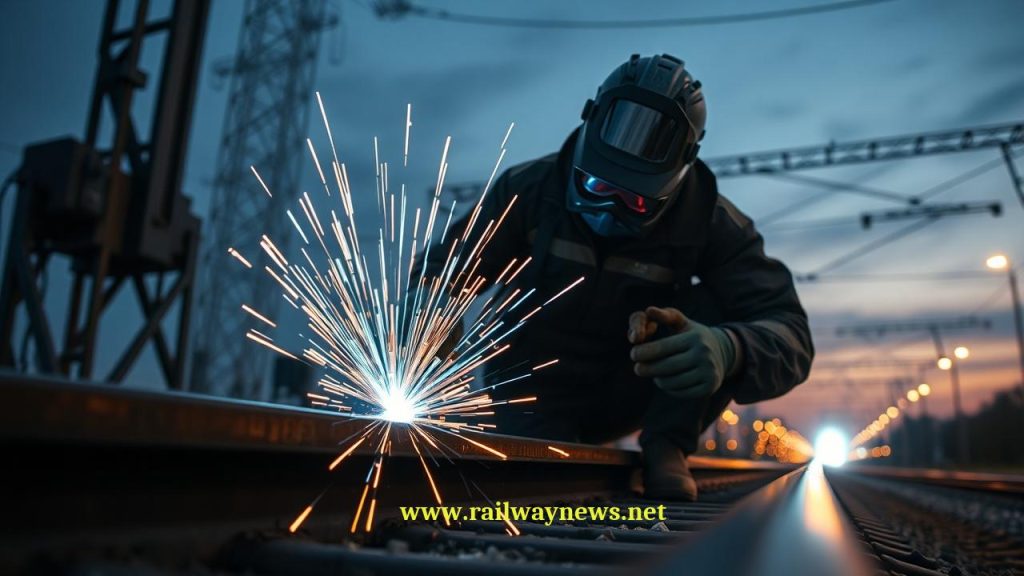
Understanding EN 15594: Electric Arc Welding for Rail Restoration
EN 15594 is a European Standard that specifies the requirements for the restoration of rails by electric arc welding. This standard is a critical document for railway infrastructure managers, maintenance contractors, and welding operators, as it provides a unified framework for repairing worn or damaged rails in-situ, ensuring the safety, reliability, and longevity of the track.
The primary goal of EN 15594 is to define a repeatable and verifiable process for welding that guarantees the restored rail section meets the stringent mechanical and geometric properties required for modern railway operations. It covers the entire workflow, from the approval of welding procedures and the qualification of welders to the final inspection and acceptance of the completed weld.
Scope and Objectives of EN 15594
The standard is specifically focused on the repair of the running surface and edges of Vignole rails (flat-bottomed rails) made from non-heat-treated, non-alloy R200, R220, and R260 steel grades. Its key objectives include:
- Standardization of Procedures: To establish a common technical procedure for electric arc welding on rails across different European networks, enhancing interoperability.
- Quality Assurance: To define strict criteria for welding consumables, equipment, welder competency, and inspection methods to ensure a high-quality, durable repair.
- Safety: To ensure that the repaired rail section has mechanical properties (e.g., hardness, toughness) comparable to the parent rail, preventing premature failure under operational loads.
- Approval and Certification: To outline the process for the technical approval of a welding procedure (Welding Procedure Specification) and the qualification testing of welders.
Core Technical Requirements of the Standard
EN 15594 is highly technical and details every critical step of the rail restoration process. The main technical aspects are broken down into several key areas.
1. Welder Qualification and Approval
A fundamental requirement of the standard is that all welding must be performed by certified welders. The qualification process tests a welder’s ability to produce a weld that meets the specified quality criteria. This involves:
- Practical Tests: The welder must perform a test weld under supervision, following an approved Welding Procedure Specification (WPS).
- Theoretical Knowledge: An assessment of the welder’s understanding of the welding process, safety precautions, and the requirements of the standard.
- Record Keeping: All welder qualifications must be formally documented and maintained by the railway authority or contractor.
2. Welding Procedure Specification (WPS)
Before any welding can be carried out, a detailed WPS must be established and approved. The WPS is the formal “recipe” for the weld, ensuring consistency and quality. It must specify:
- Welding Process: Primarily Manual Metal Arc Welding (MMAW), also known as Shielded Metal Arc Welding (SMAW).
- Parent Material: The grade of rail steel (e.g., R260).
- Welding Consumables: The specific type and classification of the welding electrodes.
- Pre-heating Temperature: The required minimum temperature of the rail before welding begins, crucial for preventing hydrogen cracking.
- Welding Parameters: Current, voltage, travel speed, and electrode manipulation techniques.
- Post-Weld Treatment: Procedures for cooling, grinding, and finishing the weld.
3. The Step-by-Step Welding and Restoration Process
The standard provides a clear sequence for the physical work:
- Pre-Weld Preparation: The damaged area of the rail must be thoroughly cleaned to remove contaminants like grease, rust, and moisture. Any existing cracks or severe defects are removed by grinding to create a sound base for the new weld metal.
- Pre-heating: The prepared area is heated to a specified temperature (typically between 300°C and 400°C) using induction or gas flame heaters. This slows the cooling rate of the weld, reduces hardness, and minimizes the risk of cracking.
- Welding: The welder deposits weld metal in layers (or beads) to build up the worn area. Meticulous technique is required to ensure proper fusion, prevent slag inclusions, and control the heat input.
- Post-Weld Finishing: After welding, the excess weld metal is carefully ground down to match the exact profile of the parent rail. The geometric accuracy of the running surface and gauge corner is critical for vehicle-track interaction.
- Controlled Cooling: The completed weld is often covered with an insulating blanket to ensure it cools slowly and evenly to ambient temperature, which helps achieve the desired metallurgical structure and mechanical properties.
4. Inspection and Acceptance Criteria
A completed weld is not accepted until it passes a series of rigorous inspections to ensure it complies with the standard. Failure at any stage requires the weld to be cut out and the process repeated.
- Visual Inspection: Checking for surface defects like cracks, porosity, or undercut.
- Dimensional Checks: Ensuring the weld profile matches the required rail template using precision gauges.
- Non-Destructive Testing (NDT): Primarily using Magnetic Particle Inspection (MPI) to detect surface-breaking cracks and Ultrasonic Testing (UT) to find internal flaws.
- Hardness Testing: Measuring the hardness of the weld metal and the heat-affected zone (HAZ) to ensure it falls within the specified range, preventing it from being too brittle or too soft.
Key Stages of the EN 15594 Welding Process
The table below summarizes the critical stages and objectives of the rail restoration process according to EN 15594.
| Stage | Key Activities | Primary Objective |
|---|---|---|
| 1. Preparation | Cleaning the rail surface, removing defects by grinding, checking for hidden cracks. | To provide a clean, sound metal base for welding and eliminate potential failure points. |
| 2. Pre-heating | Heating the prepared area to a specified temperature (e.g., 350°C ± 20°C). | To remove moisture, reduce thermal shock, slow the cooling rate, and prevent hydrogen-induced cracking. |
| 3. Welding | Depositing layers of weld metal using approved consumables and a qualified WPS. | To restore the rail’s profile with new metal that has compatible mechanical properties. |
| 4. Post-Weld Grinding | Grinding the weld deposit to precisely match the rail head profile and running surface. | To ensure a smooth transition for train wheels, preventing impact loads and noise. |
| 5. Inspection | Visual, dimensional, Magnetic Particle (MPI), Ultrasonic (UT), and hardness tests. | To verify that the completed weld is free of defects and meets all geometric and mechanical requirements. |
Importance in the Railway Sector
The implementation of EN 15594 is vital for modern railway maintenance for several reasons:
- Cost-Effectiveness: Repairing rails in-situ is significantly cheaper and faster than replacing entire rail sections, especially in complex areas like switches and crossings.
- Extended Asset Life: Proactive repair of surface defects like squats, wheel burns, and rolling contact fatigue (RCF) prevents them from growing into major fractures, thereby extending the life of the rail.
- Minimized Disruption: Welding repairs can often be completed within short overnight track possessions, minimizing disruption to train services compared to the logistics of full rail replacement.
- Enhanced Safety and Reliability: By ensuring a high-quality, standardized repair, the standard reduces the risk of weld failure, which could lead to a broken rail and potential derailment.
Conclusion
EN 15594 serves as a cornerstone for the safe and efficient maintenance of railway tracks. It transforms rail welding from a craft into a controlled engineering process, governed by strict rules for procedures, personnel, and quality control. Adherence to this standard ensures that repaired rails can withstand the immense dynamic forces of modern rail traffic, safeguarding the integrity of the railway network and contributing to its overall reliability and performance.

Railway infrastructure, rolling stock and transport technologies specialist focused on global rail industry developments, high-speed rail systems, signaling technologies and freight transportation. Covering railway investments, public transport modernization, rail operations and international mobility projects across Europe, Asia and North America.