
EU Rail: EN 12663-1 Explained – Vehicle Body Structural Integrity
EN 12663-1 is a European standard that establishes minimum structural requirements for railway vehicle bodies, ensuring safety, durability, and operational reliability through harmonized load cases and acceptance criteria, thereby facilitating interoperability across different national networks.
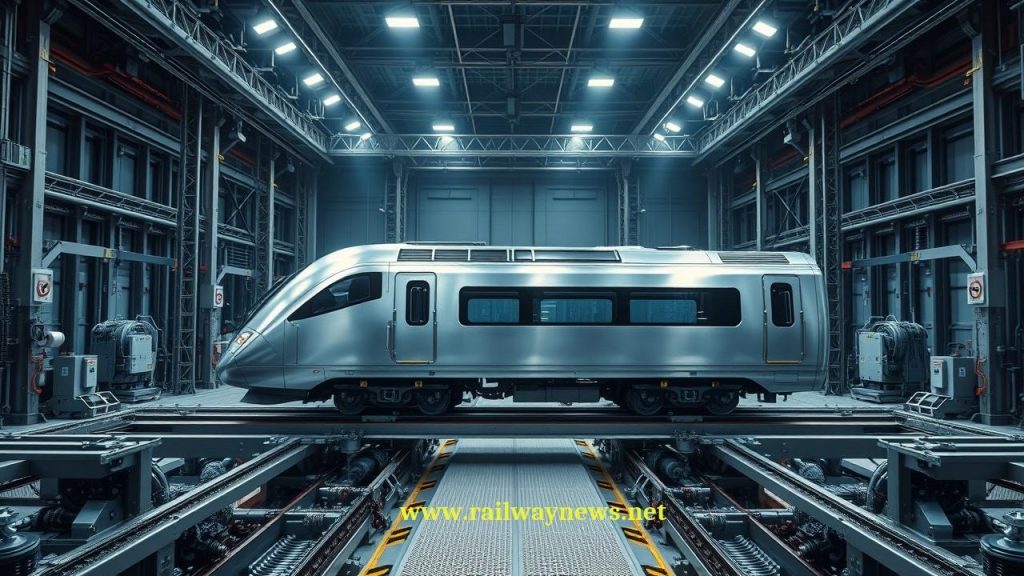
Understanding EN 12663-1: The Foundation for Railway Vehicle Body Structural Integrity
EN 12663-1 is a fundamental European standard that specifies the minimum structural requirements for the bodies of railway locomotives and passenger rolling stock. It serves as a cornerstone for ensuring the safety, durability, and operational reliability of vehicles by defining the loads they must be able to withstand without failure or significant deformation throughout their service life.
The primary goal of this standard is to establish a common framework for vehicle body design and validation. By defining a set of harmonized load cases and acceptance criteria, EN 12663-1 ensures that vehicle structures are robust enough to handle all foreseeable operational forces, from static weight and passenger loads to dynamic forces encountered during acceleration, braking, and traversing varied track conditions.
Key Objectives and Importance of EN 12663-1
The standard is critical for several reasons, directly impacting manufacturers, operators, and safety authorities in the railway sector. Its main objectives include:
- Ensuring Safety: The foremost objective is to protect passengers and crew by guaranteeing the structural integrity of the vehicle body under all normal operating conditions.
- Defining Durability: It provides the basis for designing a vehicle body that can endure the cumulative effects of operational loads (fatigue) over its entire design life, typically 30 years or more.
- Standardizing Design Requirements: It creates a level playing field for manufacturers by setting clear, measurable, and verifiable structural requirements.
- Facilitating Interoperability: While not a TSI itself, compliance with EN 12663-1 is a key part of demonstrating conformity with the Technical Specifications for Interoperability (TSI) within the European Union, allowing vehicles to operate across different national networks.
- Providing a Basis for Validation: The standard outlines the methods—through calculation, static testing, and dynamic analysis—by which a manufacturer must prove that its vehicle body design meets the required performance criteria.
Vehicle Categorization under EN 12663-1
A core concept of EN 12663-1 is the classification of railway vehicles into categories based on their intended use and the structural loads they are expected to encounter. This categorization ensures that the design requirements are appropriate for the vehicle’s operational context. For instance, a mainline locomotive requires a much stronger structure than a lightweight tram.
| Category | Description | Typical Application |
|---|---|---|
| L | Locomotives and power units that may be marshalled anywhere in a train without restriction. | Mainline freight and passenger locomotives, high-speed power cars. |
| P-I | Passenger vehicles designed for mainline operations, requiring high structural strength. | Intercity coaches, high-speed train passenger cars. |
| P-II | Passenger vehicles with lower longitudinal load requirements than P-I. | Regional and suburban trains (EMUs, DMUs). |
| P-III | Passenger vehicles for metro and similar segregated networks. | Underground/subway trains. |
| P-IV | Lightweight passenger vehicles. | Trams and Light Rail Vehicles (LRVs) operating on dedicated lines. |
| P-V | Very lightweight passenger vehicles with the lowest structural requirements. | Automated people movers, specialized light transit systems. |
Note: While the standard provides an alternative method for freight wagons (Categories F-I and F-II), the primary standard for freight wagon bodies is EN 12663-2.
Technical Deep Dive: The Core Load Cases
The heart of EN 12663-1 is its detailed definition of “load cases.” These are specific, quantified forces and combinations of forces that a vehicle body must be designed to resist. They are broadly divided into static, fatigue (dynamic), and exceptional loads.
Static Load Requirements
Static load cases represent forces that are applied slowly and steadily. The structure must withstand these without any permanent deformation. Key static cases include:
- Longitudinal Compressive Loads: This is one of the most critical requirements, simulating the “buffing” forces experienced when vehicles are coupled in a train during pushing, braking, or shunting. For Category L and P-I vehicles, this is typically a proof load of 1500 kN or 2000 kN applied at the buffer or coupler height.
- Vertical Loads: This case simulates the vehicle body under its maximum design mass (tare weight + exceptional payload). The analysis must show that stresses remain within allowable limits and deflections are controlled.
- Lifting and Jacking: The standard specifies forces for lifting the entire vehicle body (e.g., in a workshop) or jacking it from specific points for maintenance. The structure must support its own weight without damage.
- Torsional Stiffness: The car body is subjected to a twisting load to simulate running on uneven or twisted track. This test ensures the body is stiff enough to prevent excessive distortion, which could affect doors, windows, and component mountings.
Fatigue Load Requirements
Fatigue loads are repetitive, lower-magnitude forces that occur millions of times over a vehicle’s life. These can cause material fatigue and crack propagation if not properly accounted for in the design. The standard requires designers to demonstrate that the vehicle body can withstand a defined spectrum of dynamic loads from:
- Track Irregularities: Vertical and transverse accelerations from the bogies as the vehicle moves over imperfect track.
- Aerodynamic Loads: Pressure changes when passing other trains, entering tunnels, or in crosswinds.
- Traction and Braking Cycles: Repetitive longitudinal forces from the train’s propulsion and braking systems.
Compliance is typically shown through Finite Element Analysis (FEA) using methods like the Palmgren-Miner rule for cumulative damage, supported by physical testing of critical joints and components.
Validation and Verification Methods
Proving compliance with EN 12663-1 involves a combination of theoretical analysis and physical testing. The standard provides a clear pathway for validation:
- Design and Analysis: The initial phase relies heavily on computer-aided engineering (CAE) and Finite Element Analysis (FEA). Engineers create a detailed digital model of the car body and apply the standard’s load cases virtually to predict stress, strain, and deformation.
- Static Physical Testing: A physical prototype of the car body shell is subjected to the key static load cases in a specialized test rig. Strain gauges and deflection sensors are placed at hundreds of critical points to measure the structure’s real-world response. The results must correlate with the FEA predictions and meet the standard’s acceptance criteria.
- Fatigue Analysis: While a full-body fatigue test is rare due to cost and time, critical structural components and welded joints are often subjected to fatigue testing to validate their durability and the analysis models.
Relationship with Other Key Railway Standards
EN 12663-1 does not exist in isolation. It works in conjunction with other crucial standards, most significantly:
- EN 15227 (Crashworthiness Requirements for Railway Vehicle Bodies): This is a critical distinction. EN 12663-1 covers operational loads (the day-to-day forces of running). In contrast, EN 15227 covers collision scenarios, defining how a vehicle should deform in a controlled manner during a crash to protect occupants. A vehicle must comply with both.
- EN 12663-2 (Structural requirements of railway vehicle bodies – Part 2: Freight wagons): This is the dedicated standard for the structural design of freight wagons, which have a different set of operational requirements compared to passenger vehicles.
- TSI (Technical Specifications for Interoperability): For vehicles intended for use on the trans-European network, compliance with standards like EN 12663-1 is a Presumption of Conformity with the essential requirements of the relevant TSIs (e.g., TSI LOC & PAS for locomotives and passenger stock).
Conclusion: A Pillar of Railway Vehicle Engineering
EN 12663-1 is more than just a document; it is the embodiment of decades of engineering knowledge and operational experience in the railway industry. It provides a robust, verifiable, and harmonized methodology for designing vehicle bodies that are fundamentally safe and built to last. For any engineer, operator, or authority involved in the design, procurement, or certification of locomotives and passenger rolling stock, a thorough understanding of this standard is absolutely essential.

Railway infrastructure, rolling stock and transport technologies specialist focused on global rail industry developments, high-speed rail systems, signaling technologies and freight transportation. Covering railway investments, public transport modernization, rail operations and international mobility projects across Europe, Asia and North America.