
The Power Gap: Understanding the Neutral Section (Phase Break) in Railways
What is a Neutral Section in railways? Discover how this critical “dead zone” separates electrical phases, prevents short circuits, and ensures safe OLE transitions.
⚡ In Brief
- A neutral section (phase break, dead zone, or electrical separation) is a short section of overhead line equipment (OLE) that is electrically isolated from the live catenary on both sides — required wherever the catenary changes from one electrical supply phase or system to another, to prevent the train’s pantograph from simultaneously bridging two live wires of different phase or voltage.
- The electrical reason for neutral sections is fundamental: in AC electrification (25 kV, 50 Hz), traction substations fed from different phases of the national grid supply different sections of catenary. A pantograph bridging a boundary between Phase A and Phase B would create a direct phase-to-phase short circuit through the overhead wire — the resulting fault current would damage catenary, pantograph, and substation equipment in milliseconds.
- Train passage through a neutral section is managed by the Automatic Power Control (APC) or equivalent automatic system: trackside warning magnets or transponders signal the approaching train to open its main circuit breaker (typically a vacuum circuit breaker, VCB) before reaching the neutral section; the train coasts unpowered through the dead zone on momentum; and the circuit breaker recloses automatically once the pantograph has cleared the far end.
- A system break is a distinct type of electrical separation — not between phases of the same voltage system, but between two entirely different electrification systems (such as 25 kV 50 Hz AC and 750 V DC third rail). System breaks require the pantograph to be lowered or switched, and multi-system locomotives must switch their onboard power conversion equipment, making system break passages significantly slower and operationally more complex than phase break passages.
- At high speed, a train traverses a short neutral section in approximately 1–2 seconds — a brief interruption to traction that a well-designed train on a level section will barely notice. At lower speeds on a rising gradient, the same neutral section can cause a significant speed loss; badly positioned neutral sections on gradients are a known operational problem on several European networks and were explicitly addressed in high-speed line design standards.
On 28 September 1994, the Eurostar service from London Waterloo to Paris Gare du Nord crossed the French border at Coquelles and began its approach to Lille. Somewhere between the Channel Tunnel portal and Lille-Europe station, the pantograph of the Class 373 set traversed the boundary between two different 25 kV AC supply phases. The Automatic Power Control system on the train opened the main circuit breaker a fraction of a second before the pantograph reached the dead zone, the train coasted unpowered for approximately 1.7 seconds, the circuit breaker reclosed, and traction power was restored. No passenger noticed anything. No driver action was required. No operational delay resulted.
This unremarkable event — repeated thousands of times every day on every AC-electrified railway in the world — represents one of the most elegant solutions in railway electrical engineering. The problem it solves is one of the most fundamental constraints in railway electrification: a high-speed train drawing 10 megawatts of traction power cannot simply cross the boundary between two different electricity supplies without consequences. Those consequences, if unmanaged, would be severe. The neutral section is the management.
Why Neutral Sections Are Necessary: The Electrical Constraint
Railway catenary systems on AC-electrified lines are fed from traction substations spaced every 20–60 km along the route. Each substation draws power from the national grid and feeds it into the overhead contact wire (OLE). In a 25 kV AC system, the national grid supply is typically three-phase at 400 kV or 132 kV; the traction transformer reduces this to 25 kV single-phase for the catenary.
The critical issue is phase: adjacent traction substations on the same line are often fed from different phases of the national three-phase supply — deliberate policy to balance the load that a railway’s large single-phase traction demand imposes on the grid. If Substation A feeds Phase A onto the catenary, and Substation B feeds Phase B onto an adjacent section of the same catenary, the voltage difference between the two live wires at their meeting point is not zero — it is the phase-to-phase voltage, which in a 25 kV system is approximately 43 kV.
A pantograph bridging from the Phase A section to the Phase B section would create a short circuit through the overhead wire with an available fault current of thousands of amperes. The resulting arc would ablate the contact wire and pantograph head in milliseconds, trip the substation protection, and potentially cause a fire or structural damage to the OLE structure. The neutral section is the physical gap that prevents this from happening.
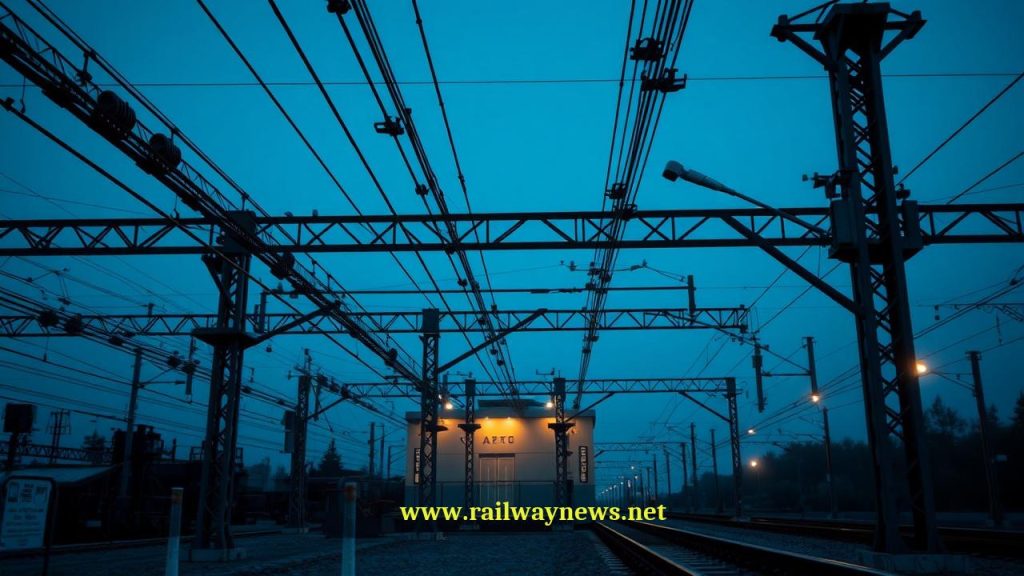
The Anatomy of a Neutral Section
| Component | Function | Material / Type |
|---|---|---|
| Section insulators | Electrically isolate the dead section of contact wire from the live catenary on each side; the pantograph slides over them without mechanical discontinuity | PTFE (Teflon)-coated composite or porcelain bodies; designed for smooth pantograph passage at high speed |
| Dead (neutral) contact wire | The section of contact wire between the two insulators — electrically floating (not connected to either supply); pantograph slides along it unpowered | Same copper contact wire as live sections; no electrical connection |
| APC trackside magnets / transponders | Warning device upstream of neutral section triggers the train’s APC system to open the VCB before the pantograph reaches the dead zone. Second magnet downstream triggers VCB reclose. | Permanent magnets mounted on sleepers (older systems); Eurobalise transponders (ETCS-integrated systems) |
| Vacuum Circuit Breaker (VCB) on train | Main circuit breaker between pantograph and traction equipment; opens on APC command to isolate traction load before neutral section; reclosed after clear | Vacuum interrupter; fast-acting (open/close in <100 ms); rated for full traction current interruption |
| Arc traps / arc diverters | If arcing occurs at the insulator (e.g., from a slow train, VCB failure, or current surge), arc traps divert the arc to a sacrificial electrode away from the insulator body | Copper or carbon electrodes positioned to attract arc discharge; replaced at maintenance intervals |
| Lineside indicator boards | Visual indication to driver of neutral section position — typically “PS” (Power Section) board approaching and departure boards; allows manual VCB control if APC fails | Standard lineside signs; mounted alongside track at defined approach distance |
The APC Passage Sequence: Step by Step
- Approach warning: The train passes over the upstream APC magnet/transponder, typically 200–400 metres before the neutral section. The APC receiver on the train detects the signal.
- VCB open command: The APC system sends an open command to the Vacuum Circuit Breaker. The VCB opens, disconnecting the traction transformer and all electrical loads from the pantograph. The pantograph remains raised and in contact with the OLE — only the electrical circuit is interrupted.
- Load clearance: Within milliseconds of the VCB opening, the current through the pantograph drops to zero (parasitic capacitance discharge). The pantograph is now effectively isolated from the traction circuit.
- Entry into neutral section: The pantograph slides onto the section insulator and enters the dead zone. Since no current is flowing through the pantograph circuit, no arc is generated at the insulator boundary. The mechanical pantograph-contact-wire interaction continues smoothly.
- Coasting: The train coasts through the neutral section on momentum. At 300 km/h, a 300-metre neutral section takes approximately 3.6 seconds to traverse. Auxiliary systems (lighting, heating, HVAC, control electronics) may remain powered from onboard batteries or auxiliary converters during this brief interval.
- Exit from neutral section: The pantograph exits the dead zone onto the second section insulator and enters the new live supply section.
- VCB reclose command: The downstream APC magnet/transponder signals the APC system, which sends a reclose command to the VCB. The VCB closes, reconnecting the traction transformer to the new live supply phase.
- Power restoration: The traction motors receive power from the new supply. Normal traction resumes. Total power interruption time: 2–8 seconds depending on train speed and neutral section length.
Phase Break vs System Break: A Critical Distinction
| Parameter | Phase Break (Neutral Section) | System Break |
|---|---|---|
| What changes | Phase of supply (same voltage: 25 kV Phase A → 25 kV Phase B) | Entire electrification system (e.g., 25 kV 50 Hz AC → 1.5 kV DC) |
| Dead zone length | Short: 100–600 m typical; train coasts through on momentum | Longer: may require pantograph lowering, system reconfiguration, and controlled stop |
| Train action | Open VCB; coast; reclose VCB. Pantograph remains raised throughout. Transparent to passengers. | Lower pantograph; reconfigure traction electronics for new voltage; raise alternative pantograph or reconnect to different system. Operationally visible — several seconds’ delay. |
| Onboard equipment change | None — same 25 kV 50 Hz input to traction transformer on both sides | Complete — different voltage, frequency (AC/DC) requires different converter settings or physical reconnection |
| Train type required | Any train equipped with APC; all modern AC electric units | Multi-system locomotive/EMU only (e.g., Class 373 Eurostar: 25 kV AC + 3 kV DC + 750 V DC) |
| Frequency in service | Multiple times per journey on any AC-electrified route | Only at national border crossings or legacy/modern system transitions (e.g., UK HS1/classic network junction) |
| European examples | Every 20–60 km on any 25 kV 50 Hz route; between power supply districts on the French LGV, CTRL, Shinkansen | France–Belgium (25 kV/3 kV); France–UK (25 kV AC/750 V DC at St Pancras/HS1 junction) |
Types of Neutral Section: Short, Long, and Overlap
Not all neutral sections are identical. Different railway networks and operating conditions have led to three distinct neutral section designs:
Short neutral section (SNS): The standard design on high-speed lines and modern electrification. The dead zone contact wire is only long enough to ensure that no pantograph can bridge both insulators simultaneously — typically 100–200 metres for a single-pantograph train, 200–400 metres for trains with multiple pantographs spread over a longer length. The train coasts briefly and experiences minimal speed loss.
Long neutral section (LNS): Used on gradients or where slow trains might lose excessive speed coasting through a short section. The dead zone is longer — potentially 400–600 metres — and the approach magnets are further upstream, giving longer warning time to open the VCB. Some high-speed lines use long neutral sections at locations where maintaining consistent pantograph lift is difficult with short sections.
Overlapping neutral section: Used at transitions between different supply districts where the two live sections need to overlap slightly for operational reasons (such as when a train must be able to draw power from either side during a planned substation outage). Two section insulators are positioned some distance apart, with an overlapping zone that can be energised from either side. The train traverses the overlap with its VCB open.
What Happens if the APC Fails?
If the APC system fails to open the VCB before the pantograph reaches the neutral section insulator, the train arrives at the insulator with live traction current flowing through the pantograph circuit. As the pantograph slides from the live catenary onto the dead zone insulator, the current path is interrupted — an arc is initiated at the insulator surface.
The consequences depend on current magnitude and arc duration:
- Low current (light traction, high speed): A small arc may extinguish quickly as the pantograph moves onto the dead zone, causing minor damage to the insulator’s arc-resistant coating. The arc trap may divert the arc before significant damage occurs.
- High current (full traction, low speed): A sustained arc can ablate the insulator surface, damage the contact wire at the insulator location, and potentially cause a fire in the insulator housing. Repeated APC failures at the same insulator cause cumulative damage that eventually requires insulator replacement.
- VCB failure combined with high current: In extreme cases, sustained arcing at an insulator can damage the OLE structure and interrupt service. This failure mode is one of the primary drivers for APC system redundancy and regular testing of VCB operation on electric trains.
To address manual operation fallback, lineside boards (“PS” boards in the UK, equivalent signs on other networks) give the driver visual confirmation of the neutral section location, enabling manual VCB operation if the APC has failed. Every driver on an AC-electrified route is trained to recognise and respond to these boards.
Neutral Sections on High-Speed Lines
On high-speed lines where trains operate at 300+ km/h, neutral section placement and design requires careful consideration:
- Positioning on level track: Neutral sections are placed on level or near-level sections of route wherever possible — a train coasting unpowered for 2–5 seconds loses minimal speed on level track but significant speed on a rising gradient.
- Approach distance: At 300 km/h, a train travels 250 metres in 3 seconds. The APC warning magnets must be far enough upstream to allow the VCB to open and all current to clear before the pantograph reaches the insulator — typically placed 300–500 metres before the neutral section at high-speed.
- Multiple pantograph management: High-speed trains carrying two raised pantographs (some ICE and TGV configurations use two pantographs in parallel) require a neutral section long enough that the rear pantograph has cleared the entry insulator before the leading pantograph reaches the exit insulator — otherwise current can flow through both pantographs and the dead zone wire. Modern multi-pantograph trains use APC interlocking to ensure only one pantograph is raised when traversing a neutral section.
- Regenerative braking interaction: A train in regenerative braking mode cannot regenerate into the network when its VCB is open. The approach to neutral sections therefore requires the traction control system to switch from regen to friction braking if the train is decelerating through the neutral section — a consideration for energy recovery efficiency on high-frequency services.
Electrification Systems and Their Neutral Section Characteristics
| System | Voltage / Frequency | Neutral Section Required? | Typical Spacing | Notes |
|---|---|---|---|---|
| 25 kV 50 Hz AC OLE | 25,000 V, 50 Hz | Yes — at every supply phase boundary | Every 20–60 km (substation spacing) | Standard for HSR, HS1, French LGV, German NBS, Shinkansen |
| 15 kV 16.7 Hz AC OLE | 15,000 V, 16.7 Hz | Yes — at supply district boundaries | Every 30–80 km | Germany (DB), Austria (ÖBB), Switzerland (SBB) — separate railway grid at 16.7 Hz reduces neutral section frequency |
| 3 kV DC OLE | 3,000 V DC | Yes — at supply section boundaries | Every 5–15 km (closer substations needed) | Italy, Belgium, Spain (some lines), Czech Republic — DC sections use simpler neutral sections (no phase issue, only supply separation) |
| 1.5 kV DC OLE | 1,500 V DC | Yes — at supply section boundaries | Every 3–10 km (very close substations) | France (legacy), Netherlands, Japan (some metro) — low voltage requires high current and many substations |
| 750 V DC Third Rail | 750 V DC (third rail) | Yes — at supply section gaps | Every 2–5 km; gaps also at level crossings, crossovers | Southern England Network Rail, London Underground — train coasts through gaps; APC or momentum-only depending on gap length |
Editor’s Analysis
The neutral section is among the least visible and most elegant engineering solutions in the entire railway system. Its purpose is to prevent an electrical catastrophe that would otherwise occur thousands of times per day on every AC-electrified mainline in the world; its operation is transparent to every passenger on every journey; and its failure is rare but can be dramatic when it occurs. The APC system that manages neutral section passage is one of the most reliable subsystems on modern electric trains — VCB open/close cycles are monitored, tested, and logged, and APC failures are among the first triggers for vehicle withdrawal from service for investigation. The reason for this vigilance is straightforward: a single APC failure at a busy neutral section on a high-frequency mainline can damage both the train’s pantograph and the overhead insulator, potentially disrupting services across a wide area. The interaction between neutral sections and energy recovery is becoming increasingly important as railways pursue decarbonisation goals. A train in regenerative braking that passes through a neutral section cannot feed energy back into the network during the coast phase — and on routes with many neutral sections and frequent stops, the cumulative energy recovery penalty is measurable. This is driving interest in onboard energy storage (batteries, supercapacitors) that can absorb regenerative braking energy even when the VCB is open, storing it for use after the neutral section rather than losing it to friction brakes. The humble neutral section — a dead wire and a couple of insulators — is thus at the intersection of two of the most consequential trends in railway engineering: electrification expansion and energy efficiency improvement. — Railway News Editorial
Frequently Asked Questions
- Q: Can a train stall in a neutral section if it runs out of momentum?
- Yes — this is one of the most problematic operational scenarios associated with neutral sections. If a train enters a neutral section too slowly (due to a preceding delay, an incorrect APC trigger at the wrong speed, or stopping unexpectedly before the neutral section), it may decelerate to a stop within the dead zone. With the VCB open and the pantograph on the dead wire, the train has no traction power and cannot move. The immediate consequence is service disruption: the stalled train blocks the line, and the driver must follow the degraded mode procedure — contacting the control centre, assessing whether any movement is possible (on a gradient the train may be able to roll clear), and in the worst case requesting assistance from a rescue locomotive. On lines with gradients, neutral sections are designed and positioned so that a train entering at the minimum service speed (typically 80–120 km/h on high-speed lines) will coast to the end of the neutral section with adequate margin. Network Rail’s UK standards specify that a train must be able to traverse any neutral section at a defined minimum speed without stalling. On routes where older infrastructure creates sub-optimal neutral section positioning, speed restriction signs may be posted to ensure trains approach with adequate momentum.
- Q: Why do some countries use 15 kV at 16.7 Hz instead of 25 kV at 50 Hz, and does this affect neutral sections?
- Germany, Austria, and Switzerland (DB, ÖBB, SBB) use a 15 kV 16.7 Hz system that dates from the early 20th century — before single-phase motors could operate efficiently at the national grid frequency of 50 Hz. When their railway electrification networks were built, 16.7 Hz (originally 16⅔ Hz, exactly one-third of 50 Hz) was the optimal frequency for the series commutator motors of the era. The three countries maintain dedicated railway electricity networks at 16.7 Hz, fed from the national 50 Hz grid via frequency converters and dedicated 16.7 Hz generation plant. This separate railway grid means that adjacent traction substations on the DB/ÖBB/SBB networks are fed from the same dedicated single-phase railway system — they can all be the same phase, eliminating the inter-phase boundary problem. This reduces the frequency of neutral sections compared to a 25 kV 50 Hz system: neutral sections still exist at supply district boundaries and at locations where two independent substation feeds meet, but they are less frequent than on a 25 kV network fed from the national three-phase grid. The 25 kV 50 Hz system, by contrast, must balance the single-phase traction load across the national three-phase grid, which inherently means adjacent substations feed different phases — and neutral sections are required between every pair of adjacent substation feed zones.
- Q: What happens to the train’s auxiliary power (lights, heating, HVAC) during a neutral section passage?
- Modern electric trains are designed to maintain auxiliary power (lighting, HVAC, control systems, passenger information displays) through neutral section passages without interruption, using one of several approaches. On many modern trains, the auxiliary power supply is fed through an auxiliary inverter/converter that draws from the traction line but provides isolated 3-phase 400V (or equivalent) output to auxiliaries. When the VCB opens for a neutral section, the auxiliary converter’s input briefly loses supply, but the converter’s DC link capacitors maintain output for the 2–5 seconds of the coast phase — passengers experience no lighting flicker and no HVAC interruption. On older trains with less sophisticated auxiliary systems, brief lighting and heating interruptions during neutral section passage were visible and audible — passengers would hear the lights go out and feel a momentary change in the train. This was particularly notable on older InterCity services on the UK East Coast Main Line, where the overhead wiring has several neutral sections between King’s Cross and Edinburgh. Modern Class 800 IET sets designed for the same route maintain fully stable auxiliary supply through all neutral sections, representing a significant improvement in passenger experience from the older rolling stock they replaced.
- Q: Are neutral sections needed on DC third-rail systems like London’s Southern routes?
- Yes — DC third-rail systems require electrical gaps in the third rail at specific locations, though for different reasons than the phase separation needed in AC systems. DC third-rail gaps (sometimes called “neutral sections” by analogy, though technically they are supply section separations rather than phase breaks) occur at: boundaries between adjacent substation supply sections (each substation feeds a section of third rail from one end, and adjacent sections must be separated by a gap to allow independent circuit protection); at level crossings (the third rail cannot cross a road or footpath at surface level, so a gap is required where the crossing occurs); at switches and crossings (the geometry of the third rail must be interrupted at points to allow wheelset passage); and at some station platforms where access to the track must be possible for safety reasons. These gaps are typically short (1–3 metres at level crossings, up to 30–40 metres at supply section boundaries) and trains coast through them on momentum. Unlike AC phase breaks, DC gaps do not require the train’s main circuit breaker to open — the train simply loses contact with the third rail briefly and the traction motors coast on residual kinetic energy. The operational impact is minimal at normal operating speeds, but slow-moving trains on rising gradients near third-rail gaps can experience speed loss, which is one of the reasons DC third-rail electrification is generally not used on steeply graded routes.
- Q: How do multi-system trains handle the transition between different electrification voltages at a system break?
- Multi-system trains (such as the Class 373 Eurostar, which operates on 25 kV AC in France and the UK’s HS1, 3 kV DC in Belgium, and 750 V DC third rail on approach to London Waterloo International) carry separate power conversion equipment for each electrification system and a control system that selects the appropriate mode based on the current supply. At a system break (e.g., the transition between French 25 kV overhead and Belgian 3 kV overhead), the sequence is: train enters the dead section at the system boundary; VCB opens for overhead systems, or pantograph lowers for the transition to third rail; train coasts through the dead section (longer than a phase break — typically several hundred metres to ensure no arcing between systems); control system reconfigures the traction electronics for the new voltage (different transformer tap, different converter configuration); pantograph rises or VCB recloses for the new system; traction power restored from the new supply. This process takes longer than a simple phase break — typically 10–30 seconds depending on the systems involved — and requires a longer coast section, which means more speed loss. At the former London Waterloo International approach, the transition from HS1’s 25 kV overhead to the third-rail 750 V DC required a significant reduction in speed before the transition point to maintain adequate momentum through the dead section — a constraint that would have been less significant if the line had been electrified consistently throughout.

Railway infrastructure, rolling stock and transport technologies specialist focused on global rail industry developments, high-speed rail systems, signaling technologies and freight transportation. Covering railway investments, public transport modernization, rail operations and international mobility projects across Europe, Asia and North America.
RELATED POSTS
September 6, 2026 5:19 am
Hitachi delivered Taiwan's first N700ST high-speed train from Japan in...

September 5, 2026 4:19 pm
CPK launched formal tender talks with four consortia to design...

September 5, 2026 7:14 pm
HS2 Ltd signed renegotiated civils contracts with EKFB and Align...

September 6, 2026 4:12 am
Alstom delivered the first of 100 new G Class trams...
September 6, 2026 1:17 am
Hitachi Toshiba Supreme Consortium confirmed the first of 12 N700ST...
September 6, 2026 6:17 am
Hungary ordered a national ban on most freight trains from...