
Wyss&Lila Opens 3-Line Locomotive Workshop in Germany
Wyss&Lila opened a 3,500 sq m, 3-line locomotive workshop with 6 work bays and 1,000 m of storage tracks in Schwarzheide, Germany, offering 24/7 maintenance.
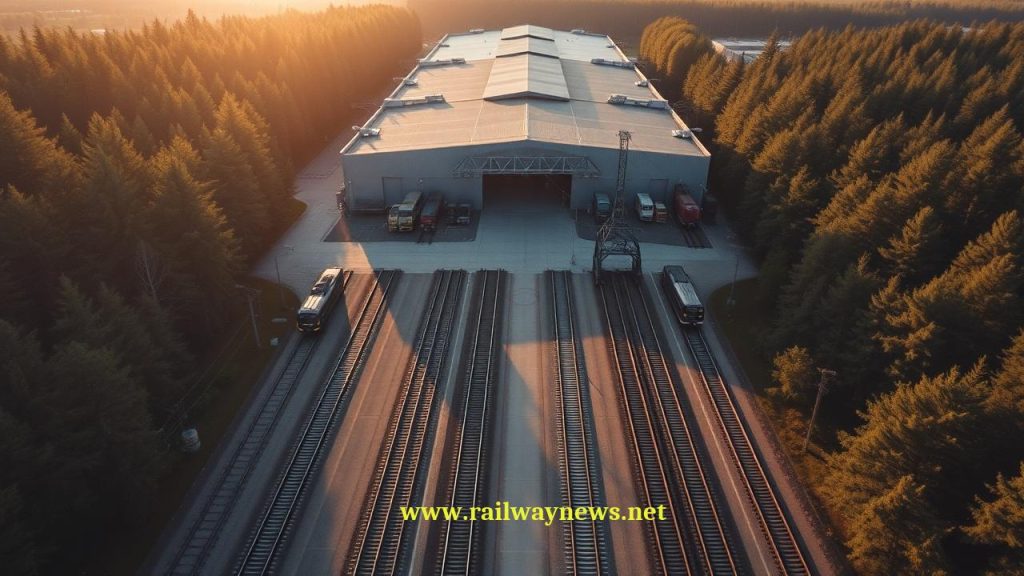
⚡ In Brief: Swiss railway engineering firm Wyss&Lila inaugurated a 3-line locomotive maintenance workshop in Schwarzheide, Germany, with 6 work bays and 3,500 sq m of indoor space.
Schwarzheide, Germany – Wyss&Lila AG has put into operation a new railway maintenance facility inside Industriepark Lausitz, roughly 130 km south of Berlin. The workshop opens with 3 maintenance lines, 6 locomotive work bays, and 3,500 square metres of covered workshop area, supported by 1,000 metres of storage tracks and an 8‑tonne gantry crane. No investment figure was officially disclosed.
What Is the Full Scope of This Development?
The Schwarzheide site is designed to handle the full life‑cycle maintenance of modern rolling stock, from locomotives and railcars to electric and diesel multiple units, trams, and special‑purpose vehicles. The facility operates 24/7 under the security perimeter of the BASF‑operated industrial park and includes high‑voltage testing systems, 5,000 square metres of on‑site open storage, and dedicated secure tracks for long‑term vehicle storage and condition monitoring. Wyss&Lila is a certified Entity in Charge of Maintenance (ECM) for functions 1–4 and provides mobile maintenance teams and 24/7 technical support across Europe.
Key Development Data
| Parameter | Value |
|---|---|
| Company / Organisation | Wyss&Lila AG (Zug, Switzerland) |
| Total Value | Not disclosed |
| Parties Involved | Wyss&Lila; Industriepark Lausitz (BASF site) |
| Timeline / Completion | Operational as of mid-2026 |
| Country / Corridor | Germany; Berlin–Dresden corridor proximity |
How Does This Compare to Industry Trends?
The Wyss&Lila facility is a mid‑sized service centre, similar in workshop area to a typical regional locomotive depot, but smaller than the 53,000 sq‑ft (roughly 4,900 sq‑m) Mirabel facility that Volatus Aerospace opened in Canada for aerospace maintenance in 2026 (Source: StockTitan, 2026). In Germany, the rail maintenance market is expanding alongside broader transport investments: the country’s battery electric vehicle (BEV) and plug‑in hybrid (PHEV) share reached 33.7% in Q1 2026, up from 26.6% a year earlier, partially driven by new purchase incentives (Source: CleanTechnica, June 2026). Tesla’s plan to lift German production by 20% in 2026 (Source: Reuters, June 2026) signals additional industrial logistics demand that could increase rolling stock utilisation. At the infrastructure level, five firms recently won work on a £1.2 billion overhead line upgrade programme in the UK, illustrating the scale of concurrent European rail investment (Source: Construction News, June 2026).
Editor’s Analysis
Wyss&Lila’s decision to locate inside a BASF chemical park hints at a strategy to serve industrial rail logistics rather than just passenger rail, where maintenance demand is tied to freight shuttles and plant rail operations. The facility’s ECM 1–4 certification and 24/7 guarding align with the high availability requirements of industrial supply chains, positioning the company for long-term contracts with manufacturers and logistics providers. Meanwhile, the jump in German EV adoption and Tesla’s production ramp are adding pressure to rail freight corridors, as battery and automotive supply chains increasingly rely on rail for first‑ and last‑mile movements.
FAQ
Q: What types of vehicles can Wyss&Lila service at the Schwarzheide workshop?
A: The facility is equipped for locomotives, electric and diesel multiple units, railcars, trams, subways, and special‑purpose vehicles, covering everything from routine maintenance to full life‑cycle overhauls.
Q: How many maintenance lines and work bays does the new facility have?
A: It has 3 maintenance lines and 6 dedicated locomotive work bays, supported by 1,000 metres of storage tracks and a 3,500‑square‑metre indoor workshop.
Q: Why was Schwarzheide selected over other locations?
A: The company cited existing rail connectivity, direct access to major transport routes, and the scalable infrastructure of the BASF industrial park as key factors; however, specific comparative criteria or incentives were not publicly disclosed.

Railway infrastructure, rolling stock and transport technologies specialist focused on global rail industry developments, high-speed rail systems, signaling technologies and freight transportation. Covering railway investments, public transport modernization, rail operations and international mobility projects across Europe, Asia and North America.
RELATED POSTS

October 8, 2026 12:18 pm
Siemens Mobility signed an agreement with VinSpeed to supply 350...

October 4, 2026 5:14 pm
Alstom secured a CA$4.7 billion order from VIA Rail Canada...

October 5, 2026 6:12 pm
AECOM and Jacobs secured a contract in September 2026 to...

October 4, 2026 11:08 pm
Sound Transit confirmed the September 30 opening of Seattle Pinehurst...
October 5, 2026 1:13 pm
New York MTA confirmed a late 2026 DEIS release for...
October 6, 2026 9:17 am
Illinois approved $1.1M in state funds to upgrade two McHenry...