
Wuhan-Baku Freight Cuts Transit Time to 18 Days Middle Corridor
China Railway and Azerbaijan Railways launched the Wuhan-Baku freight service, cutting transit time to 18 days for cargo on the Middle Corridor.
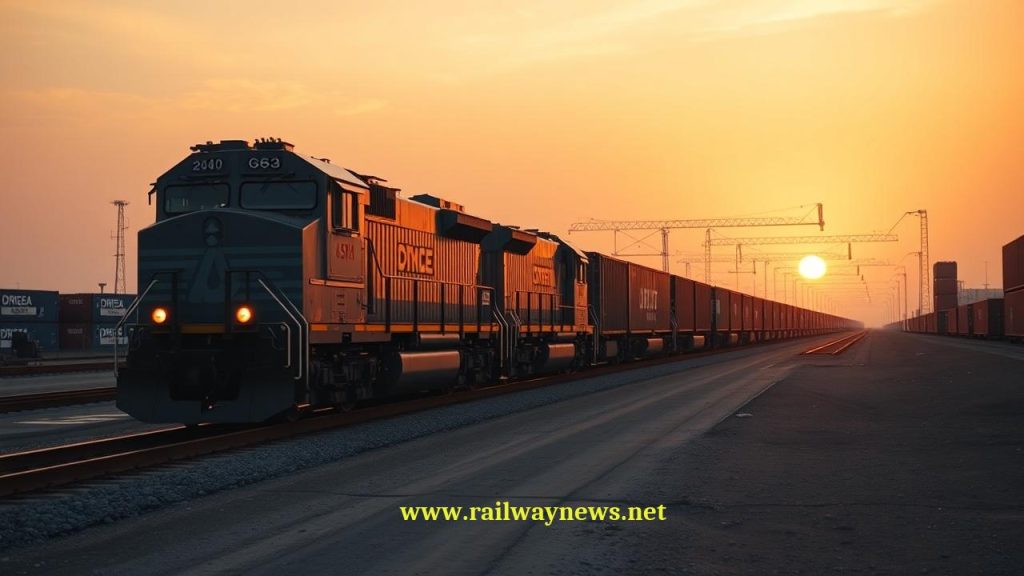
⚡ In Brief: A new China-Europe freight service from Wuhan to Baku has launched via the Middle Corridor, cutting transit time to approximately 18 days as cargo volumes on the trans-Caspian route have increased by nearly 90% since 2022.
WUHAN, CHINA – The first freight train on the new Wuhan–Baku route has departed, establishing a rail-sea connection through the Middle Corridor. The service, carrying electronic equipment and consumer goods, is projected to reduce transit times to 18 days, compared to up to 22 days on other routes. This launch occurs as overall China-Europe train services grew 29% in the first quarter of 2026, reaching 5,460 trains.
What Is the Full Scope of This Project?
The new service establishes a multimodal link from Wuhan, a major central China manufacturing hub, to European markets via Azerbaijan. The route involves rail transport from Wuhan’s Wujiashan and Xianglushan stations across China to the Khorgos border crossing, a maritime crossing of the Caspian Sea, and final transfer onto container block trains in Baku managed by Azerbaijan Railways (ADY). The full operational frequency of the Wuhan-Baku service has not been disclosed.
Key Project Data
| Parameter | Value |
|---|---|
| Project / Contract Name | Wuhan–Baku Freight Rail Service |
| Total Value | Not disclosed |
| Parties Involved | China Railway, Azerbaijan Railways (ADY) |
| Timeline / Completion | Service launched; transit time approx. 18 days |
| Country / Corridor | China, Kazakhstan, Azerbaijan / Middle Corridor |
How Does This Compare to Similar Projects?
The strategic importance of this route is underscored by its function as a bypass to both Russian and Iranian infrastructure, a critical factor following Russia’s 2022 invasion of Ukraine. The corridor is backed by significant capital, with European and international financial institutions committing around $10.8 billion for development, while China’s broader investments in Central Asia exceed $66 billion (Source: JPost, Newsweek). The rapid launch of this new *service* contrasts sharply with the timeline for major new *infrastructure* construction; for instance, the UK’s East West Rail project is a multi-decade build not expected to be fully complete until the mid-to-late 2030s (Source: Construction News).
Editor’s Analysis
This Wuhan-Baku service is a tactical activation of existing infrastructure in response to geopolitical realignment, rather than a long-term construction project. The growth of the Middle Corridor is directly linked to China’s domestic economic strategy, where state-funded infrastructure investment is a key tool for bolstering GDP growth amidst weak consumer spending (Source: The New York Times). The success of this and similar routes will depend heavily on the operational efficiency gains promised through digitalization, an area where China’s leadership in private 5G RAN technology could provide a distinct advantage in logistics coordination (Source: Telecoms.com).
FAQ
Q: Why is the Middle Corridor becoming more important?
A: The corridor has gained strategic importance as it provides the only major east-west trade route that bypasses both Russian and Iranian territory. This has become a critical factor for logistics resilience since Russia’s invasion of Ukraine in 2022.
Q: How does the 18-day transit time compare to other routes?
A: The projected 18-day transit time is approximately four days faster than the 22-day transit time cited for some conventional Eurasian rail routes. The efficiency is achieved by avoiding congested overland border crossings in favour of the trans-Caspian sea link.
Q: What is the scale of investment in the Middle Corridor?
A: While the value of this specific service is not public, the broader corridor is receiving major funding. International and European financial bodies have committed approximately $10.8 billion, complementing China’s more than $66 billion in investments across Central Asian nations.

Railway infrastructure, rolling stock and transport technologies specialist focused on global rail industry developments, high-speed rail systems, signaling technologies and freight transportation. Covering railway investments, public transport modernization, rail operations and international mobility projects across Europe, Asia and North America.
RELATED POSTS

October 1, 2026 7:09 am
United States regulators confirmed a September 30 deadline for the...

October 8, 2026 1:15 pm
Alstom secured a €1bn contract to build 13 automated trains,...

October 4, 2026 5:14 pm
Alstom secured a CA$4.7 billion order from VIA Rail Canada...

October 1, 2026 12:13 am
Illinois approved $1.5 billion annually for the Northern Illinois Transit...

October 6, 2026 2:14 am
Union Pacific launched export rail shipments with Ferromex to deliver...

October 1, 2026 6:10 am
Amtrak approved a System Expansion Committee on July 30 to...