
Webuild Launches 144-metre TBM for Gardena Tunnel Italy
Webuild launched a 144-metre TBM for over 16 km of the Gardena tunnel in Italy, part of the Brenner Base Tunnel’s southern access.
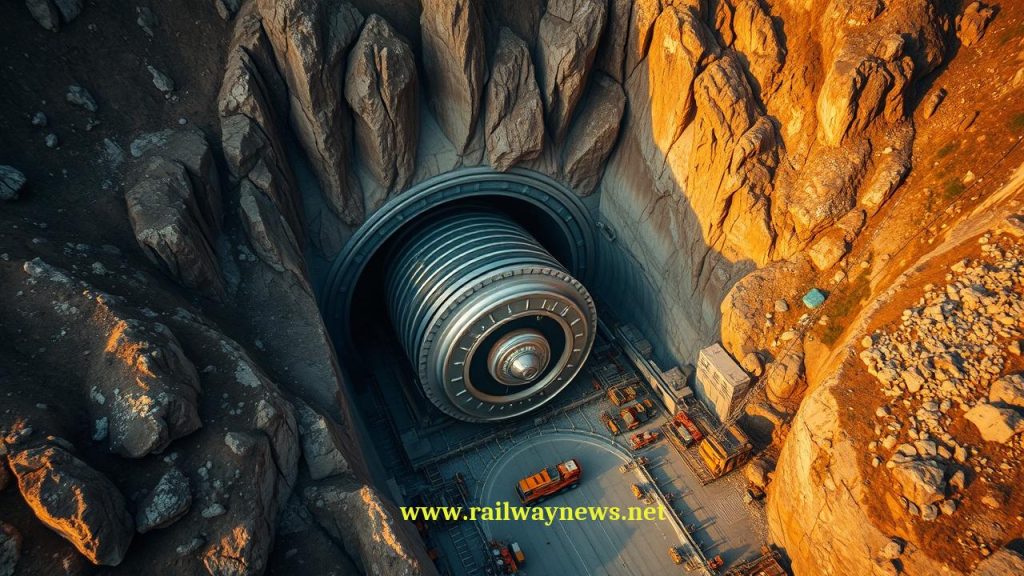
⚡ In Brief: Webuild has launched a 144-metre Tunnel Boring Machine to excavate over 16 km for the Gardena tunnel, a key section of the Brenner Base Tunnel’s southern access route in Italy designed to enhance the Munich-Verona freight and passenger corridor.
FORTEZZA, ITALY – Webuild, leading an international consortium, has commenced excavation on the Gardena tunnel with the launch of the 144-metre long Tunnel Boring Machine (TBM) “Kathrin”. The TBM, featuring a cutterhead nearly 10 metres in diameter, will bore the main tubes on the Fortezza–Ponte Gardena section, part of the southern access for the Brenner Base Tunnel. This phase of the project is being executed for the client Rete Ferroviaria Italiana (RFI).
What Is the Full Scope of This Project?
The Fortezza–Ponte Gardena section represents the first segment of the southern access route’s quadrupling and is a critical component of the wider Brenner Corridor. The project scope includes over 16 km of tunnels for the Gardena section, the excavation of the 15 km-long Scaleres Tunnel, a 250-metre viaduct over the Isarco River, and the modernisation of the Ponte Gardena station. This section is part of a larger 52 km network of tunnels designed to create a high-speed, high-capacity line between Munich and Verona with significantly reduced gradients compared to the existing railway.
Key Project Data
| Parameter | Value |
|---|---|
| Project / Contract Name | Gardena Tunnel (Fortezza–Ponte Gardena Section) |
| Total Value | Not disclosed |
| Parties Involved | Webuild (lead), Implenia, SELI Overseas (Consortium); Rete Ferroviaria Italiana (Client) |
| Timeline / Completion | Not disclosed for this specific section; TBM excavation commenced May 2026. |
| Country / Corridor | Italy / Brenner Corridor (Munich-Verona) |
How Does This Compare to Similar Projects?
The entire Brenner Base Tunnel system, of which the Gardena tunnel is a part, will create a 64 km continuous tunnelled route, set to become the longest underground rail connection in the world. This surpasses the current record holder, the 57 km Gotthard Base Tunnel in Switzerland, which opened in 2016. While both projects target trans-alpine freight and passenger traffic, the Brenner project’s complexity involves extensive access routes, such as the Fortezza–Ponte Gardena section, to connect the new base tunnel to the existing national networks in Italy and Austria. The total project costs and geological challenges are broadly comparable to other major Alpine crossings. (Source: BBT SE, AlpTransit Gotthard AG).
Editor’s Analysis
The progress on the Brenner Base Tunnel’s civil engineering highlights a dual-track investment strategy within Italy’s railway sector. While massive capital is allocated to heavy infrastructure for trans-European corridors, parallel investments are targeting the network’s digital backbone. Siemens Mobility’s recent agreement to acquire parts of signalling specialist MerMec Group shows a focus on upgrading control and diagnostic systems, essential for maximising the capacity of new lines like the Brenner. (Source: Pitchbook, 2025). The scale of these multi-year, cross-border construction contracts also brings project management and dispute resolution into focus, making new legal frameworks like the UNCITRAL SPEDR model increasingly relevant for ensuring timelines are met. (Source: UNCITRAL, 2024).
FAQ
Q: What is the main purpose of the Brenner Base Tunnel?
A: The primary goal is to create a flat, high-speed railway through the Alps to shift a significant volume of freight traffic from road to rail on the Munich-Verona corridor. It will also reduce passenger train journey times between Austria and Italy.
Q: How long will the entire Brenner Base Tunnel system be upon completion?
A: The main tunnel between Tulfes, Austria, and Fortezza, Italy, is 55 km. When connected to an existing Innsbruck bypass, the total continuous tunnel length will be 64 km, making it the longest of its kind globally.
Q: What is the significance of the “dual mode” TBM being used?
A: The “dual mode” capability allows the TBM “Kathrin” to alternate between excavating hard rock and operating in less stable ground conditions. This versatility is critical for navigating the complex and variable geology found in the Alpine region without requiring different machines.

Railway infrastructure, rolling stock and transport technologies specialist focused on global rail industry developments, high-speed rail systems, signaling technologies and freight transportation. Covering railway investments, public transport modernization, rail operations and international mobility projects across Europe, Asia and North America.
RELATED POSTS

October 5, 2026 6:12 pm
AECOM and Jacobs secured a contract in September 2026 to...

October 1, 2026 12:13 am
Illinois approved $1.5 billion annually for the Northern Illinois Transit...

October 4, 2026 11:08 pm
Sound Transit confirmed the September 30 opening of Seattle Pinehurst...

October 1, 2026 6:10 am
Amtrak approved a System Expansion Committee on July 30 to...
October 6, 2026 9:17 am
Illinois approved $1.1M in state funds to upgrade two McHenry...
October 6, 2026 2:14 am
Union Pacific launched export rail shipments with Ferromex to deliver...