
DB Cargo Delivers 120m Rails Weekly on Poland-Sweden Ferry
DB Cargo FLS Nordics moves 120-metre rails weekly directly from a Polish factory to Swedish rail project sites via the Świnoujście-Ystad ferry without intermediate transshipment.
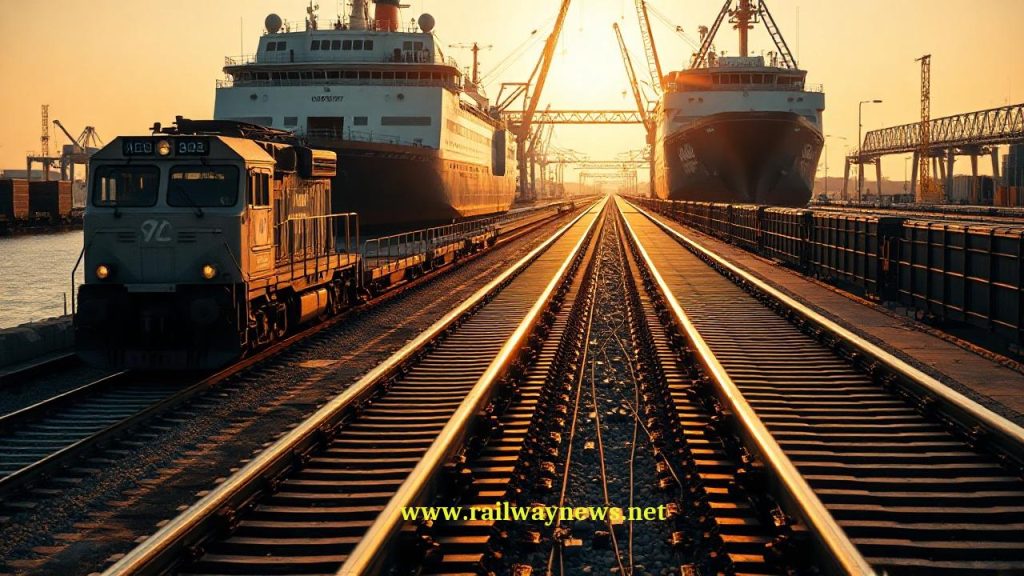
⚡ In Brief: DB Cargo Full Load Solutions Nordics operates a weekly rail service moving 120-meter rails from southern Poland to Sweden via the Świnoujście-Ystad rail ferry, with zero intermediate transshipment for Swedish railway infrastructure projects.
ŚWINOUJŚCIE, Poland – DB Cargo Full Load Solutions Nordics has been running a dedicated rail transport corridor between southern Poland and Sweden for approximately one year, using the rail ferry connection between Świnoujście and Ystad. The service moves rails up to 120 meters in length directly from factory to Swedish infrastructure project sites. Weekly departures carry nearly an entire freight train per sailing, with the ferry offering approximately 540 meters of track capacity.
What Is the Full Scope of This Project?
The service connects a rail manufacturing facility in southern Poland to multiple railway infrastructure project sites across Sweden, using a single rail ferry crossing that departs Świnoujście daily in the early afternoon and arrives at Ystad on Sweden’s Baltic coast the same evening. The 120-meter rails are loaded simultaneously onto multiple connected railcars using specialized securing devices, then roll directly onto the ferry without any intermediate transshipment. DB Cargo FLS Nordics — a unit of TRANSA Spedition GmbH — coordinates with Väte Rail as a project partner, the shipping company Unity Line, and port authorities at both terminals. The service had previously operated but was discontinued roughly ten years ago; the current challenge involved reassembling the partner network and establishing a viable operational framework for regular shipments.
Key Project Data
| Parameter | Value |
|---|---|
| Project / Contract Name | Poland-Sweden Long Rail Transport Service (DB Cargo FLS Nordics) |
| Total Value | Not disclosed |
| Parties Involved | DB Cargo FLS Nordics (TRANSA Spedition GmbH), Väte Rail, Unity Line, Port of Świnoujście, Port of Ystad |
| Timeline / Completion | Operational for approximately one year; ongoing weekly service, no end date disclosed |
| Country / Corridor | Southern Poland – Świnoujście – Ystad – Swedish rail network |
| Maximum Rail Length | 120 metres |
| Ferry Track Capacity | Approximately 540 metres (nearly one full freight train) |
| Frequency | Generally once per week |
How Does This Compare to Similar Projects?
The Świnoujście-Ystad route is one of only a handful of operational rail ferry corridors serving Sweden. The Swedish Transport Administration has actively intervened to secure continued rail ferry operations across multiple routes, despite a structural decline in wagon-load ferry traffic following the opening of the Öresund Bridge in 2000. A parallel example is the Stena Line rail ferry between Trelleborg and Rostock, which the Swedish state has designated as critical for military mobility and national resilience, with a formal agreement signed to maintain that service (Source: Swedish Transport Administration, 2025). The DB Cargo FLS Nordics service differs in its specialization — moving exceptionally long, project-specific rail segments that cannot be practically transported by road or via the fixed Öresund link. The Poland rail freight market, which underpins the origin side of this corridor, is projected to expand through 2025 on the back of logistics sector growth and strategic infrastructure investment (Source: IndexBox, 2025). Specific shipment volumes and contract values for the DB Cargo FLS Nordics service were not publicly available at time of publication.
Editor’s Analysis
The reactivation of a previously mothballed Poland-Sweden rail ferry corridor signals that infrastructure renewal spending in Scandinavia is strong enough to justify bespoke, high-coordination logistics chains. Transporting 120-metre rails by rail-sea-rail eliminates the need for cutting, welding, or intermediate storage — a cost advantage that appears to outweigh the operational complexity of multi-party scheduling across two ports, a shipping line, and two national rail networks. The Swedish state’s parallel commitment to maintaining the Trelleborg-Rostock ferry for defence purposes suggests rail ferry capacity has a dual-use resilience dimension that fixed crossings cannot replicate. If Nordic infrastructure investment maintains its current trajectory, demand for these specialized heavy-cargo rail ferry corridors is likely to intensify, potentially straining the 540-metre-per-sailing capacity ceiling on the Świnoujście-Ystad link.
FAQ
Q: Why transport 120-metre rails by ferry instead of via the Öresund Bridge?
A: Rails of this length cannot negotiate road or standard rail curves on alternative overland routes without being cut into shorter segments. The rail ferry allows a single continuous 120-metre piece to travel from a Polish factory directly to a Swedish worksite without any intermediate cutting or re-welding.
Q: What specialized equipment secures rails of this length during transport?
A: DB Cargo FLS Nordics loads each 120-metre rail simultaneously onto multiple connected flatcars using bespoke securing devices that distribute load forces and prevent longitudinal shifting during both rail haulage and the ferry crossing. The exact design specifications of these devices have not been publicly released.
Q: Which rail infrastructure projects in Sweden receive these deliveries?
A: DB Cargo FLS Nordics has not publicly named the specific Swedish railway infrastructure projects or end clients receiving the rails. The Swedish Transport Administration is the primary procurer of rail infrastructure works in the country and is the most likely ultimate customer for such deliveries, though this has not been officially confirmed.

Railway infrastructure, rolling stock and transport technologies specialist focused on global rail industry developments, high-speed rail systems, signaling technologies and freight transportation. Covering railway investments, public transport modernization, rail operations and international mobility projects across Europe, Asia and North America.
RELATED POSTS

October 8, 2026 1:15 pm
Alstom secured a €1bn contract to build 13 automated trains,...

October 1, 2026 7:09 am
United States regulators confirmed a September 30 deadline for the...

October 4, 2026 5:14 pm
Alstom secured a CA$4.7 billion order from VIA Rail Canada...

October 1, 2026 12:13 am
Illinois approved $1.5 billion annually for the Northern Illinois Transit...

October 1, 2026 6:10 am
Amtrak approved a System Expansion Committee on July 30 to...

October 5, 2026 1:13 pm
New York MTA confirmed a late 2026 DEIS release for...