
Vancouver SkyTrain Turns 40: Automated Rail Pioneer Celebrated
Vancouver SkyTrain celebrates 40 years! From a 13-mile Expo showcase to a 50-mile automated network, it proves driverless rail’s global impact.
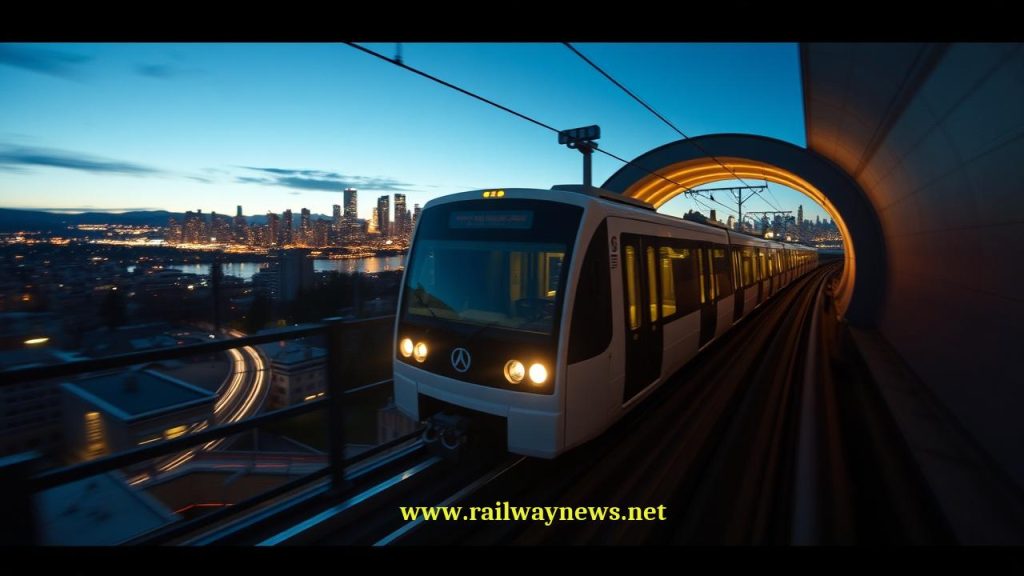
VANCOUVER, B.C. — TransLink is marking four decades of its pioneering SkyTrain automated light metro system, a landmark project that has grown from a 13-mile showcase for the 1986 World Exposition to a sprawling 50-mile network integral to Metro Vancouver’s mobility. The system, one of the world’s longest and oldest fully automated transit networks, stands as a global testament to the long-term success of driverless urban rail technology.
| Category | Details |
|---|---|
| System Operator | TransLink (South Coast British Columbia Transportation Authority) |
| Inauguration | December 11, 1985 (ahead of Expo 86) |
| Core Technology | Automated Rapid Transit (ART) with Linear Induction Motors (LIM) |
| Rolling Stock Manufacturer | UTDC / Bombardier Transportation / Alstom |
| Initial Network Size | 13 miles (21.4 km) |
| Current Network Size | Approx. 50 miles (80 km) |
TransLink, the transportation authority for Metro Vancouver, is celebrating the 40th anniversary of its SkyTrain service. The system’s origins trace back to the early 1980s, when regional officials sought a futuristic transportation solution to feature at the 1986 World Exposition (Expo 86). According to TransLink, the vision was for an automated rapid transit system with a small footprint, capable of navigating dense urban areas and steep grades. “Celebrating 40 years of SkyTrain reminds us just how far this bold Expo 86 idea has come,” said TransLink CEO Kevin Quinn. “As we mark this milestone, I’m excited for how the next phase of the system will keep Metro Vancouver at the forefront of modern, climate-focused transportation.”
From a technical standpoint, the SkyTrain was a trailblazer. The Expo and Millennium lines operate on Advanced Rapid Transit (ART) technology, which utilizes steerable-axle bogies and linear induction motors (LIMs) for propulsion. This LIM technology, where the motor is effectively unrolled along the track, allows for exceptional grade-climbing ability, quieter operation compared to conventional wheel-on-rail systems, and precise braking without physical contact. The entire system was designed for Grade of Automation 4 (GoA4), meaning it is fully automated and driverless, a rarity for large-scale public transit systems at the time of its launch. Original rolling stock was developed by the Urban Transportation Development Corporation (UTDC), with subsequent generations delivered by Bombardier Transportation (now part of Alstom).
What began as a single 13-mile line has quadrupled in size, evolving into a multi-line network that forms the backbone of regional transit. Following the initial Expo Line, the system expanded with the Millennium Line in 2002 and the Canada Line in 2009, the latter of which uses conventional electric motors but is fully integrated into the SkyTrain brand and network. This sustained investment highlights the system’s success and scalability. Major expansion projects are currently underway, including the Broadway Subway Project—a 5.7 km extension of the Millennium Line—and the 16 km Surrey Langley SkyTrain Extension, which will further cement its role in the region’s long-term growth and sustainability goals.
Key Takeaways
- Pioneering Automation: Vancouver’s SkyTrain was one of the first and remains one of the longest fully automated, driverless transit systems in the world, proving the concept’s viability on a mass scale.
- Fourfold Growth: The system has expanded from its original 13-mile Expo 86 route to a detailed 50-mile, three-line network, demonstrating its scalability and central role in regional planning.
- Continued Investment: With major projects like the Broadway Subway and Surrey Langley extensions underway, SkyTrain continues to be the focus of significant capital investment for Metro Vancouver’s future.
Editor’s Analysis
The 40-year anniversary of the Vancouver SkyTrain is more than a local milestone; it’s a significant marker for the global urban rail industry. SkyTrain served as a crucial proof-of-concept for Grade of Automation 4 (GoA4) systems, demonstrating that the public would embrace driverless technology and that it could be operated safely and efficiently at high frequencies. Its success provided a blueprint for cities worldwide, de-risking the political and technical challenges associated with adopting automated metros. Additionally, its long-term use of Linear Induction Motor (LIM) technology offers a valuable case study for transit planners considering alternatives to conventional propulsion, especially in topographically challenging urban environments. As cities globally grapple with decarbonization and densification, the SkyTrain legacy underscores the transformative power of bold, forward-looking investments in automated rail technology.
Frequently Asked Questions
- Why was the SkyTrain system originally built?
- The SkyTrain was developed in the early 1980s as a showcase project for the 1986 World Exposition (Expo 86) in Vancouver. The goal was to demonstrate a modern, automated rapid transit system that could serve as a model for future urban transportation.
- What makes the SkyTrain’s technology unique?
- The Expo and Millennium Lines use Advanced Rapid Transit (ART) technology with linear induction motors (LIMs). Unlike conventional trains, this system uses a magnetic field for propulsion, allowing for better performance on steep grades and quieter operation. It was also one of the world’s first large-scale, fully automated (driverless) transit systems.
- Is the SkyTrain system still expanding?
- Yes, the system is actively expanding. Key projects include the Broadway Subway Project, which will extend the Millennium Line further into Vancouver, and the Surrey Langley SkyTrain project, which will extend the Expo Line to serve growing communities south of the Fraser River.

Railway infrastructure, rolling stock and transport technologies specialist focused on global rail industry developments, high-speed rail systems, signaling technologies and freight transportation. Covering railway investments, public transport modernization, rail operations and international mobility projects across Europe, Asia and North America.
RELATED POSTS

October 8, 2026 1:15 pm
Alstom secured a €1bn contract to build 13 automated trains,...

October 1, 2026 7:09 am
United States regulators confirmed a September 30 deadline for the...

October 4, 2026 5:14 pm
Alstom secured a CA$4.7 billion order from VIA Rail Canada...

October 5, 2026 6:12 pm
AECOM and Jacobs secured a contract in September 2026 to...

October 1, 2026 12:13 am
Illinois approved $1.5 billion annually for the Northern Illinois Transit...

October 4, 2026 11:08 pm
Sound Transit confirmed the September 30 opening of Seattle Pinehurst...