
US Mandates English for Border Rail Crews, Citing Safety Concerns
US mandates English proficiency for border rail crews, restricting Mexican operations. This safety-focused move impacts Union Pacific and CPKC, reshaping cross-border logistics.
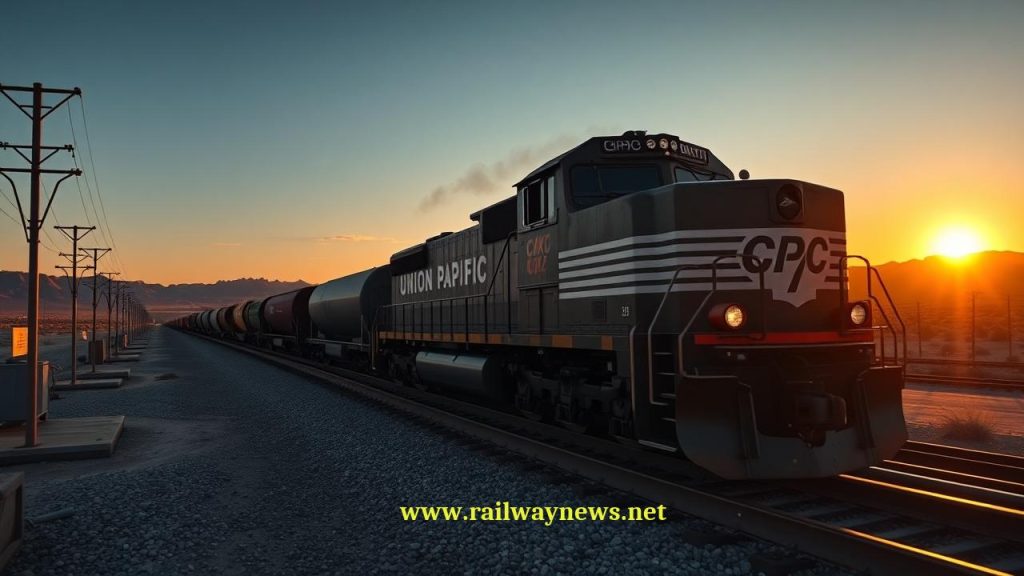
WASHINGTON D.C. – The Trump administration has mandated English language proficiency for all rail crews operating across the U.S.-Mexico border, a move announced by U.S. Transportation Secretary Sean Duffy on December 19. Following safety audits that revealed significant communication issues, the new federal directive also restricts Mexican train crews to operating within a 10-mile radius of their U.S. entry points.
| Category | Details |
|---|---|
| New Regulation | Mandatory English language proficiency for cross-border rail crews. |
| Key Restriction | Mexican crews are prohibited from operating more than 10 miles (16 km) into the U.S. |
| Affected Railroads | Union Pacific (UP) and Canadian Pacific Kansas City (CPKC). |
| Announcing Body | U.S. Department of Transportation, Federal Railroad Administration (FRA). |
| Rationale | Safety concerns after crews struggled to interpret operational bulletins and safety rules in English. |
Main Body:
The new requirement was formalized after Federal Railroad Administration (FRA) inspectors conducted focused safety audits this fall. According to Transportation Secretary Sean Duffy, inspectors encountered inbound rail crews from Mexico who “appeared to have difficulty interpreting” general track bulletins—critical notices about track conditions that temporarily impact operations. Additionally, the crew members reportedly struggled to communicate effectively about mandatory safety requirements when questioned by the federal inspectors, prompting immediate action from the Department of Transportation.
The FRA inspections, which focused on rail yards in Texas, uncovered specific instances of communication failure. Inspectors noted that Mexican crews had difficulty understanding technical details, specifications, dates, and safety information related to their consists. At a Canadian Pacific Kansas City (CPKC) rail yard, inspectors found numerous cases where crews could not comprehend operating bulletins or U.S. regulations requiring hazardous materials and emergency response information to be maintained in English. While Union Pacific had a translator available for its crews, inspectors expressed concern about the long-term viability of this solution and the crews’ independent understanding of operating rules.
In response, the FRA issued formal letters to both Union Pacific and CPKC, urging them to reexamine their cross-border practices. Railroads like UP and CPKC routinely rely on Mexican crews to operate trains from Mexico into U.S. rail yards before handing them over to American engineers and conductors. “Train crew operators who can’t speak English pose a significant safety risk that should not be ignored,” stated FRA Administrator David Fink, underscoring the non-negotiable nature of the new safety protocol.
Key Takeaways
- New Operational Limit: Mexican crews are now restricted to operating no more than 10 miles into the U.S., a move that will directly impact cross-border crew change points and logistics.
- Increased Scrutiny on Railroads: Union Pacific and CPKC are under direct notice from the FRA to revise and enforce stricter language proficiency and training protocols for their cross-border operations.
- Safety Precedent Established: The mandate establishes a clear federal link between language proficiency and operational rail safety, which could influence future regulations for international transport corridors.
Editor’s Analysis
This directive from the Trump administration marks a pivotal moment for the highly integrated North American rail network. While ostensibly a safety measure, it exposes a critical friction point between the seamless logistics envisioned by agreements like the USMCA and the realities of national regulatory oversight. For carriers like CPKC, which has built its entire post-merger identity on a single-line network connecting Canada, the U.S., and Mexico, this presents a significant operational challenge. The mandate will force railroads to immediately invest in robust language training and verification programs or reconfigure crew change logistics, potentially adding time and cost to a vital and competitive freight corridor. This move highlights that as supply chains become more international, operational vulnerabilities like language barriers can trigger swift and impactful regulatory intervention.
Frequently Asked Questions
- Why did the U.S. government implement this new rule for train crews?
- The rule was implemented after Federal Railroad Administration (FRA) inspectors identified significant safety risks. They found that some Mexican train crews had difficulty understanding critical safety information, track bulletins, and hazardous materials regulations written in English.
- Which railroad companies are most affected by this regulation?
- The regulation directly impacts major Class I railroads with substantial cross-border operations, specifically Union Pacific (UP) and Canadian Pacific Kansas City (CPKC), both of which were subjects of the recent FRA inspections.
- What are the specific restrictions now in place for Mexican train crews?
- Mexican crews are now subject to two main restrictions: they must be able to demonstrate proficiency in English, and they are not permitted to operate trains more than 10 miles (16 kilometers) into the United States from their point of entry.

Transport and railway industry editor covering global rail infrastructure, sustainable mobility, urban transit systems and next-generation railway technologies with a focus on accessible and industry-focused reporting.
RELATED POSTS

October 8, 2026 1:15 pm
Alstom secured a €1bn contract to build 13 automated trains,...

October 1, 2026 7:09 am
United States regulators confirmed a September 30 deadline for the...

October 8, 2026 12:18 pm
Siemens Mobility signed an agreement with VinSpeed to supply 350...

October 4, 2026 5:14 pm
Alstom secured a CA$4.7 billion order from VIA Rail Canada...

October 5, 2026 6:12 pm
AECOM and Jacobs secured a contract in September 2026 to...

October 1, 2026 12:13 am
Illinois approved $1.5 billion annually for the Northern Illinois Transit...