
UP & NS Merger: Rivals Challenge Application’s Completeness
UP and NS defend their merger application against rivals’ claims of incompleteness, potentially impacting communities like Chesterton, Indiana, and rail traffic.
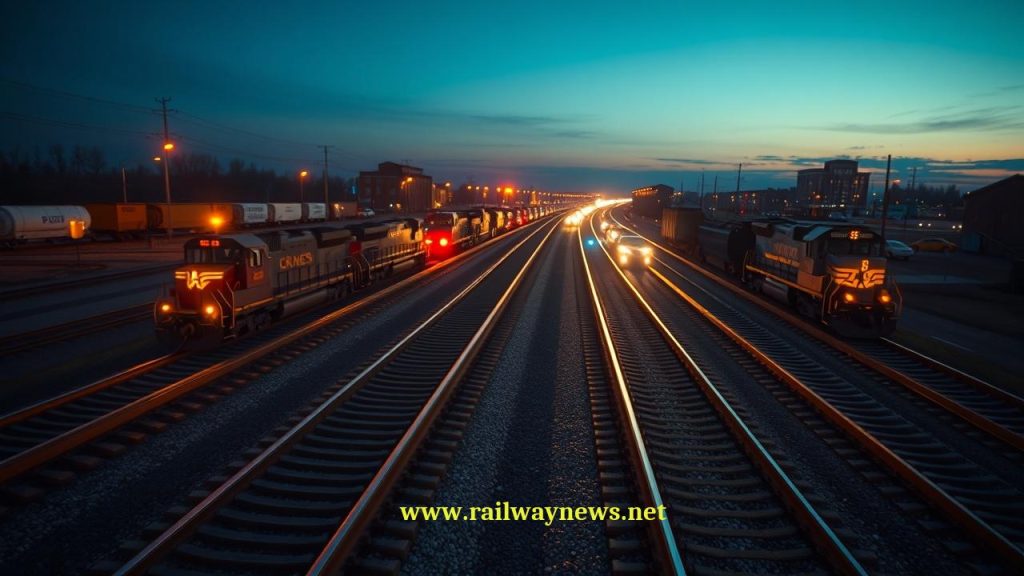
Union Pacific and Norfolk Southern have formally defended their merger application before the Surface Transportation Board (STB), rejecting claims from all four of their Class I railroad rivals that the filing is incomplete and should be dismissed. The procedural battle marks the first major hurdle in a consolidation proposal that could see rail traffic increase significantly in key corridors, such as the 1.14-mile stretch in Chesterton, Indiana, which already handles an average of 85 trains per day.
| Category | Details |
|---|---|
| Regulatory Filing | UP-NS Merger Application Completeness Review |
| Regulating Body | Surface Transportation Board (STB) |
| Merger Proponents | Union Pacific Railroad (UP) & Norfolk Southern Railway (NS) |
| Formal Opponents | BNSF Railway, Canadian Pacific Kansas City (CPKC), CN, CSX |
| Key Community Impact | Potential traffic increase in Chesterton, IN (current avg: 85 trains/day) |
Main Body:
In a direct response to the Surface Transportation Board’s call for public input, Union Pacific and Norfolk Southern have pushed back against a unified front of competitors seeking to block their merger application at its initial stage. The two railroads assert that their filing contains all necessary information for the STB to proceed with a detailed review. This statement follows formal comments submitted by BNSF, CPKC, CN, and CSX, which argued that the application was materially deficient, lacking the critical data required by the board to adequately assess the merger’s potential impact on competition, service, and the national rail network.
The core of the opposition’s argument centers on the alleged failure of UP and NS to provide sufficient operational and market data. Competitors claim that without this detailed information, the STB cannot properly model the effects of the consolidation on freight traffic patterns and service reliability. This is particularly salient for communities like Chesterton, Indiana, where a dense 1.14-mile rail corridor already experiences heavy traffic. An increase beyond the current 85-train daily average, a potential outcome of the merger, would have significant local impacts on grade crossings and community life—precisely the type of consequence the STB is mandated to evaluate based on a complete and thorough application.
This procedural challenge is a standard but critical phase in any major rail merger. The North American rail industry, dominated by a handful of Class I carriers, views any consolidation as a seismic shift in the competitive landscape. The recent formation of CPKC set a modern precedent for the intense level of scrutiny applied by the STB. The current dispute over the application’s “completeness” is a strategic effort by rivals to raise the regulatory bar from the outset. This occurs against a backdrop of heightened industry focus on supply chain stability, where events like the recent CSX derailment in Kentucky serve as a constant reminder of the network’s operational vulnerabilities, a key concern in any merger evaluation.
Key Takeaways
- Union Pacific and Norfolk Southern are actively defending the completeness of their merger application filed with the Surface Transportation Board.
- All other Class I railroads—BNSF, CPKC, CN, and CSX—have formally requested the STB reject the application as incomplete.
- The dispute highlights the significant local impacts under consideration, such as potential traffic increases in high-density corridors like Chesterton, Indiana.
Editor’s Analysis
This initial skirmish over the application’s completeness is more than just procedural posturing; it is the opening salvo in what promises to be a protracted and highly contentious regulatory battle. By challenging the filing at its inception, the rival railroads are attempting to frame the narrative and force UP and NS onto the defensive, compelling them to disclose more granular operational data than they might have intended. The STB’s decision on whether to accept the application as filed will be a crucial early indicator of the board’s stance. A rejection would signal a demand for unprecedented transparency, potentially delaying the merger timeline and setting a formidable tone for the entire review process in an era where network fluidity and public interest are paramount.
Frequently Asked Questions
- Who is opposing the Union Pacific and Norfolk Southern merger application?
- All four other Class I railroads are opposing the application at this stage: BNSF Railway, Canadian Pacific Kansas City (CPKC), CN, and CSX, along with some shipper groups.
- What is the main argument against the merger application right now?
- The primary argument from competitors is that the application is “incomplete.” They claim it lacks sufficient data and detailed information for the Surface Transportation Board (STB) to properly evaluate its competitive and operational impacts.
- What is an example of a potential local impact from this merger?
- A potential merger could significantly increase train traffic in communities along key routes. For example, Chesterton, Indiana, which already sees an average of 85 trains per day in a 1.14-mile corridor, could experience even higher volumes.

Railway infrastructure, rolling stock and transport technologies specialist focused on global rail industry developments, high-speed rail systems, signaling technologies and freight transportation. Covering railway investments, public transport modernization, rail operations and international mobility projects across Europe, Asia and North America.
RELATED POSTS

October 1, 2026 7:09 am
United States regulators confirmed a September 30 deadline for the...

October 8, 2026 1:15 pm
Alstom secured a €1bn contract to build 13 automated trains,...

October 4, 2026 5:14 pm
Alstom secured a CA$4.7 billion order from VIA Rail Canada...

October 1, 2026 12:13 am
Illinois approved $1.5 billion annually for the Northern Illinois Transit...

October 6, 2026 2:14 am
Union Pacific launched export rail shipments with Ferromex to deliver...

October 1, 2026 6:10 am
Amtrak approved a System Expansion Committee on July 30 to...