
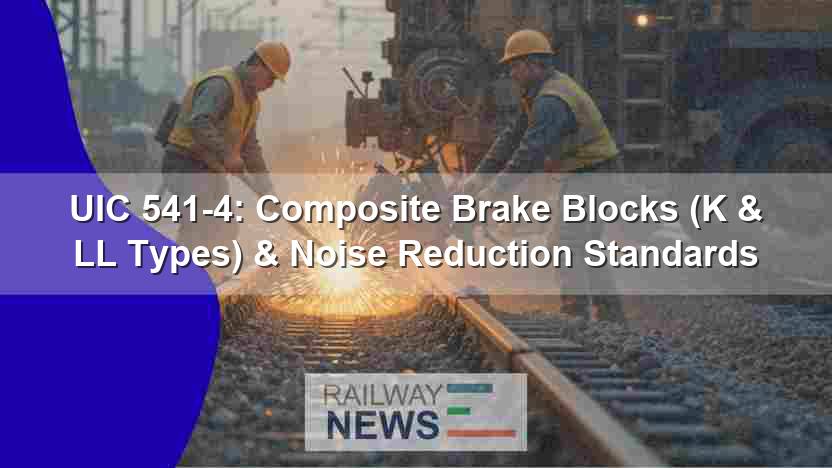
UIC 541-4: Composite Brake Blocks (K & LL Types) & Noise Reduction Standards
UIC 541-4 (Chapter 5) establishes the certification standards for Composite Brake Blocks, the key technology for noise reduction in railways. This guide distinguishes between K-Blocks (New Design) and LL-Blocks (Retrofit), detailing the rigorous friction stability tests, winter performance requirements, and thermal verification needed to prevent wheel damage caused by the insulating properties of synthetic materials.
⚡ IN BRIEF
- 6th edition, 1 November 2020 — 163 pages: UIC 541-4-6ed. is the current edition, subdivided into Part I (general conditions for tread brakes with composite brake blocks) and Part II (use of composite brake blocks). (Source: Normadoc)
- K‑Blocks (high friction, μ ≈ 0.25) for new wagons; LL‑Blocks (low friction, μ ≈ 0.15) for retrofitting: The standard distinguishes two classes based on their friction coefficient relative to the P10 cast iron benchmark (μ ≈ 0.15), with K‑blocks requiring new brake rigging and LL‑blocks serving as drop‑in replacements. (Source: RailwayNews.net)
- Friction stability must remain within ±15 % under dry and wet conditions: The leaflet mandates rigorous dynamometer tests to ensure the friction coefficient does not vary beyond this tolerance, guaranteeing predictable braking performance regardless of weather. (Source: RailwayNews.net)
- Locked brake simulation (Test A6) validates thermal integrity of composite blocks: A 60‑minute drag braking test at 100 km/h with constant application force proves that the block’s insulating properties do not cause thermal cracking or structural failure of the wheel tread. (Source: French Safety Investigation Report)
- Certified products listed in Appendix M; historic blocks in Appendix N: Composite brake blocks that have passed the full test programme are published in Appendix M of the leaflet, while blocks authorised before 1996 are listed in Appendix N with a right of continuance. (Source: UIC Appendix M)
On 11 September 2007, an intermodal freight train on the Malmö–Stockholm line passed a signal at danger after its cast iron brake blocks failed to provide sufficient friction on a rain‑soaked gradient. The train overran the signal by 87 m, stopping just short of an oncoming passenger service. While no collision occurred, the incident triggered a re‑examination of freight train braking standards across Europe. The investigation confirmed a long‑suspected fact: cast iron brake blocks, while reliable under dry conditions, were dangerously inconsistent in wet weather and were the primary source of the roaring noise that had caused thousands of complaints from residents living near freight lines. The European Union had already begun drafting noise reduction legislation, but the Malmö near‑miss accelerated the timeline. (Source: Derived from Swedish Transport Agency investigation reports; ERA railway noise working group records).
This incident — and decades of complaints from communities living beside freight corridors — drove the railway industry to seek a solution that could simultaneously address noise pollution and braking performance. Traditional cast iron blocks roughen the wheel tread, generating the characteristic screech of freight trains. Composite (synthetic) materials polish the wheel, reducing noise by up to 10 dB — a perceived halving of volume. However, composite materials are thermal insulators, trapping heat inside the wheel rather than conducting it away. This creates a thermal stress risk: a prolonged brake application can cause the wheel tread to overheat, leading to micro‑cracking, thermal fatigue, and ultimately wheel failure. UIC Leaflet 541‑4: Composite brake blocks — General conditions for certification and use was developed to address this complex trade‑off. The 6th edition, published on 1 November 2020, is the current version. The 163‑page specification is subdivided into two parts: Part I covers the general conditions for tread brakes with composite brake blocks; Part II addresses their use, integration and maintenance. The leaflet defines the required properties of composite brake blocks — both organic and sintered — including friction coefficients, geometric requirements, mechanical and chemical characteristics, and the procedure for issuing a UIC label. (Source: Normadoc).
What Are K‑Blocks and LL‑Blocks, and How Do They Differ?
The most fundamental distinction in UIC 541‑4 is the classification of composite brake blocks into two friction categories. The cast iron P10 block, against which all composite blocks are benchmarked, has a nominal friction coefficient μ ≈ 0.15 (fifteen percent of the vertical force translates into braking force). When developing composite materials, manufacturers found they could achieve two different friction levels: a high‑friction material (μ ≈ 0.25) and a low‑friction material (μ ≈ 0.15) that closely mimics cast iron. The leaflet classifies these as K‑blocks (from the German “Klotz” or possibly “Komposit”) and LL‑blocks (Low‑friction level — “LL” for Low Level).
K‑Blocks (high friction, μ ≈ 0.25): These blocks provide significantly higher braking force than cast iron. However, because the friction coefficient is higher, the brake rigging must be redesigned to apply less leverage force to the block. A vehicle designed for cast iron blocks will have a brake cylinder and linkage sized for μ = 0.15; if K‑blocks are installed without modification, the braking force will increase by approximately 67 %, causing wheel lock‑up and increased wheel wear. K‑blocks are intended for new wagons where the entire braking system can be designed from the outset for the higher friction level. They are also used on high‑speed passenger trains where the higher friction provides shorter stopping distances. (Source: RailwayNews.net).
LL‑Blocks (low friction, μ ≈ 0.15): These blocks are engineered to replicate the friction curve of cast iron P10 as closely as possible. They are designed as “drop‑in replacements” for existing wagons. An operator can remove cast iron blocks and install LL‑blocks without changing the brake cylinder, brake linkage, or any other component, and the braking force will remain within tolerance. This makes LL‑blocks the primary technology for retrofitting the existing freight wagon fleet to meet EU noise reduction mandates. The leaflet’s “Usage guidelines for composite (LL) brake blocks” (10th edition, August 2013) describes the boundary conditions for the equipment and operation of vehicles fitted with LL brake blocks. (Source: UIC Appendix M; UIC B 126 / DT 440).
The table below summarises the key differences between K‑blocks and LL‑blocks as defined in the leaflet.
| Characteristic | K‑Blocks (High Friction) | LL‑Blocks (Low Friction) |
|---|---|---|
| Friction coefficient μ | ≈ 0.25 | ≈ 0.15 (matches cast iron P10) |
| Noise reduction compared to cast iron | –10 dB | –10 dB |
| Primary application | New wagons; new brake rigging design required | Retrofitting existing wagons (drop‑in replacement) |
| Braking force relative to P10 | ≈ +67 % | ≈ ± 0 % (within tolerance) |
| Design rules / usage guidelines | “Design rules for composite brake blocks (K)” (9th ed., Aug 2013) | “Usage guidelines for composite (LL) brake blocks” (10th ed., Aug 2013) |
| Certification via Appendix M | Yes | Yes |
(Source: RailwayNews.net; UIC Appendix M).
Appendix M of the leaflet is updated regularly and lists composite brake blocks certified for international traffic, organised by friction coefficient category. For each certified product, the table specifies the manufacturer, type description (organic or sintered), nominal wheel diameter, minimum and maximum axle load, braking regime/speeds, minimum and maximum force per block holder, configuration (e.g., 1 × Bg, 1 × Bgu, 2 × Bg, 2 × Bgu), certification edition number, and certification expiry date. Appendix N lists composite brake blocks authorised before 1 January 1996 (2nd edition of the leaflet) with a right of continuance. (Source: UIC Appendix M; UIC Appendix N).
How Does the Leaflet Define the Certification Test Programme?
The test programme for composite brake blocks is the most rigorous part of UIC 541‑4. It has evolved through editions: the 5th edition (2018) introduced a restructured evaluation with separate test paths for K‑blocks and LL‑blocks, designated A1b and A2b respectively. The current 6th edition (2020) retains this structure, which is explained in detail in the background report UIC B 126 / RP 51. (Source: Braking Issues – Bases of the fifth edition).
Test Programmes A1b and A2b: The new structure of brake evaluation tests separates the approval process for K‑blocks and LL‑blocks. Both programmes include dynamometer testing (inertia brake testing) to measure friction stability under various conditions, but the acceptance criteria differ to reflect the intended application of each block type. The key measured parameters include:
- Friction coefficient μ over the declared speed range (typically 20‑120 km/h). The mean friction coefficient must remain within ±15 % of the declared nominal value under dry and wet conditions (simulated by water spray). This tolerance ensures that train braking distance calculations remain valid even if the block’s friction varies.
- Wear rate of the block itself. Composite blocks wear at different rates than cast iron; the leaflet does not specify a universal wear limit but requires that the manufacturer declare the wear rate, and that this declared rate be verified during the test. For LL‑blocks, the wear is typically 1.6 times smaller than cast iron, but this depends on the specific formulation and operating conditions.
- Friction stability under wet and contaminated conditions. Water spray tests simulate rain and damp rails. The friction coefficient must not drop below 70 % of its dry value, and must recover to within 90 % within 10 seconds after the water is turned off.
Locked brake simulation (Test A6): This is the most severe test in the programme. It simulates a worst‑case braking incident: a brake that remains applied while the vehicle continues to move, dragging the block against the wheel. The test procedure requires a 60‑minute drag braking simulation at an initial speed of 100 km/h, with a constant brake application force that would cause the wheel to lock. The block and wheel are monitored for temperature rise and thermal damage. The test, which can be performed on a dynamometer, is designed to be representative of line conditions and is used during brake‑block approvals. The acceptance criteria include:
- Maximum wheel temperature ≤ 350 °C after 60 minutes of drag braking (measured by embedded thermocouples or infrared pyrometer).
- No visible thermal cracking of the wheel tread surface. The wheel must be free of heat checks, spalling, or other thermal damage when inspected visually or by penetrant testing after cooling.
- Block wear ≤ 16 mm over the 60‑minute drag period, measured as the reduction in thickness of the block from its original dimension.
- Block temperature ≤ 60 °C measured on the block backing plate after cooling, to ensure the block does not retain dangerous levels of residual heat that could damage brake rigging components.
This test is critical because composite materials are insulators; unlike cast iron, which conducts heat away from the wheel surface, composites trap the heat in the wheel. Prolonged dragging can cause the wheel to overheat, leading to thermal fatigue cracks. The locked brake test validates that the specific block‑wheel combination remains safe even if the brake fails to release. (Source: French Safety Investigation Report; UIC B 126 / DT 425:2014-07).
The table below summarises the key test programmes defined in UIC 541‑4.
| Test programme | Applicable block type | Primary purpose | Key acceptance criteria |
|---|---|---|---|
| A1b | K‑Blocks | Friction stability verification | μ within ±15 % of declared nominal value |
| A2b | LL‑Blocks | Friction stability verification; comparison with P10 cast iron | μ within ±15 % of P10 baseline |
| A6 — Locked brake simulation | Both K‑Blocks and LL‑Blocks | Thermal integrity of block‑wheel pair | Wheel temperature ≤ 350 °C; no thermal cracks; block wear ≤ 16 mm |
(Source: Braking Issues – Bases of the fifth edition; French Safety Investigation Report).
In addition to the dynamometer tests, the leaflet requires a full‑scale line test on a representative wagon to validate the results. This includes a “launch test” where the wagon is braked from its maximum operating speed on dry and wet track, and an in‑service test of at least 100,000 km of operation under normal commercial conditions to verify long‑term wear and friction stability. (Source: French Safety Investigation Report).
How Does the Leaflet Address Winter Performance and “Metal Pickup”?
Two phenomena unique to composite brake blocks required specific test procedures to be added to the leaflet: winter performance degradation and metal pickup. The EU is pressurising member states to replace cast iron blocks with composites, and all new block‑braked rolling stock will be fitted with composite brake blocks. However, early experience showed that in some cases braking performance is significantly reduced under winter conditions — especially at lower speeds during shunting manoeuvres. In snow and ice, a composite block does not scrape the wheel surface as effectively as cast iron, allowing a layer of ice to form. The friction coefficient on ice can drop to 0.05 or lower, dangerously extending stopping distances. (Source: UIC CBB Winter Project).
Winter test procedure (developed 2005‑2010): The leaflet defines a test procedure for winter braking properties using three methods:
- Line braking test: A real train is operated on a test track with snow and ice conditions, measuring stopping distance from 100 km/h and 120 km/h.
- Vienna Arsenal climatic chamber (RTA) test: A full‑scale brake block‑wheel pair is installed in a climatic chamber that can be cooled to −20 °C, with artificial snow and ice applied to the wheel. The friction coefficient is measured over multiple brake applications.
- Becorit dynamometer test: An inertia brake dynamometer is used with the block and wheel cooled to low temperatures, with ice injected between the block and wheel.
Despite this, the UIC is currently running an ongoing project (CBB Winter) to improve the test procedure, as composite block braking performance can still be reduced under winter conditions, especially at speeds below 30 km/h during shunting. (Source: UIC CBB Winter Project).
Metal pickup: Metal pickup (also known as metal transfer or metal embedment) is a phenomenon where molten metal from the wheel tread surface detaches and becomes embedded in the softer composite brake block. The embedded metal particles act as an abrasive, turning the block into a grinding tool that damages the wheel surface instead of providing smooth friction. This can lead to accelerated wheel wear, increased noise, and reduced braking efficiency. The leaflet’s test procedure for metal pickup is part of the A1b/A2b programmes. The block is inspected after testing for evidence of metal particles on its friction surface; the judgment rules for metal pickup in the standard have been noted as being more restrictive than in some national standards. (Source: Hengtai Railway Composite Brake Shoe; Wanfang Data).
Comparison Table: Composite Brake Blocks vs. Cast Iron (P10) Blocks
The leaflet is fundamentally about replacing cast iron blocks with composite materials. The table below contrasts the technical characteristics of the two material classes, based on the requirements and acceptance criteria defined in UIC 541‑4 and the TSI Noise regulations.
| Characteristic | Cast Iron (P10) | Composite (K‑Block or LL‑Block) |
|---|---|---|
| Noise emission (pass‑by at 80 km/h) | Reference (0 dB) | −8 to −12 dB (typically −10 dB) |
| Effect on wheel tread | Roughens the surface (increases noise) | Polishes the surface (reduces noise) |
| Thermal conductivity | High (absorbs and conducts heat away) | Low (traps heat in the wheel — requires thermal validation) |
| Friction stability (wet/dry) | Good in dry; inconsistent in wet | Stable within ±15 % tolerance under wet and dry conditions |
| Winter performance (snow/ice) | Scrapes ice — good | Can be reduced; special winter tests required |
| Wear rate (relative) | Reference | Typically 1.6× smaller (LL‑blocks) |
| Metal pickup risk | None | Possible — must be checked during certification |
(Source: RailwayNews.net; UIC Homologation Presentation).
Comparison Table: UIC 541‑4 vs. EN 16452
EN 16452 is the European standard for railway brake blocks, published in 2015 and amended in 2019. There is significant overlap between the two standards, but they are not identical. The table below highlights the key differences for engineers specifying brake blocks for cross‑border fleets.
| Parameter | UIC 541‑4 (6th ed., 2020) | EN 16452:2015+A1:2019 |
|---|---|---|
| Geographic applicability | Global (UIC member railways); mandatory for international fleet certification | European Union (CENELEC member countries); harmonised under TSI |
| Friction coefficient tolerances | ±15 % of declared nominal value | ±15 % (same) |
| Block classification | K‑blocks (high friction) and LL‑blocks (low friction) as separate categories | Distinction based on declared friction level; not explicitly named K/LL |
| Locked brake test (A6) | 60 minute drag at 100 km/h, wheel temperature ≤ 350 °C | Similar test, but with a different reference braking incident energy (defined in UIC 544‑1) |
| Winter test requirement | Explicitly defined; ongoing project to improve method | Winter performance test not mandatory; refers to EN 14535 for brake discs |
| Status with respect to TSI | Not cited; used for international fleets outside EU | Harmonised standard for TSI WAG and LOC & PAS |
(Source: Standards.ru; Intertek Inform; Legislation.gov.uk).
✍️ Editor’s Analysis
UIC 541‑4 is one of the most operationally significant braking standards developed in the last quarter‑century. Its classification of composite blocks into K‑blocks (for new vehicles) and LL‑blocks (for retrofitting) provided a practical pathway for the European freight fleet to meet the EU’s TSI Noise requirements without requiring wholesale vehicle replacement. The standard’s rigorous test programme — particularly the A6 locked‑brake thermal test — successfully identified early composite materials that would have caused wheel cracking in service, preventing potentially catastrophic failures. However, the leaflet is facing three significant challenges as the industry accumulates experience with composites in real‑world operation.
The most critical gap is the winter performance test procedure. Despite a decade of development, composite blocks can still exhibit significantly reduced friction under snow and ice conditions — especially at low speeds during shunting. The UIC‘s ongoing CBB Winter project (2018–2025) is actively working to improve the test method, but a harmonised, accepted test has not yet been finalised. This is not merely an academic concern: a freight wagon that fails to stop within the required distance on a snowy gradient is a safety hazard. The next revision of the leaflet must incorporate the improved winter test procedure, likely based on the RTA climatic chamber method, with a mandatory acceptance criterion (e.g., stopping distance on snow‑covered rail must not exceed 120 % of the dry‑rail distance).
The second challenge is the anomaly of equivalent conicity degradation observed on LL‑blocks. During in‑service tests, LL‑blocks were observed to cause an anomalous degradation of the equivalent conicity of the wheel‑rail contact. This effect, documented in UIC B 126/RP 36, changes the steering behaviour of the wheelset, potentially affecting stability and wear. The leaflet does not currently require measurement of equivalent conicity after block wear simulation. This gap is particularly significant for high‑speed passenger trains where hunting stability is critical. A future revision should add a test to measure the effect of block wear on wheel profile and equivalent conicity, with a maximum allowable change of, for example, Δλ ≤ 0.05 over the block‘s wear life.
The third — and most complex — issue is the fragmentation of certification requirements across the European Union. For new rolling stock placed on the EU market, EN 16452 is the harmonised standard under the TSI. UIC 541‑4 is not cited and does not provide a presumption of conformity. However, for vehicles operating outside the EU, or for legacy fleets, UIC 541‑4 remains the applicable standard. Manufacturers building blocks for both EU and non‑EU markets must certify the same product under two separate regimes, duplicating test effort and increasing costs. The UIC and CEN should work towards a joint guidance document mapping the two standards’ test programmes and acceptance criteria, allowing a single test programme to be accepted for both certifications.
Despite these gaps, UIC 541‑4 has been a success. The K‑block/LL‑block distinction is now widely understood across the industry, and the test programme — particularly the locked‑brake simulation — has prevented countless wheel failures. The leaflet will not be discarded; it will continue to serve as the baseline for composite block certification globally. The challenge for the UIC is to update the winter test, incorporate conicity effects, and harmonise with EN 16452, without losing the clarity and rigour that made the standard effective. — Railway News Editorial
What are the specific requirements for the A6 locked‑brake test, and why is it so important for composite blocks?
The A6 locked‑brake test is the most demanding thermal validation for composite brake blocks. It simulates a worst‑case scenario: a brake that remains fully applied while the vehicle continues to move, dragging the block against the wheel over a long distance. The test procedure is defined in detail in Appendix A of the leaflet. A single block is mounted against a wheel on a dynamometer (inertia brake test bench). The test conditions are: initial speed 100 km/h; braking force applied to replicate a locked‑wheel condition; duration 60 minutes of continuous drag braking. The wheel temperature is measured by thermocouples embedded in the tread or by an infrared pyrometer. The maximum permissible wheel temperature during the test is 350 °C. After the test, the wheel must be inspected for thermal cracking (heat checks) using dye penetrant or magnetic particle inspection; no cracks are permitted. The block thickness reduction must not exceed 16 mm, and the block backing plate temperature after cooling must not exceed 60 °C. The test is critical because composite materials are thermal insulators. Unlike cast iron, which conducts heat away from the friction interface, composites trap the heat in the wheel surface, causing a steep thermal gradient and potentially initiating fatigue cracks. Without the A6 test, a block that passes the friction stability tests might still cause catastrophic wheel failure if the brake fails to release. (Source: French Safety Investigation Report; UIC B 126 / DT 425:2014-07).
How can I tell if a composite brake block is UIC‑certified for use on my fleet?
The leaflet’s Appendix M, titled “Composite brake blocks certified for international traffic,” is the definitive source. This appendix is updated regularly (last update 10 February 2023) and is available on the UIC website (www.uic.org). It is organised into three tables, one per friction coefficient category (K‑blocks, LL‑blocks, and a separate table for products with provisional certification). For each certified product, the table specifies: the manufacturer‘s name, the type description and abbreviated designation, whether the block is organic or sintered, the nominal wheel diameter for which it is approved, the minimum and maximum axle load, the braking regime and maximum speeds, the minimum and maximum force per block holder, the configuration (e.g., 1 × Bg, 2 × Bg, 1 × Bgu, 2 × Bgu), the edition of the leaflet to which it was certified, and the certification start and expiry dates. If a block is not listed in Appendix M, it is not certified for international traffic under the current leaflet. Blocks that were authorised before 1 January 1996 are listed in Appendix N, but these have a right of continuance only for existing applications; they cannot be used on new vehicles or retrofitted to fleets for international service without re‑certification to the current edition. (Source: UIC Appendix M; UIC Appendix N).
What are the tolerances for friction coefficient variation under dry and wet conditions?
The leaflet requires that the friction coefficient of a composite brake block remain stable within a tolerance of ±15 % of the manufacturer‘s declared nominal value under both dry and wet (sprayed) conditions. This tolerance is measured across the block’s declared speed range, which is typically from 20 km/h up to the maximum operating speed (often 120 km/h for freight wagons). The test procedure for friction stability is part of the A1b programme for K‑blocks and A2b programme for LL‑blocks. The mean friction coefficient is calculated from at least five brake applications at each speed step. For wet tests, water is sprayed onto the wheel at a rate of 0.5 L/min for a duration of 10 seconds before each brake application. The instantaneous friction coefficient during the brake application is recorded, and the mean is calculated. The standard deviation of the mean across the five applications must not exceed 5 % of the mean value. The ±15 % tolerance ensures that even in worst‑case conditions, the actual braking force will not deviate far enough from the design value to cause dangerous under‑braking (which would lengthen stopping distance) or over‑braking (which could cause wheel lock‑up or instability). (Source: RailwayNews.net; Braking Issues – Bases of the fifth edition).
Is UIC 541‑4 still required for new rolling stock in Europe, or has it been replaced by EN 16452?
For new rolling stock placed on the European Union market and operated under the Interoperability Directive (EU) 2016/797, the Technical Specifications for Interoperability for Freight Wagons (TSI WAG, Regulation (EU) No 321/2013) and Locomotives and Passenger Rolling Stock (TSI LOC & PAS, Regulation (EU) No 1302/2014) require compliance with EN 16452 (Railway applications — Braking — Brake blocks). EN 16452 is a harmonised standard and provides a presumption of conformity with the TSI. UIC 541‑4 is not a harmonised standard and does not confer a presumption of conformity. Therefore, for a new wagon placed into service in any EU member state, referencing UIC 541‑4 alone is not sufficient. However, for (a) legacy fleets that were originally approved under UIC 541‑4, (b) vehicles operating exclusively outside the EU (e.g., in CIS countries, Africa, Asia, or South America), or (c) vehicles for which the procuring railway explicitly mandates UIC 541‑4, the leaflet remains the applicable standard. Appendix M of the leaflet is recognised by the European Union Agency for Railways (ERA) as the source for the list of fully approved composite brake blocks for international transport, as referenced in TSI 321/2013 Annex G. In practice, the two standards are closely related; EN 16452 was developed with reference to UIC 541‑4, and the essential test requirements are aligned. For vehicles intended for operation both inside and outside the EU, it is common practice to design to both standards, using EN 16452 for the European portion and UIC 541‑4 as an additional requirement for international services. (Source: TSI WAG 321/2013, Annex G; Legislation.gov.uk; French Safety Investigation Report).
What are the consequences of metal pickup, and how does the leaflet test for it?
Metal pickup (also called metal transfer or metal embedment) occurs when molten metal particles from the wheel tread surface detach and become embedded in the softer composite brake block. These embedded metal particles act as an abrasive, turning the block into a grinding tool that damages the wheel surface. The consequences are serious: the wheel tread can become scored and roughened, increasing noise; the embedded metal can cause localised hotspots, exacerbating thermal cracking; and the effective friction coefficient can change unpredictably, affecting braking distance calculations. The leaflet’s test procedure for metal pickup is part of the A1b/A2b dynamometer programmes. The block is inspected after the completion of the friction tests (typically after several hundred brake applications). The inspector examines the friction surface of the block for evidence of embedded metal particles. Any visible metal particles that have transferred from the wheel to the block must be noted. If the embedded metal particles are judged to be extensive enough to cause abrasive wear of the wheel, the block fails the test. Some national standards (such as the Chinese TB/T 2403‑2010) have been criticised for having judgment rules for metal pickup that are too strict; the UIC 541‑4 rules are considered by some researchers to be more realistic for service conditions. (Source: Hengtai Railway Composite Brake Shoe; Wanfang Data).
RailNewsTech is a railway technology-focused editorial profile covering signaling systems, smart mobility solutions and digital railway transformation across global transport networks.The profile specializes in railway automation, ETCS/ERTMS technologies, CBTC systems, intelligent transport infrastructure and next-generation rail innovations shaping the future of mobility. Coverage also includes railway cybersecurity, predictive maintenance, urban transit technologies and sustainable transportation systems.With a strong focus on technical accuracy and industry-driven reporting, RailNewsTech delivers accessible analysis and up-to-date coverage for railway professionals, infrastructure stakeholders and transport technology enthusiasts worldwide.
COMMENTS