
Stadler-Siemens Consortium Wins 350-Train Berlin S-Bahn
Stadler and Siemens won a contract to supply 350 new four-car trains for Berlin’s S-Bahn, and will maintain them for 30 years and operate core lines for 15 years.
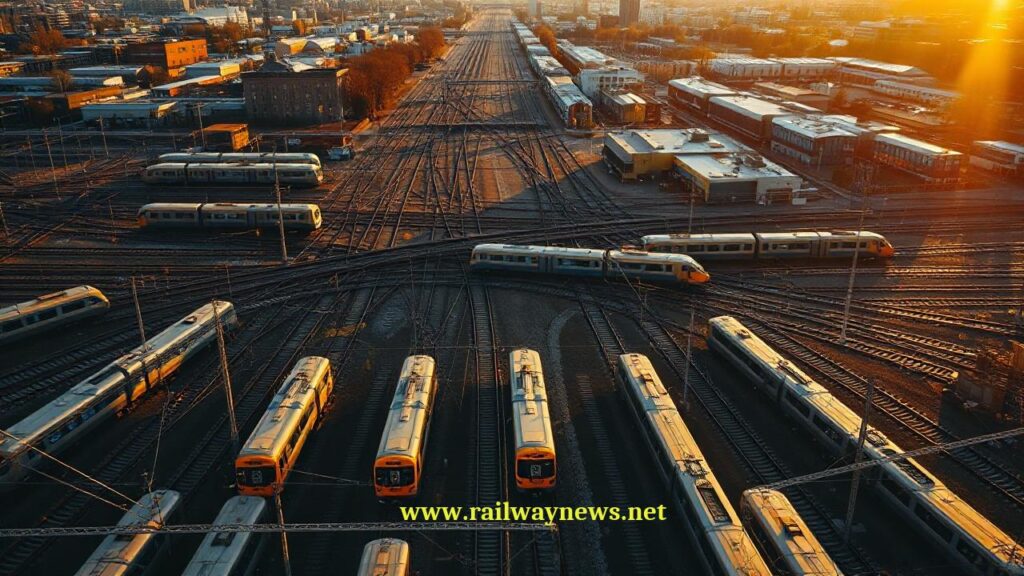
⚡ In Brief: A consortium of S-Bahn Berlin, Siemens Mobility, and Stadler won the contract to deliver 350 four-car S-Bahn trains, provide 30-year maintenance, and operate Berlin’s North–South and Stadtbahn subnetworks for 15 years.
BERLIN, GERMANY – A consortium comprising S-Bahn Berlin, Siemens Mobility, and Swiss manufacturer Stadler secured the final award decision for one of Germany’s largest urban rail projects in mid-2025. The contract covers delivery of 350 four-car commuter trains, 30 years of fleet maintenance, and 15 years of operations on two core Berlin subnetworks. S-Bahn Berlin currently transports approximately 1.4 million passengers per day across the capital region.
What Does This Contract Cover?
The contract bundles train manufacturing, long-term maintenance, and service operations into a single integrated framework covering Berlin’s North–South and Stadtbahn (east–west) subnetworks. Stadler will produce all new-generation trains at its Berlin facilities, while Siemens Mobility supplies the Railigent X digital maintenance platform for real-time predictive analytics across the 30-year maintenance term. The North–South subnetwork crosses the capital center along the north–south axis, and the Stadtbahn corridor passes through Berlin Hauptbahnhof, Friedrichstraße, Alexanderplatz, and Ostbahnhof. S-Bahn Berlin retains operational responsibility for both subnetworks over the 15-year service period. No financial value for the overall contract was publicly disclosed by the awarding authority or consortium members.
Key Contract Data
| Parameter | Value |
|---|---|
| Contract Name | Berlin S-Bahn Fleet Modernisation & Operations (North–South / Stadtbahn) |
| Total Value | Not disclosed |
| Parties Involved | S-Bahn Berlin (operator), Siemens Mobility (digital maintenance platform), Stadler (train manufacturing) |
| Timeline / Completion | 15-year operations; 30-year maintenance; delivery schedule not disclosed |
| Country / Corridor | Germany / Berlin–Brandenburg, North–South and Stadtbahn subnetworks |
How Does This Compare to Similar Contracts?
A 350-unit four-car train order places this among the largest single suburban fleet procurements in Europe this decade. By comparison, Cluj-Napoca in Romania initiated suburban rail vehicle tenders in June 2025 for a significantly smaller network scale (Source: Railway Gazette, June 2026). The Berlin contract aligns with the broader Digital Rail Germany programme, which allocated 8.6 billion euros to replace analogue interlockings with computer-based train control across 5,000 kilometres of track, and the European Rail Traffic Management System targeting over 60% of the EU core rail network upgraded by 2030, with a projected compound annual growth rate of 12.2% from 2025 to 2033 (Source: Market Data Forecast, 2025). Passenger rail operating performance in Germany increased by 1.5% in 2025, even as rail freight declined 5.4%, reinforcing the strategic shift toward mass transit investment in metropolitan regions (Source: Railmarket, 2025). The existing Berlin S-Bahn fleet on the Ringbahn has accumulated over 120 million kilometres of service, providing a reliability baseline against which the new Stadler-built units will be measured.
Editor’s Analysis
Bundling train supply, 30-year maintenance, and 15-year operations into a single award signals a structural shift in German urban rail procurement toward lifecycle-integrated contracts—mirroring models already prevalent in UK and Australian rail franchising. The decision to retain S-Bahn Berlin as operator while outsourcing manufacturing and digital maintenance to Siemens and Stadler suggests the Berlin-Brandenburg transport authority is prioritising fleet reliability guarantees over full vertical integration. With German passenger rail performance rising against a declining freight market, the capital region is positioning its S-Bahn network as the backbone of a decarbonised urban transport strategy through at least 2040.
FAQ
Q: How much is the Berlin S-Bahn fleet contract worth?
A: The total contract value was not disclosed by the consortium or the awarding authority at the time of the award decision.
Q: When will the new S-Bahn trains enter passenger service?
A: No delivery or entry-into-service schedule has been publicly confirmed. The 15-year operations and 30-year maintenance timelines begin upon fleet deployment.
Q: Which lines will the new trains serve?
A: The trains will operate on the North–South subnetwork (crossing central Berlin along the north–south axis) and the Stadtbahn subnetwork (the east–west corridor serving Hauptbahnhof, Friedrichstraße, Alexanderplatz, and Ostbahnhof).
Q: What passenger amenities do the new trains include?
A: Each train features a multifunctional area for wheelchair users and passengers with reduced mobility, a halogen-free water-cooled air-conditioning system rated for high outside temperatures, and USB-C charging ports installed every two seats.

Railway infrastructure, rolling stock and transport technologies specialist focused on global rail industry developments, high-speed rail systems, signaling technologies and freight transportation. Covering railway investments, public transport modernization, rail operations and international mobility projects across Europe, Asia and North America.
RELATED POSTS

October 1, 2026 7:09 am
United States regulators confirmed a September 30 deadline for the...

October 8, 2026 1:15 pm
Alstom secured a €1bn contract to build 13 automated trains,...

October 4, 2026 5:14 pm
Alstom secured a CA$4.7 billion order from VIA Rail Canada...

October 1, 2026 12:13 am
Illinois approved $1.5 billion annually for the Northern Illinois Transit...

October 6, 2026 2:14 am
Union Pacific launched export rail shipments with Ferromex to deliver...

October 1, 2026 6:10 am
Amtrak approved a System Expansion Committee on July 30 to...