
U.S. Freight Rail Traffic Dips, Intermodal Down; Carloads Gain
U.S. freight rail traffic saw a slight dip. Intermodal units declined, impacting overall volumes. Coal and grain carloads showed positive growth within the railway sector.
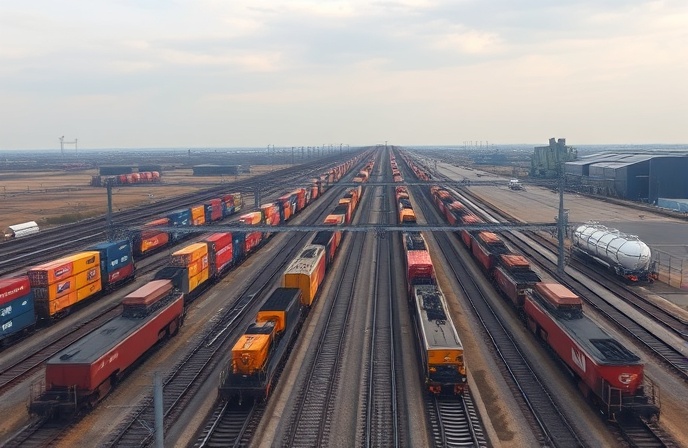
U.S. freight railroads saw a marginal dip in total traffic for the week ending November 22, 2025, reporting a 0.9% decrease in combined carloads and intermodal units to 516,110. This slight downturn was driven by a notable decline in intermodal volume, partially offset by a modest increase in carload traffic.
| Key Entity | Critical Detail |
|---|---|
| U.S. Freight Railroads | Total traffic: 516,110 carloads & intermodal units (Week ending Nov. 22, 2025) |
| Total Traffic Change (vs. 2024) | -0.9% |
| Carloads | 234,592 (Up 2.0%) |
| Intermodal Units | 281,518 (Down 3.2%) |
| Top Carload Gainers | Coal (+8.2%), Nonmetallic Minerals (+8.0%), Grain (+9.5%) |
| Top Carload Declines | Petroleum & Products (-10.1%), Miscellaneous (-10.7%), Chemicals (-3.2%) |
Despite the overall decrease in traffic volume, the U.S. freight rail sector demonstrated resilience in specific commodity groups. Total carloads saw a 2% increase, reaching 234,592, with coal shipments exhibiting a robust gain of 8.2% to 62,956 carloads. Nonmetallic minerals and grain also posted healthy increases of 8% and 9.5% respectively, highlighting strong demand in these industrial and agricultural sectors.
The primary driver of the week’s traffic reduction was the intermodal segment, which experienced a 3.2% decline, totaling 281,518 containers and trailers. This segment often serves as a key indicator for broader economic activity and consumer demand. Conversely, a significant decrease was observed in petroleum and petroleum products, down 10.1% to 10,587 carloads, alongside a 10.7% drop in miscellaneous carloads to 8,875. Chemicals also contributed to the decline, with a 3.2% reduction to 32,699 carloads.
Last June 2025, we published an article about Renfe’s cutting-edge Aranjuez maintenance hub. Click here to read – Future of Rail: Renfe’s Railway Technology Hub, Aranjuez: Essential Guide
Across North America, Canadian railroads reported a more positive trend, with carloads up 1.5% to 96,121 and intermodal units also up 1.5% to 70,202. Mexican railroads showed even stronger growth, particularly in intermodal traffic, which rose 7.4% to 13,705 units, while carloads increased by 1.5% to 12,744.
Industry Context
This weekly traffic report offers a granular view of commodity flows, providing vital intelligence for supply chain managers, logistics providers, and investors. The divergence between carload and intermodal performance suggests potential shifts in freight patterns and consumer spending habits. While gains in bulk commodities like coal and minerals could indicate renewed industrial activity or energy demand, the decline in intermodal traffic might signal a slowdown in e-commerce or a recalibration of inventory levels. The strong performance of Canadian and Mexican railroads in comparison to the U.S. could also point to differing economic conditions or trade dynamics within North America, necessitating a strategic reassessment of cross-border logistics and manufacturing strategies.

Railway infrastructure, rolling stock and transport technologies specialist focused on global rail industry developments, high-speed rail systems, signaling technologies and freight transportation. Covering railway investments, public transport modernization, rail operations and international mobility projects across Europe, Asia and North America.
RELATED POSTS

October 1, 2026 7:09 am
United States regulators confirmed a September 30 deadline for the...

October 1, 2026 12:13 am
Illinois approved $1.5 billion annually for the Northern Illinois Transit...

October 4, 2026 5:14 pm
Alstom secured a CA$4.7 billion order from VIA Rail Canada...

October 1, 2026 6:10 am
Amtrak approved a System Expansion Committee on July 30 to...

October 6, 2026 2:14 am
Union Pacific launched export rail shipments with Ferromex to deliver...

October 1, 2026 3:12 am
Greenbrier confirmed Brian Comstock as new president and CEO effective...