
Správa železnic Opens €60M Transport Hub in Jihlava
Správa železnic opened a €60M multimodal hub at Jihlava město station, co-financed by the EU Cohesion Fund, linking rail, bus, trolleybus, and a 68-space P+R.
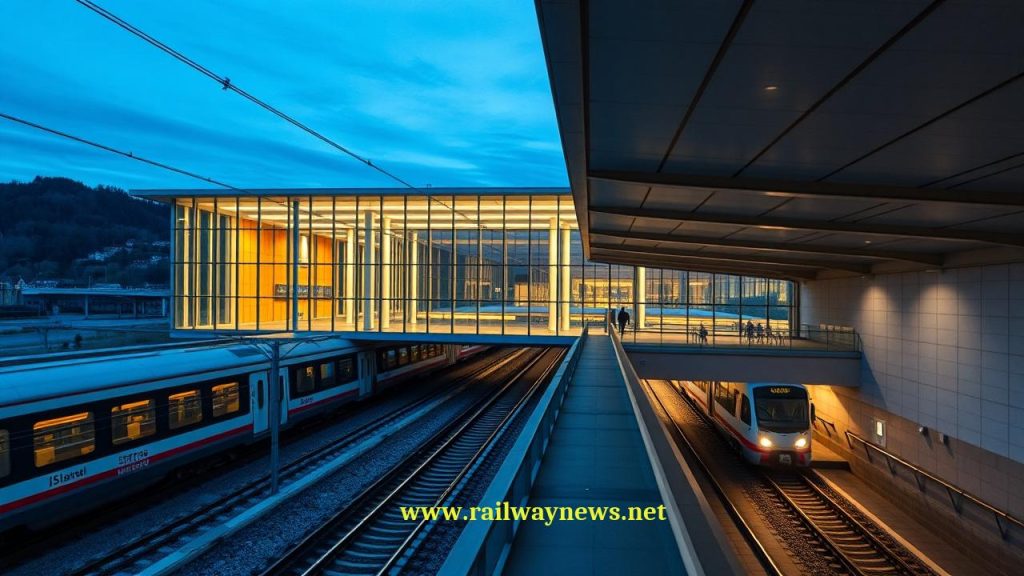
⚡ In Brief: Správa železnic and the city of Jihlava opened a CZK 1.485 billion (EUR 60 million) multimodal transport hub at Jihlava město station, co-financed by the EU Cohesion Fund with up to CZK 1.266 billion.
JIHLAVA, CZECH REPUBLIC – The Czech railway infrastructure manager Správa železnic and Jihlava city authorities inaugurated a rebuilt transport terminal at Jihlava město station following two years of construction. The CZK 1.485 billion project replaces the station’s deteriorating forecourt with integrated rail, bus, trolleybus, and private vehicle connections. Part of the station entered service in December 2024, with remaining works now completed.
What Is the Full Scope of This Project?
The Jihlava město modernization encompassed track reconstruction, two new accessible platforms, a passenger terminal building across two levels, and an underground passageway with elevators beneath the entire track area. The city separately delivered suburban bus stops, urban public transit stations, a 68-space P+R parking facility, a new access road (Evropská Street) connected via a roundabout, and electrical infrastructure for trolleybus operations. Nearly 100 trees, shrubs, and ornamental plants form part of expanded green space. Local authorities confirmed a future extension of the pedestrian underpass to Mostecká Street on the station’s opposite side, though no construction timeline for that phase was disclosed.
Key Project Data
| Parameter | Value |
|---|---|
| Project Name | Jihlava město Station Modernization & Transport Terminal |
| Total Value (Railway Component) | CZK 1.485 billion (approx. EUR 60 million) |
| EU Cohesion Fund Contribution | Up to CZK 1.266 billion (approx. EUR 51 million), Transport Programme 2021–2027 |
| Municipal Investment | Not separately disclosed |
| Parties Involved | Správa železnic (railway manager), City of Jihlava, Skanska (construction), EU Cohesion Fund |
| Construction Period | 2 years; partial operation from December 2024 |
| Country / Corridor | Czech Republic, Vysočina Region, city-centre urban node |
How Does This Compare to Similar Projects?
The Jihlava město hub sits in the mid-range of Czech station modernizations by cost. By comparison, the Praha Masarykovo nádraží reconstruction (completed 2024) required an investment exceeding CZK 3.4 billion for a significantly larger passenger volume. The Jihlava project’s contractor, Skanska, holds a substantial European transport infrastructure portfolio. In the UK market during 2024/25, Skanska UK ranked as the fifth-largest recipient of work from National Highways at £302.6 million (approx. CZK 8.8 billion), according to construction industry data. However, National Highways cancelled Skanska UK’s £297 million contract for the A46 Newark bypass in June 2026, seeking a replacement main contractor — a development tracked by Construction News that illustrates uneven risk profiles across the contractor’s European operations (Source: Construction News, June 2026). The Czech project’s EU Cohesion Fund structure, covering up to 85% of the railway component, mirrors funding ratios applied to comparable Central European intermodal terminal builds under the 2021–2027 programming period. No aggregated figure combining Správa železnic and municipal expenditure was publicly released.
Editor’s Analysis
Jihlava město represents the Czech Republic’s ongoing shift toward federated transport nodes rather than single-mode station renewals — a pattern visible across EU cohesion-funded projects in medium-sized cities. Transport Minister Ivan Bednárik’s framing of the terminal as a potential national model matters because it signals Prague’s willingness to replicate the integrated design in other regional centres. For Skanska, delivering this project on schedule contrasts with its UK civil engineering setbacks and reinforces the contractor’s capacity to execute complex urban rail interfaces in Central Europe. Indian Railways’ accelerated capital expenditure — deploying nearly 30% of its FY2026-27 budget within two months — reflects a parallel global trend of front-loaded rail infrastructure spending that Czech planners would recognise (Source: Construction World, 2026). The unanswered question is whether Jihlava’s passenger volumes will justify the CZK 1.485 billion outlay once the EU monitoring period concludes.
FAQ
Q: How much did the EU contribute to the Jihlava město terminal?
A: The European Union, through the Cohesion Fund under the Transport Programme 2021–2027, provided up to CZK 1.266 billion (approximately EUR 51 million), covering roughly 85% of the railway infrastructure component managed by Správa železnic.
Q: What transport modes connect at the new Jihlava město hub?
A: The terminal integrates Czech Railways trains, suburban buses, urban trolleybuses, and private vehicles via a 68-space P+R parking lot. A new access road, Evropská Street, links the forecourt to the city road network through a roundabout.
Q: Will the pedestrian underpass be extended further?
A: Správa železnic CEO Tomáš Tóth stated that plans exist to extend the underpass to Mostecká Street on the opposite side of the tracks. No construction start date or budget for this extension has been officially confirmed.

Railway infrastructure, rolling stock and transport technologies specialist focused on global rail industry developments, high-speed rail systems, signaling technologies and freight transportation. Covering railway investments, public transport modernization, rail operations and international mobility projects across Europe, Asia and North America.
RELATED POSTS

October 8, 2026 1:15 pm
Alstom secured a €1bn contract to build 13 automated trains,...

October 1, 2026 7:09 am
United States regulators confirmed a September 30 deadline for the...

October 8, 2026 12:18 pm
Siemens Mobility signed an agreement with VinSpeed to supply 350...

October 4, 2026 5:14 pm
Alstom secured a CA$4.7 billion order from VIA Rail Canada...

October 5, 2026 6:12 pm
AECOM and Jacobs secured a contract in September 2026 to...

October 1, 2026 12:13 am
Illinois approved $1.5 billion annually for the Northern Illinois Transit...