
ZIM MSC Launches Weekly Asia-Jacksonville Container Service
ZIM and MSC launched a weekly Asia-Jacksonville container service on 14 July 2025, calling at JAXPORT’s Blount Island terminal with transit times of 28–32 days.
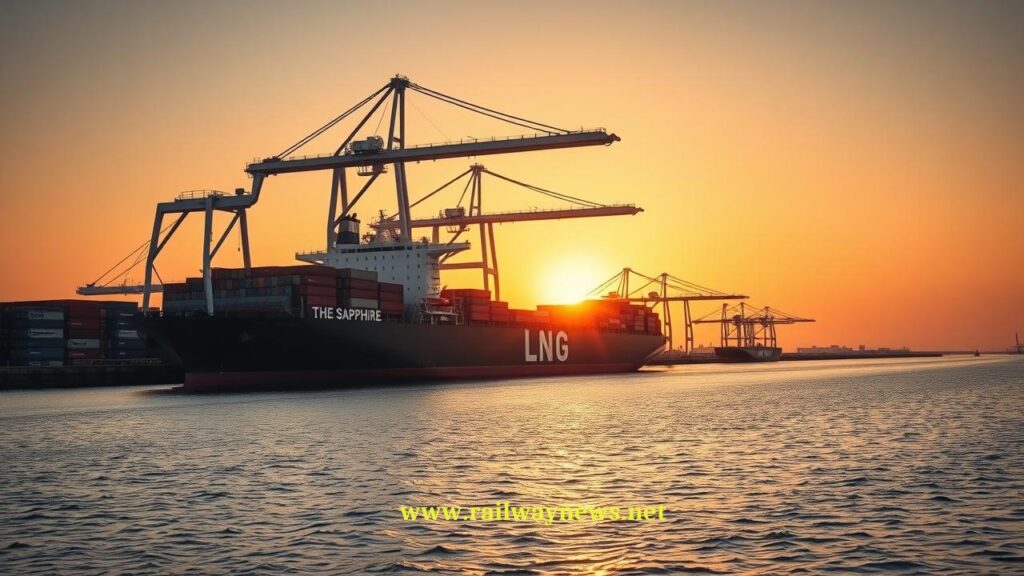
⚡ In Brief: ZIM Line and MSC launched a weekly ZCP-Amberjack container service calling at JAXPORT’s Blount Island Marine Terminal, connecting Jacksonville to major Asian ports including Shanghai, Ningbo, and Busan with transit times of 28–32 days from North Asia.
JACKSONVILLE, USA – ZIM Line and Mediterranean Shipping Company (MSC) inaugurated weekly container service at the Jacksonville Port Authority (JAXPORT) on 14 July 2025, with the arrival of the LNG-powered vessel The Sapphire at Blount Island Marine Terminal. The ZCP-Amberjack service links JAXPORT to a rotation covering Qingdao, Ningbo, Shanghai, Busan, Manzanillo, Cartagena, Kingston, Charleston, and Savannah. Transit times from North Asia range from 28 to 32 days, placing the service in a competitive mid-range position for Asia–US East Coast routings via the Panama Canal.
What Is the Full Scope of This Project?
The ZCP-Amberjack service operates on a fixed weekly rotation, with vessels calling at JAXPORT’s Blount Island Marine Terminal as part of a multi-carrier arrangement between ZIM Line and MSC. The port rotation spans four continents: Qingdao, Ningbo, and Shanghai in China; Busan in South Korea; Manzanillo in Panama; Cartagena in Colombia; Kingston in Jamaica; and three US East Coast calls — Charleston, Savannah, and Jacksonville. ZIM’s transshipment hubs at Kingston and Cartagena function as secondary gateways, offering connecting feeder services to Latin America, the Caribbean, the Mediterranean, and additional Asian destinations. All vessels deployed on the service are powered by liquefied natural gas (LNG). No total TEU capacity for the service or individual vessel specifications were publicly disclosed by either carrier at launch.
Key Project Data
| Parameter | Value |
|---|---|
| Project / Contract Name | ZCP-Amberjack Container Service |
| Total Value | Not disclosed |
| Parties Involved | ZIM Line, Mediterranean Shipping Company (MSC), Jacksonville Port Authority (JAXPORT) |
| Timeline / Completion | Service commenced 14 July 2025; ongoing weekly rotation |
| Country / Corridor | North Asia – Panama Canal – Caribbean – US East Coast (China, South Korea, Panama, Colombia, Jamaica, USA) |
| First Vessel | The Sapphire (LNG-powered) |
| Transit Time (North Asia) | 28–32 days |
| JAXPORT Terminal | Blount Island Marine Terminal |
| Vessel Fuel Type | Liquefied natural gas (LNG) |
How Does This Compare to Similar Projects?
The ZCP-Amberjack service enters a competitive Asia–US East Coast corridor where transit times for Panama Canal routings typically range from 25 to 35 days, depending on origin port and canal waiting times. At 28–32 days from North Asia, the service positions itself in the middle of this band — comparable to Ocean Alliance’s AWE services and marginally slower than the fastest express loops that achieve 25–27 days from Shanghai to Savannah. The deployment of LNG-powered vessels aligns with a broader fleet transition underway across the container shipping industry, where carriers face tightening IMO emissions targets. The inclusion of JAXPORT as a weekly call is notable given that Jacksonville has historically received fewer direct Asia services than larger South Atlantic ports. Meanwhile, broader trade shifts are reshaping carrier calculations: China-Europe rail freight volumes declined 1.3% year-on-year in 2025, while flows to Central Asia surged 27.7%, partly driven by US market restrictions redirecting cargo flows (Source: Upply, 2025). These dynamics may strengthen the rationale for diversified US East Coast port calls as carriers hedge against geopolitical disruptions affecting both trans-Pacific and Eurasian corridors.
Editor’s Analysis
JAXPORT’s addition to the ZCP-Amberjack rotation reflects a calculated bet by ZIM and MSC on the growing cargo demand in the US Southeast, where population growth and warehousing investment have outpaced the national average. By including Jacksonville alongside Charleston and Savannah on the same string, the carriers are effectively offering shippers three discharge options across Georgia and Florida, reducing inland trucking costs for distribution centres in the region. The LNG-powered vessel deployment also reduces fuel-cost exposure to volatile marine gasoil prices while generating compliance credits under IMO’s Carbon Intensity Indicator framework — an operational hedge that grows more valuable as regulatory scrutiny intensifies. The Asia-Pacific rail logistics market is projected to grow at a CAGR of 6.4% from 2026 to 2035 (Source: GM Insights, 2025), suggesting that ocean carriers will face mounting competition from overland corridors for time-sensitive cargo, making reliable, fuel-efficient ocean services increasingly critical for retaining market share on Asia–North America routes.
FAQ
Q: What is the ZCP-Amberjack container service?
A: The ZCP-Amberjack is a weekly container shipping service jointly operated by ZIM Line and MSC, connecting major Asian ports — including Shanghai, Ningbo, Qingdao, and Busan — to the US East Coast via the Panama Canal. It calls at JAXPORT’s Blount Island Marine Terminal along with Charleston and Savannah.
Q: How long does shipping take from Shanghai to Jacksonville on this service?
A: Transit times from North Asia to JAXPORT are approximately 28 to 32 days. The exact duration varies depending on the specific port of origin and Panama Canal transit conditions. The first vessel, The Sapphire, arrived at JAXPORT on 14 July 2025.
Q: Are the vessels on the ZCP-Amberjack service LNG-powered?
A: Yes. The service utilises vessels powered by liquefied natural gas (LNG). The first vessel to call at JAXPORT under this service, The Sapphire, is an LNG-powered ship. The total number and TEU capacity of vessels deployed on the rotation have not been officially disclosed.

Railway infrastructure, rolling stock and transport technologies specialist focused on global rail industry developments, high-speed rail systems, signaling technologies and freight transportation. Covering railway investments, public transport modernization, rail operations and international mobility projects across Europe, Asia and North America.
RELATED POSTS

October 1, 2026 7:09 am
United States regulators confirmed a September 30 deadline for the...

October 1, 2026 12:13 am
Illinois approved $1.5 billion annually for the Northern Illinois Transit...

October 1, 2026 6:10 am
Amtrak approved a System Expansion Committee on July 30 to...

October 4, 2026 5:14 pm
Alstom secured a CA$4.7 billion order from VIA Rail Canada...

October 1, 2026 3:12 am
Greenbrier confirmed Brian Comstock as new president and CEO effective...

October 6, 2026 2:14 am
Union Pacific launched export rail shipments with Ferromex to deliver...