
Port of Coos Bay Signs $50M INFRA Pre-Construction Deal
Port of Coos Bay secured a $50M INFRA pre-construction deal, with $25M federal and $25M private match from NorthPoint, for the Pacific Coast Intermodal Port.
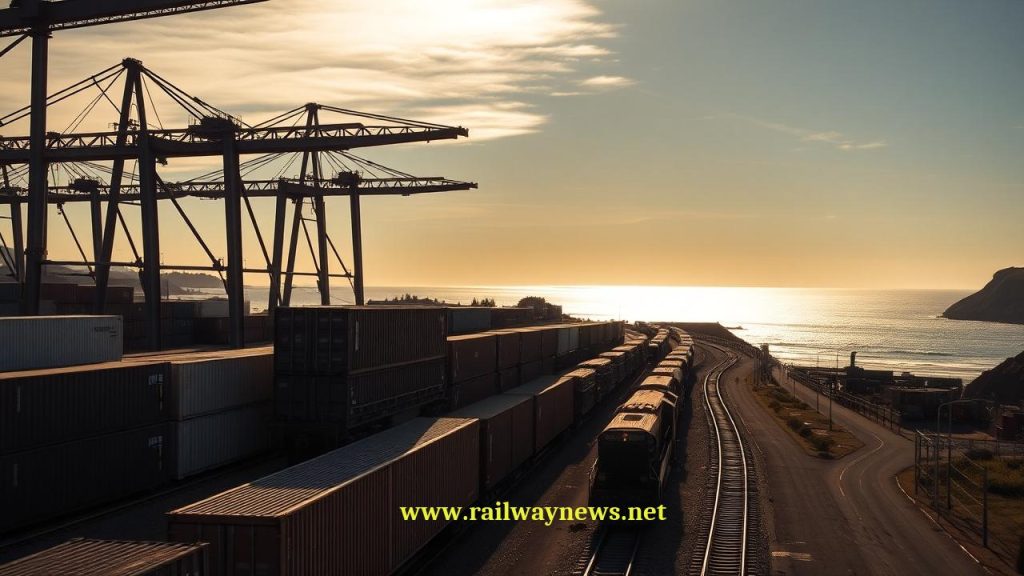
⚡ In Brief: The Oregon International Port of Coos Bay signed a $25 million INFRA grant agreement with USDOT, matched by $25 million from NorthPoint Development, releasing $50 million for pre-construction of the Pacific Coast Intermodal Port.
COOS BAY, OREGON – The Oregon International Port of Coos Bay has formally executed its $25 million Infrastructure for Rebuilding America (INFRA) grant agreement with the U.S. Department of Transportation, port officials confirmed. The agreement unlocks a matching $25 million from private-sector partner NorthPoint Development, together channeling $50 million into planning, design, environmental review, permitting, and preliminary engineering for the Pacific Coast Intermodal Port (PCIP). Construction-related disbursements will begin immediately now that legal requirements have been met.
How Is the Funding Structured?
The PCIP funding structure combines a $25 million federal INFRA grant, a $25 million private match from NorthPoint Development, and three other previously awarded sources: a $29.75 million CRISI grant, an $11.25 million Port Infrastructure Development Program (PIDP) award, and a $100 million investment from the Oregon legislature. The $50 million INFRA/matched component is dedicated exclusively to pre-construction activities, while the additional $116 million in grants and state funds supports other development phases, bringing total committed public and private capital to $166 million as of the agreement execution date. No single entity disclosed a final total project cost estimate.
Key Funding Data
| Parameter | Value |
|---|---|
| Fund / Programme Name | INFRA Grant (USDOT) |
| Total Value (INFRA Phase) | $50 million ($25M federal + $25M private match) |
| Parties Involved | Oregon International Port of Coos Bay, NorthPoint Development, USDOT |
| Timeline / Completion | Not disclosed (pre-construction and planning phase only) |
| Country / Corridor | USA – Oregon, Coos Bay North Spit; connecting to inland rail markets |
| Additional Committed Funds | CRISI $29.75M, PIDP $11.25M, Oregon legislature $100M (total $166M) |
How Does This Compare to Similar Funding Programs?
Comparable data for this specific type of port intermodal federal grant was not publicly available at time of publication. The PCIP’s $166 million cumulative commitment from all sources ranks it among the larger recent U.S. small-port intermodal initiatives, though it remains well below the multi-billion-dollar capital programs of major West Coast gateways. For context, separate industry contract data shows Skanska recently secured $580 million in construction contracts across the U.S., and Carollo Engineers won a $210 million California water contract—indicating that large-scale infrastructure spending continues to flow into West Coast projects broadly (Source: Construction Dive, 2025). No directly equivalent intermodal terminal funding package was identified for a direct side-by-side comparison.
Editor’s Analysis
The PCIP represents a calculated bet on shifting U.S. supply chain patterns that favor rail-connected secondary ports over congested primary gateways. With a ship-to-rail design and direct inland market access, the terminal aligns with the 2025 transportation investment trend that PwC’s Midyear Outlook describes as “focused on premium assets and rail-adjacent players” (Source: PwC via Logistics Management, 2025). By locking in the INFRA agreement now, Coos Bay moves from conceptual planning to a funded pre-construction stage at a time when intermodal dealmaking activity is rising and governments are monetizing legacy rail assets—as seen in India’s planned stake sale of Indian Railway Finance Corp (Source: Reuters, 2025). The project’s ability to attract a private-sector match also signals developer confidence in long-term container volumes at a non-traditional West Coast port.
FAQ
Q: What is the Pacific Coast Intermodal Port (PCIP)?
A: The PCIP is a proposed ship-to-rail container terminal on the North Spit of Coos Bay, Oregon, designed to transfer containers directly from vessels to rail and connect to inland markets, adding new capacity outside the major Californian port gateways. The project has secured $166 million in combined federal, state, and private commitments as of mid-2025.
Q: When will the PCIP terminal be operational?
A: No operational timeline has been announced. The newly executed $50 million INFRA package funds only pre-construction activities—design, environmental review, permitting, and preliminary engineering—meaning final construction scheduling has not been set.
Q: How does the PCIP funding compare to other West Coast port investments?
A: Direct comparisons to similar small-port intermodal grants are not publicly available. The $166 million total committed so far is sizable for a secondary port but smaller than the multi-year capital programs at ports like Los Angeles or Long Beach, which regularly exceed $1 billion. The $25 million INFRA grant itself falls within the typical range for mid-sized U.S. DOT port infrastructure awards.

Railway infrastructure, rolling stock and transport technologies specialist focused on global rail industry developments, high-speed rail systems, signaling technologies and freight transportation. Covering railway investments, public transport modernization, rail operations and international mobility projects across Europe, Asia and North America.
RELATED POSTS

October 8, 2026 1:15 pm
Alstom secured a €1bn contract to build 13 automated trains,...

October 1, 2026 7:09 am
United States regulators confirmed a September 30 deadline for the...

October 8, 2026 12:18 pm
Siemens Mobility signed an agreement with VinSpeed to supply 350...

October 4, 2026 5:14 pm
Alstom secured a CA$4.7 billion order from VIA Rail Canada...

October 5, 2026 6:12 pm
AECOM and Jacobs secured a contract in September 2026 to...

October 4, 2026 11:08 pm
Sound Transit confirmed the September 30 opening of Seattle Pinehurst...