
O’Hare Flyer Confirms 15-Minute Chicago Airport Link
O’Hare Flyer promoters confirmed track terms with CSX to run a private 15-minute battery train line from downtown Chicago to the airport within five years.
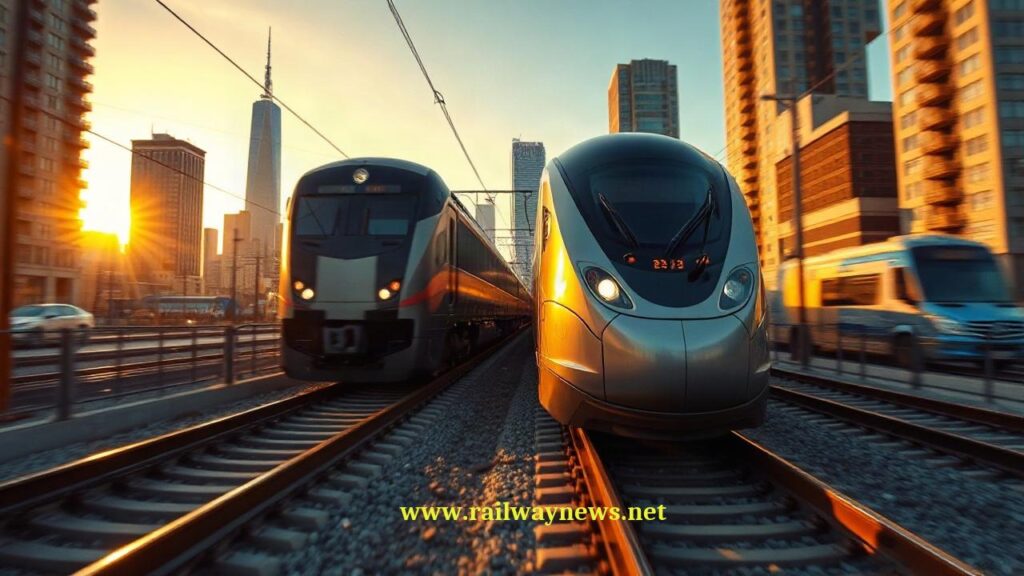
⚡ In Brief: A Chicago civic consortium has unveiled plans for the O’Hare Flyer, a privately funded battery-electric express rail service designed to link downtown Chicago and O’Hare Airport in 15 minutes across existing freight corridors within five years.
CHICAGO, UNITED STATES – A coalition of Chicago business and civic leaders announced plans on August 25, 2026, to build the O’Hare Flyer, a private battery-electric passenger rail service targeting a 15-minute trip between downtown Chicago and O’Hare International Airport. The project targets an operational launch within five years and will operate on 15-minute departure intervals along existing freight rights-of-way. Project promoters confirmed commercial term agreements with CSX and are actively negotiating trackage rights with Canadian National and Union Pacific Railroad.
What Is the Full Scope of This Project?
The O’Hare Flyer will establish a dedicated, continuous-welded express rail route connecting O’Hare International Airport’s Terminal 2 directly to a downtown terminal adjacent to the Old Post Office. Fleet operations will utilize battery-electric trainsets that recharge at both terminal locations, avoiding full-line overhead catenary installation. Infrastructure plans combine underused freight rights-of-way owned across three Class I carriers: CSX, Canadian National, and Union Pacific. The consortium confirmed it has reached commercial terms with CSX, while formal negotiations remain underway with Canadian National and Union Pacific. The project structure is entirely private and is not seeking state or federal subsidies. The total capital expenditure required to construct the line and procure rolling stock was not disclosed at the time of announcement.
Key Project Data
| Parameter | Value |
|---|---|
| Project / Contract Name | O’Hare Flyer Airport Express Link |
| Total Value | Not disclosed |
| Parties Involved | O’Hare Flyer consortium, CSX, Canadian National (CN), Union Pacific (UP) |
| Timeline / Completion | Targeted launch within 5 years (circa 2031) |
| Country / Corridor | United States / Chicago Old Post Office to O’Hare Terminal 2 |
How Does This Compare to Similar Projects?
Dedicated airport express rail routes in North America typically depend on public agency capital rather than unassisted private investment. In Toronto, Metrolinx operates the Union Pearson Express (UPX) on an established mainline corridor, where rolling stock operations and maintenance are managed by Alstom under a five-year extension valued at approximately EUR 800 million through 2031 (Source: Alstom, 2025). UPX achieved an on-time performance rate exceeding 97% during the 2024–2025 operating period, illustrating the dispatching reliability required for airport transit links. Securing dependable time slots on Class I infrastructure remains challenging because the broader rail freight market was valued at USD 370 billion in 2025 and is projected to expand at a 4.5% compound annual growth rate to reach USD 602.7 billion by 2036 (Source: Future Market Insights, 2025). Freight operators must ensure that new high-frequency battery passenger movements do not constrict existing switching and mainline yard operations.
Editor’s Analysis
Securing an access framework with CSX represents meaningful progress, but coordinating operational pacts across three competing Class I railroads in a congested terminal district presents high dispatching friction. Because North American rail freight transport is projected to reach USD 534.6 billion by 2034 (Source: Market.us, 2025), Class I carriers maintain strict protection over yard approaches and corridor capacity. The project’s viability will depend on whether battery-electric charging cycles and fixed 15-minute headway requirements can function without interfering with industrial switching slots.
FAQ
Q: What are the transit time and departure frequencies planned for the O’Hare Flyer?
A: The O’Hare Flyer is designed to run nonstop in 15 minutes between downtown Chicago and O’Hare Terminal 2. Departures are scheduled to operate every 15 minutes.
Q: How much will the O’Hare Flyer cost, and is public funding involved?
A: Total development and capital costs were not disclosed by project officials. The project team stated that the line is being financed entirely through private capital and will not utilize public subsidies.
Q: Which railway companies own the tracks the service will use?
A: The alignment incorporates track segments owned by CSX, Canadian National, and Union Pacific Railroad. An initial agreement on terms has been established with CSX, while discussions with Canadian National and Union Pacific remain in progress.

Railway infrastructure, rolling stock and transport technologies specialist focused on global rail industry developments, high-speed rail systems, signaling technologies and freight transportation. Covering railway investments, public transport modernization, rail operations and international mobility projects across Europe, Asia and North America.
RELATED POSTS

October 8, 2026 1:15 pm
Alstom secured a €1bn contract to build 13 automated trains,...

October 1, 2026 7:09 am
United States regulators confirmed a September 30 deadline for the...

October 8, 2026 12:18 pm
Siemens Mobility signed an agreement with VinSpeed to supply 350...

October 4, 2026 5:14 pm
Alstom secured a CA$4.7 billion order from VIA Rail Canada...

October 5, 2026 6:12 pm
AECOM and Jacobs secured a contract in September 2026 to...

October 1, 2026 12:13 am
Illinois approved $1.5 billion annually for the Northern Illinois Transit...