
India Budgets $35.2B For 7 New High-Speed Rail Corridors
India allocates $35.2 billion for seven new high-speed rail corridors, freight capacity, and railway safety enhancements.
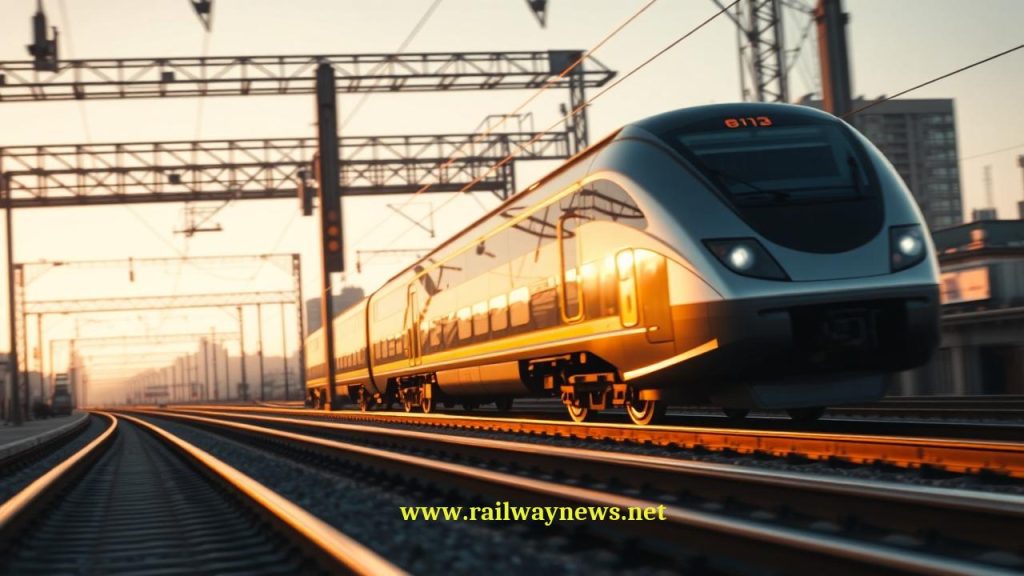
📉 Market Brief:
- Event: India’s 2026–2027 budget funds seven new high-speed rail corridors.
- Key Data: 35.2 billion USD (2.93 trillion rupees) capital expenditure allocation.
- Impact: Economic integration of major cities, reduced travel times, and freight capacity expansion.
The Indian government’s 2026–2027 budget directs 35.2 billion USD (2.93 trillion rupees) toward capital expenditure for national railway infrastructure. Within this allocation, Indian Railways (IR) is set to receive 33.2 billion USD (2.78 trillion rupees), its largest budget to date. These funds are earmarked for the development of seven new high-speed passenger lines, freight transport expansion, and systemic safety enhancements.
As part of a long-term national strategy, the government has designated these corridors as “growth connectors,” aiming to establish a sustainable and high-capacity passenger transport network. The seven proposed high-speed lines will collectively span nearly 4,000 km. The total investment required for these projects is estimated at approximately 192 billion USD (16 trillion rupees).
In southern India, the plan outlines the formation of a “Southern High-Speed Triangle (Diamond)” by linking Chennai, Bengaluru, and Hyderabad. This network is designed to connect the region’s principal economic centers and information technology hubs. Union Minister for Railways Ashwini Vaishnaw stated the projected travel times are 1 hour and 13 minutes for Chennai–Bengaluru, approximately 2 hours for Bengaluru–Hyderabad, and 2 hours and 55 minutes for Chennai–Hyderabad. The minister identified Karnataka, Telangana, Andhra Pradesh, Tamil Nadu, Kerala, and the Puducherry territory as beneficiaries of the resulting regional development.
The [month] developments included the NTSB’s findings on the NJ Transit crash. Full article title 📰
For western and central India, the Mumbai–Pune high-speed line is projected to reduce transit time to 48 minutes. An extension from Pune to Hyderabad is planned to take approximately 1 hour and 55 minutes, creating a continuous high-speed connection between western and southern economic zones. In the north and east, the Delhi–Varanasi corridor will facilitate travel in approximately 3 hours and 50 minutes. The route’s continuation through Varanasi–Patna–Siliguri is estimated at 2 hours and 55 minutes, establishing an economic corridor through Delhi, Uttar Pradesh, Bihar, and West Bengal.
| High-Speed Corridor Segment | Projected Travel Time |
|---|---|
| Mumbai–Pune | ~ 48 minutes |
| Chennai–Bengaluru | ~ 1 hour 13 minutes |
| Pune–Hyderabad | ~ 1 hour 55 minutes |
| Bengaluru–Hyderabad | ~ 2 hours |
| Varanasi–Patna–Siliguri | ~ 2 hours 55 minutes |
| Chennai–Hyderabad | ~ 2 hours 55 minutes |
| Delhi–Varanasi | ~ 3 hours 50 minutes |
The federal budget also provides for a new 2,052 km East-West Dedicated Freight Corridor (DFC). This corridor will run from Dankuni in West Bengal to Surat in Gujarat, crossing Odisha, Chhattisgarh, Madhya Pradesh, and Maharashtra. It will integrate with the existing Western DFC to provide uninterrupted goods movement to west coast ports. The Minister of Railways noted that the existing eastern and western DFCs are near capacity, handling an average of 400 freight trains daily, which necessitates the construction of additional freight capacity.
Rail safety has been allocated 14.4 billion USD (1 trillion rupees) for accident prevention and protection works. The government reported a 95% reduction in railway accidents due to prior investment. Current efforts will focus on the maintenance of tracks and rolling stock, deployment of the Kavach automatic train protection (ATP) system, installation of CCTV surveillance, and modernization of overhead electrical networks (OHE).
The minister also commented on the domestic rail manufacturing industry, noting that propulsion systems designed and produced in India are being exported to the US, Switzerland, Germany, France, and Spain. This indicates the growing international competitiveness of the Indian railway supply chain. Infrastructure development milestones cited include the construction of 35,000 km of new lines and the electrification of 47,000 km of track, bringing electrification coverage to over 99.5% of the broad gauge network.
The Vande Bharat train program continues to expand, with 164 semi-express trains currently operating on major corridors. These trains are designed and manufactured by the state-owned Integral Coach Factory (ICF) in Chennai. A sleeper car variant was introduced in January 2026. The production plan targets a fleet of 800 Vande Bharat trains by 2030, with a long-term goal of 4,500 units by 2047 to modernize intercity rail travel.

Railway infrastructure, rolling stock and transport technologies specialist focused on global rail industry developments, high-speed rail systems, signaling technologies and freight transportation. Covering railway investments, public transport modernization, rail operations and international mobility projects across Europe, Asia and North America.
RELATED POSTS
October 1, 2026 10:14 am
HS2 installed a 55-metre steel span in Birmingham, completing phase...
October 1, 2026 11:14 pm
CATS confirmed a six-mile streetcar route in Charlotte to add...
October 1, 2026 11:13 am
Norfolk Southern expanded its 3B Corridor in Alabama in 2025,...
October 1, 2026 1:12 pm
CSX expanded Queensgate Yard in Cincinnati by installing 42 power...

October 4, 2026 11:08 pm
Sound Transit confirmed the September 30 opening of Seattle Pinehurst...
October 6, 2026 12:16 am
FTA awarded $233 million in grants to eight US rail...