
Hydrogen Train Market 2025–2035: $38.6B Forecast & Key Players
Hydrogen fuel cell train market: $2.67B in 2025 to $26.4B by 2035 (28.2% CAGR). PEM tech, iLint challenges, green H₂ costs and top 10 players explained.
⚡ In Brief
- The global hydrogen fuel cell train market is projected to grow from $2.67 billion in 2025 to $26.41 billion by 2035 — a nearly 10× expansion at a CAGR of 28.2%: This growth rate, the highest of any rolling stock segment, reflects not incremental adoption but a technology at the inflection point between demonstration and commercialisation. As of 2025, hydrogen trains operate in revenue service in Germany and the United States, with further deployments confirmed in Italy, France, South Korea, Japan, and China. The demand driver is structural: more than 70% of the world’s rail lines remain non-electrified, and for routes where full electrification is economically impractical, hydrogen fuel cell trains are the only commercially available zero-emission alternative to diesel. The 28.2% CAGR reflects this large addressable market encountering a commercially ready — if still maturing — technology for the first time.
- The PEM fuel cell is the dominant technology in hydrogen trains — and its 50–60% electrical efficiency is structurally superior to diesel but inferior to direct electric traction: A Proton Exchange Membrane (PEM) fuel cell generates electricity by combining hydrogen and atmospheric oxygen across a platinum catalyst membrane, producing only water and heat as byproducts. The electrical efficiency of a PEM fuel cell stack is 50–60% (electrical energy out / hydrogen chemical energy in), compared to 30–38% for a diesel engine at its best efficiency point. When combined with regenerative braking energy recovery through the buffer battery, the train-level well-to-wheel efficiency of a hydrogen fuel cell train is approximately 25–35% (accounting for hydrogen production, compression, distribution, and fuel cell conversion losses from green hydrogen). For comparison, direct electric traction from renewable grid power achieves 70–80% well-to-wheel efficiency. The hydrogen train is therefore approximately twice as efficient as diesel but significantly less efficient than a direct electric or BEMU train — a thermodynamic reality that will influence deployment economics for the foreseeable future.
- Hydrogen’s unique advantage over battery-electric is range — 400–1,000 km on a single fill versus 80–150 km per charge for current BEMUs: The Alstom Coradia iLint achieved 1,175 km on a single hydrogen fill during a record run on 15 September 2022. The Stadler FLIRT H2 achieved 1,742 miles (2,803 km) without refuelling during its US testing in Colorado in 2024 — a Guinness World Record for a hydrogen train. These figures reflect the fundamental energy density advantage of compressed hydrogen versus lithium-ion batteries: hydrogen at 700 bar stores approximately 1.9 kWh per litre (usable after fuel cell conversion), while a lithium-ion battery stores approximately 0.25–0.35 kWh per litre — a 5–7× volumetric energy density advantage. For long non-electrified routes (above 200–300 km between opportunity charging points), hydrogen is currently the only commercially available zero-emission option.
- Alstom’s iLint fleet withdrawal in December 2024 was the most consequential setback in hydrogen rail’s commercial history — and its causes illuminate the technology’s real maturity level: In mid-December 2024, Alstom withdrew most of its 41-unit Coradia iLint fleet in Germany (27 units on the RMV Taunus network in Hesse, 14 units in Lower Saxony) for urgent rework and upgrades. The primary operational problems were fuel cell degradation faster than the designed service interval, hydrogen supply reliability issues with contracted supplier Linde, and software integration faults affecting the energy management system. A replacement fleet of 16 leased diesel LINT DMUs, funded by Alstom, operated substitute services. The incident is the defining data point for the hydrogen train market’s 2025 status: the technology works in engineering terms, but the system — train, fuel supply contract, depot maintenance, fuel cell replacement cycle — has not yet achieved the operational reliability that transit operators require as a baseline. The iLint’s 2.8 million km of cumulative service before the withdrawal proves the technology can run; the withdrawal proves it cannot yet run reliably at scale without significant ongoing OEM support.
- The hydrogen train market’s growth to 2035 will be determined by the green hydrogen cost curve, not by train technology maturity: As of 2026, green hydrogen costs €5–9 per kilogram at the production plant gate, rising to €10–15 per kg at a rail depot after compression, storage, and dispensing costs. At these prices, operating a hydrogen train costs approximately €18–30 per 100 km of traction energy versus €8–14 per 100 km for diesel — a 1.5–2.5× cost premium. Industry consensus projects green hydrogen costs falling to €2–3/kg in favourable renewable electricity regions by 2030, which would bring hydrogen train operating costs within approximately 20–40% of diesel — a competitive gap closeable by carbon pricing, emissions regulation, and the avoided cost of diesel fleet maintenance. Whether this cost trajectory is achieved on schedule will determine whether the 28.2% CAGR is realised or whether the market’s growth moderates to the lower end of the range.
The press release that Landesnahverkehrsgesellschaft Niedersachsen (LNVG) issued on 24 August 2022 described, with precise factual economy, an event that 14 years of development had been building toward: the world’s first scheduled passenger rail service to operate entirely on hydrogen fuel had commenced between Cuxhaven, Bremerhaven, Bremervörde, and Buxtehude in Lower Saxony, Germany. Fourteen Alstom Coradia iLint trains — each powered by rooftop PEM fuel cell stacks, a buffer battery, and a hydrogen tank holding 100 kg of compressed gas at 350 bar — had replaced the 15 diesel LINT multiple units that had previously operated this 100 km network. The service was commercially unremarkable in its externals: the trains departed on the same timetable, stopped at the same stations, carried the same passengers. What was internally unremarkable — the sound of a diesel engine, the exhaust from the traction unit, the fuel consumption that connected each journey to oil markets, geopolitics, and CO₂ budgets — was absent. The only emission from each train was water vapour. The moment was widely reported as a milestone, which it was. It was less widely reported as a beginning of the difficult part: the part where technology that works in trials and limited fleet operation must work continuously, reliably, and economically at scale — on winter mornings when temperatures are −12°C and fuel cell efficiency drops, on days when the hydrogen supply contractor encounters delivery problems, on months when fuel cell stacks degrade faster than the maintenance schedule predicted. The Lower Saxony service ran. It accumulated kilometres. And in December 2024, most of it was withdrawn for urgent rework — not because the technology had failed in an engineering sense, but because running hydrogen trains in real-world commercial service is harder than running them in controlled demonstration conditions. That is the current truth of the hydrogen train market: the concept is proven, the engineering is sound, the commercial case is visible but not yet closed, and the gap between demonstration success and operational maturity is still being crossed. The 2025–2035 decade will determine whether that crossing is completed.
What Is a Hydrogen Fuel Cell Train?
A hydrogen fuel cell electric train (HFCET or hydrogen FCEV for short) is a railway vehicle that generates its traction power onboard from compressed hydrogen stored in rooftop or under-frame tanks, converting it to electricity through a fuel cell stack (typically PEM — Proton Exchange Membrane) and using that electricity to drive traction motors. A buffer battery (typically lithium-ion, 100–400 kWh capacity) stores regenerated braking energy and provides peak power supplementation during acceleration, when the fuel cell alone cannot supply the instantaneous power demand. The only outputs of the electrochemical reaction are electricity, heat, and water — the train emits water vapour from the fuel cell stack’s air exhaust.
The key distinction from battery-electric trains (BEMUs) is the onboard energy generation: a BEMU stores energy that was generated elsewhere (on the overhead wire) and depleted onboard; a hydrogen train generates its energy onboard from chemical energy stored in hydrogen. This difference makes hydrogen trains independent of any external electric infrastructure — they require only a hydrogen refuelling station at the depot or at designated intermediate stops, analogous to a diesel train’s fuel point. The governing European standard for hydrogen trains is EN 17127 (public hydrogen refuelling stations) and the TSI LOC&PAS requirements for rolling stock. In the USA, the Stadler FLIRT H2 complied with FRA 49 CFR Part 238 standards — the first hydrogen train to do so. Safety certification of onboard hydrogen systems follows EN 13480 (industrial piping) and project-specific approval by national safety regulators.
The PEM Fuel Cell: The Heart of Hydrogen Traction
The Proton Exchange Membrane fuel cell is the dominant technology in hydrogen train applications because its operating temperature (60–80°C versus 650–1,000°C for solid oxide fuel cells), rapid start-up time (2–5 minutes versus 30–60 minutes for SOFC), and tolerance of the stop-start duty cycles of passenger rail service make it uniquely suited to rail traction. Every hydrogen train currently in revenue service uses PEM fuel cells.
PEM fuel cell electrochemistry and efficiency:
Anode reaction: H₂ → 2H⁺ + 2e⁻
Cathode reaction: ½O₂ + 2H⁺ + 2e⁻ → H₂O
Net reaction: H₂ + ½O₂ → H₂O + electricity + heat
Theoretical cell voltage (standard conditions): V₀ = 1.23 V
Practical operating voltage (per cell): ~0.70 V at useful power density
Voltage efficiency: 0.70 / 1.23 = 56.9%
PEM stack for a regional train (e.g. Coradia iLint):
Power per fuel cell module: 200 kW
Modules per train: 2 (total 400 kW continuous fuel cell power)
Peak traction demand (acceleration): ~800 kW
Peak demand met by: 400 kW fuel cell + 400 kW battery discharge
Hydrogen consumption per 100 km at 120 km/h average:
Traction energy (typical regional): ~250 kWh/100 km
Fuel cell electrical output per kg H₂: 33.3 kWh × 0.57 efficiency = 19.0 kWh/kg
H₂ required: 250 / 19.0 = 13.2 kg per 100 km
Tank capacity (Coradia iLint): 100 kg at 350 bar
Range per fill: 100 / 13.2 × 100 = 757 km theoretical
Practical range (with safety reserve + aux systems): 600–1,000 km
Well-to-wheel CO₂ (green H₂ from wind power):
H₂ production: ~0.5 kg CO₂/kg H₂ (lifecycle, wind electrolysis)
Per 100 km: 13.2 × 0.5 = 6.6 kg CO₂/100 km
vs diesel DMU: ~75 kg CO₂/100 km (typical 4-car)
→ 91% CO₂ reduction on green hydrogen pathway
Well-to-wheel CO₂ (grey H₂ from natural gas SMR):
H₂ production: ~11.5 kg CO₂/kg H₂
Per 100 km: 13.2 × 11.5 = 151.8 kg CO₂/100 km
→ 102% MORE CO₂ than diesel on grey hydrogen pathway ✗
→ Hydrogen trains ONLY deliver emission benefits with green hydrogen
Fuel Cell Degradation: The Operational Challenge
PEM fuel cells degrade over time through several mechanisms: platinum catalyst particle agglomeration (reducing catalytic surface area), membrane chemical degradation from hydrogen peroxide byproducts, and mechanical fatigue of the membrane from repeated hydration-dehydration cycles during start-stop operation. Current rail-grade PEM fuel cells are designed for approximately 25,000–30,000 hours of service life before a major stack overhaul — equivalent to approximately 8–10 years at typical regional train utilisation (8–10 hours per day, 300 days per year). The Alstom iLint’s December 2024 withdrawal was partly attributable to fuel cell degradation exceeding this design interval on trains that had accumulated higher than anticipated annual mileage. Fuel cell stack replacement is a significant maintenance cost event: a 200 kW PEM stack replacement costs approximately €150,000–250,000 (2025 prices, declining with scale production), versus approximately €50,000–80,000 for a diesel power pack overhaul of equivalent power. This 3–4× maintenance cost differential is the primary lifecycle cost challenge that hydrogen trains must overcome to achieve full economic competitiveness.
Market Size and Growth Architecture: $2.67B to $26.41B
| Metric | 2024 | 2025 | 2030 (proj.) | 2035 (proj.) |
|---|---|---|---|---|
| Global market size | $1.92 billion | $2.67 billion | ~$9.25 billion | $26.41 billion |
| CAGR (2025–2035) | 28.2% per year (Allied Market Research) / 29.42% (Market Research Future) | |||
| Passenger segment share | ~65% | ~65% | ~62% | ~58% |
| Freight segment CAGR | 29.3% — highest sub-segment growth (hydrogen shunters + light freight) | |||
| Europe market share | ~45% | ~43% | ~38% | ~35% (Asia-Pacific and N. America gaining) |
| Asia-Pacific CAGR | >32% — fastest growing region (China, Japan, South Korea, India) | |||
| Dominant technology | PEM fuel cell >80% market share; SOFC emerging for freight applications | |||
| Non-electrified route opportunity | >70% of global rail lines non-electrified — structural demand driver for the entire forecast period | |||
The Three Structural Growth Drivers
The first driver is the non-electrification gap. Over 70% of the world’s rail route-kilometres operate without overhead electric infrastructure. In the United States, less than 1% of rail lines are electrified; in India, approximately 90% of the network is electrified but the DFCC and non-metro regional lines have extensive unelectrified mileage; in Australia, most regional and freight lines are diesel. For routes where full electrification is economically impractical (low traffic density, complex terrain, remote geography), hydrogen trains are the only commercially available zero-emission option — a structural demand that does not diminish with time.
The second driver is legislative pressure on diesel. The EU’s Green Deal, Germany’s 2035 diesel train exit target, France’s 2040 target, and the UK’s Zero Emission Train programme (ZEP, 2040 deadline) are forcing operators to commit now to post-diesel rolling stock for trains entering service over the next 5–10 years. For routes unsuitable for electrification or BEMU (due to route length), hydrogen is the mandated alternative — operators have no choice but to plan hydrogen procurement even if the operational economics have not yet fully closed.
The third driver is the hydrogen cost trajectory. Green hydrogen was priced at approximately $12–15/kg at the depot in 2020; it has fallen to €5–9/kg in 2025–2026. Industry and academic consensus projects a further decline to €2–4/kg by 2030 in regions with abundant renewable electricity (northern Europe, California, Australia, parts of the Middle East). At €2–3/kg, hydrogen train operating costs approach within 20–30% of diesel — a gap closeable by carbon pricing, emissions penalty charges, and avoided diesel maintenance costs. The timeline to this cost milestone is the primary uncertainty in the 28.2% CAGR projection.
The Hydrogen Cost Arithmetic: From Production to Train
Green hydrogen cost chain to hydrogen train traction energy (2026 vs 2030):
─── 2026 (current) ───────────────────────────────────
Green H₂ production (electrolysis, EU avg): €5.00–9.00/kg
Compression to 350 bar: +€0.80–1.20/kg
Storage and depot dispensing: +€0.50–0.80/kg
Delivered cost at train: €6.30–11.00/kg
Train consumption: 13.2 kg/100 km
Traction energy cost: 13.2 × €8.65 (mid) = €114/100 km
Diesel equivalent (EU price €1.20/L, 8L/100 km DMU consumption):
Traction energy cost: 8 × €1.20 = €9.60/100 km
H₂ premium over diesel: €114 / €9.60 = 11.9× more expensive
(makes hydrogen trains economically unviable without subsidy in 2026)
─── 2030 (projected) ─────────────────────────────────
Green H₂ production (optimistic trajectory): €2.00–3.50/kg
Compression + depot: +€0.80–1.20/kg
Delivered cost at train: €2.80–4.70/kg
Traction energy cost: 13.2 × €3.75 (mid) = €49.50/100 km
Diesel equivalent (assuming 15% carbon tax uplift to €1.38/L):
Traction energy cost: 8 × €1.38 = €11.04/100 km
H₂ premium over diesel (2030): €49.50 / €11.04 = 4.5× more expensive
Gap vs diesel still large — but note:
Diesel fleet maintenance cost premium: ~€0.15–0.20/km vs hydrogen train
(diesel: more moving parts, oil changes, exhaust treatment; fuel cell: simpler drivetrain)
Diesel carbon cost (EU ETS at €80/t CO₂ equivalent): +€2.40/100 km
All-in 2030 comparison (fuel + avoided maintenance + carbon cost):
Diesel: €11.04 + €0.00 + €2.40 = €13.44/100 km
H₂: €49.50 − €2.00 (maint saving) = €47.50/100 km
Remaining gap: 3.5× — requires further H₂ cost reduction or higher carbon pricing
Break-even H₂ price at current diesel + carbon cost:
13.44 = (H₂/kg × 13.2) − 2.00 → H₂/kg = (13.44 + 2.00) / 13.2 = €1.17/kg
→ Full economic parity requires H₂ at depot ≤ €1.17/kg
→ Not achievable before ~2035–2040 even with aggressive assumptions
Hydrogen Trains in Service: From Lower Saxony to California
Alstom Coradia iLint — Germany (2018–present)
The iLint is the origin point of the commercial hydrogen train market. Presented at InnoTrans 2016 in Berlin, entering revenue service in Lower Saxony on 17 September 2018 (two-unit pilot), and reaching full fleet service in August 2022 (14 units, LNVG Lower Saxony) and subsequently 27 units for the RMV Taunus network in Hesse. Total: 41 iLint trainsets delivered to German operators, accumulating 2.8 million km in service by mid-2024. Technical specifications: 2-car EMU configuration, maximum speed 140 km/h, 2 × 200 kW PEM fuel cell modules (Cummins/Hydrogenics), 100 kg H₂ at 350 bar, approximately 100 kWh buffer battery, range up to 1,000 km per fill under normal service, 1,175 km record on a single fill (15 September 2022). The December 2024 fleet withdrawal for rework — primarily fuel cell degradation ahead of schedule and hydrogen supply reliability — established the real-world operational boundary conditions that successor hydrogen train designs (iLint 2.0 with upgraded fuel cell technology from 2025 onward, per Alstom’s announcement) must address.
Stadler FLIRT H2 / ZEMU — California, USA (2025–present)
The FLIRT H2 entered revenue passenger service on 13 September 2025 on the San Bernardino County Transportation Authority’s Arrow Corridor (San Bernardino–Redlands, 9 miles / 14.5 km), becoming the first hydrogen train in commercial passenger service in the United States and the first certified under FRA 49 CFR Part 238 standards. The SBCTA unit (designated ZEMU — Zero Emission Multiple Unit) is a 2-car configuration powered by 6 × Ballard FCmoveTM-HD+ 100 kW PEM fuel cells (600 kW total), with lithium-ion buffer batteries. Capacity: 116 passengers; maximum speed: 79 mph (127 km/h); range: approximately 380 miles (612 km) per fill; refuelling time: 30 minutes. The California State Transportation Agency (CalSTA) has exercised options for at least 10 FLIRT H2 units total, with the original contract allowing up to 25 units — establishing the US West Coast’s non-electrified secondary rail network as the first significant North American hydrogen train market.
The Top 10 Market Players: Technology Positions and Strategies
| # | Company | Platform / Product | Technology Role | Market Position |
|---|---|---|---|---|
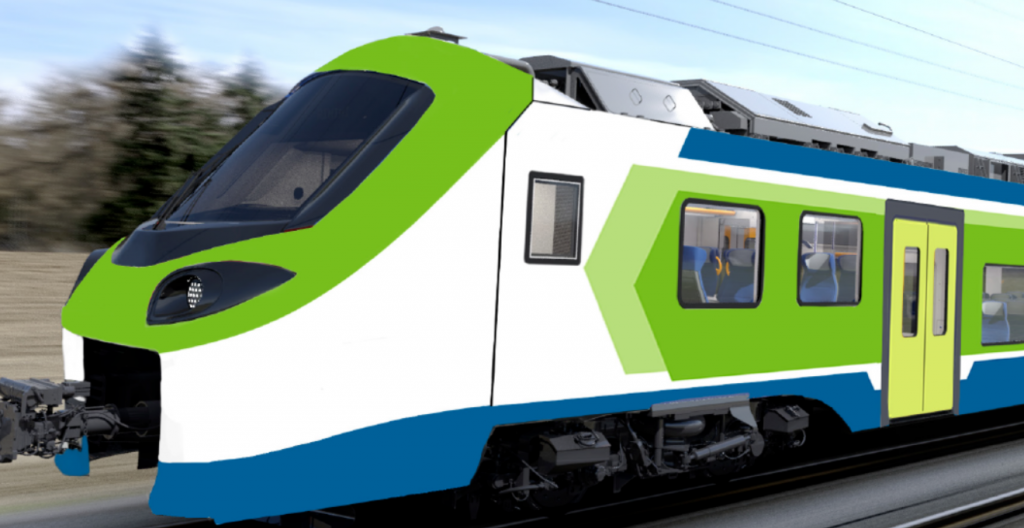
| 1 | Alstom (France) | Coradia iLint (in service); Coradia iLint 2.0 (upgraded FC technology, 2025–); Trenord order (Italy) | Train OEM + hydrogen supply ecosystem integrator; fuel cell partnership with Cummins/Hydrogenics | First mover and market leader by units delivered (41 units); 2.8 million km accumulated; December 2024 withdrawal for rework acknowledged as “operational challenge” of pioneering; Trenord order (6 units, Coradia Stream H₂, Italy) next major deployment; North America demonstration in Quebec (2023) |
| 2 | Siemens (Germany) | Mireo Plus H (hydrogen variant of Mireo Plus platform); Siemens Energy fuel cell partnership | Platform OEM; cross-group hydrogen technology integration via Siemens Energy electrolyser/fuel cell portfolio | Mireo Plus H prototype tested on Bavarian network; strong order pipeline from German states for hydrogen option alongside BEMU Mireo Plus B; positioned to scale as largest German-market hydrogen train supplier from 2027 onward when platform matures |
| 3 | Stadler Rail (Switzerland) | FLIRT H2 (in service California, 2025); GTW H₂ variants; FLIRT H2 Guinness Record (1,742 miles) | Train OEM; Ballard Power Systems fuel cell partner; modular platform approach (same body, swappable powertrain) | First hydrogen train in US passenger service (September 2025); California CalSTA order for up to 25 units; FRA certification sets template for North American hydrogen rail market; 1,742-mile world record establishes range credentials; competitive pricing versus Alstom and Siemens |
| 4 | CRRC (China) | Hydrogen tram (Qingdao, Chengdu, operating); hydrogen regional train prototypes; “Dual Carbon” programme | Vertically integrated OEM; CRRC-owned fuel cell development; scale production advantage for domestic market | Dominant in China’s massive domestic hydrogen rail market; Qingdao hydrogen tram in revenue service since 2021; hydrogen train prototypes tested on multiple provincial networks under “Shuāng Tàn” (Dual Carbon) national targets; increasingly competitive in Asia-Pacific export markets; development of groundbreaking hydrogen high-speed train prototype announced 2024 |
| 5 | Hitachi Rail (Japan/Italy) | Hitachi-Toyota JR East FC Hybrid test train; Masaccio BEMU-H₂ variant in development; tri-mode expansion | Train OEM + Toyota fuel cell technology partnership; JR East collaboration (JR East + Toyota + Hitachi agreement October 2020) | JR East hydrogen test train using Toyota automotive fuel cell technology under development; tri-mode capability (electric/diesel/battery) extending to hydrogen variant; European market position through Alstom acquisition integration; Masaccio platform adaptation for hydrogen underway |
| 6 | Cummins (Accelera) (USA) | PowerDrive 6000 fuel cell; FCmoveTM-HD series (acquired from Hydrogenics); hydrogen engine B6.7H | Critical fuel cell component supplier behind multiple OEM-branded hydrogen trains; acquired Hydrogenics (2019) for fuel cell stack production | Sole fuel cell supplier to Alstom iLint programme; supply relationship the direct cause of iLint degradation issue (Cummins is developing upgraded fuel cell technology with longer service life for iLint 2.0); also supplies components to PESA (Poland), Wabtec (USA), and other hydrogen rail programmes globally |
| 7 | Ballard Power Systems (Canada) | FCmoveTM-HD+ 100 kW module; FCmoveTM-XD heavy-duty module; rail-specific fuel cell stacks | Specialist rail-grade PEM fuel cell OEM; direct supplier to Stadler FLIRT H2 (6 × 100 kW per trainset), PESA, and others | Critical component supplier in Stadler’s value chain for FLIRT H2; growing rail specialisation alongside bus (New Flyer hydrogen buses) and marine fuel cell markets; FCmoveTM rail certification sets performance baseline for North American FRA-compliant hydrogen systems; publicly traded, providing capital market transparency on hydrogen rail investment scale |
| 8 | Hyundai Rotem (South Korea) | Hydrogen DMU prototype; integration with Hyundai Nexo fuel cell stack; Korean Green New Deal programme | Train OEM leveraging Hyundai Group’s automotive hydrogen ecosystem (Nexo, XCIENT hydrogen trucks, Hyundai hydrogen bus) | South Korean government-backed hydrogen train development programme; target: hydrogen DMU in revenue service by 2026–2027 on Korean national network; Hyundai Group’s scale hydrogen production investment reduces fuel cell cost; competitive export positioning for Southeast Asian non-electrified rail markets |
| 9 | PESA (Poland) | Hydrogen shunting locomotive (SM42 modernisation, Ballard PEM, in operation); hydrogen passenger DMU (prototype 2025) | Regional OEM with first hydrogen freight locomotive in European commercial service; partnership with Ballard for fuel cell supply; EU funding through Polish National Recovery Plan | First company to deliver a hydrogen shunting locomotive to commercial operation in Europe; 70-tonne SM42-derived locomotive with 2 × 85 kW Ballard PEM modules; maximum 90 km/h; operating at Polish freight facilities; hydrogen passenger DMU prototype targeting 2025–2026 trials; demonstrates hydrogen viability in freight/industrial context preceding passenger deployment |
| 10 | CAF (Spain) | Civity H₂ hydrogen variant; CIVIA H₂ prototype; EcoFuel programme | Train OEM with hydrogen variant across Civity platform; active in EU Shift2Rail hydrogen demonstrations; competitive in Spanish and Latin American markets | Civity H₂ prototype tested; Spanish government hydrogen rail programme under PNIEC (Integrated National Energy and Climate Plan); CAF’s dual-chemistry approach (hydrogen + battery within same CIVITY platform) allows operators to choose after network assessment; emerging Latin American hydrogen rail pipeline as Brazil, Colombia, and Chile develop green hydrogen export strategies |
Hydrogen Train vs BEMU vs Diesel DMU: Full Operational Comparison
| Parameter | Hydrogen FCEV Train | Battery-Electric (BEMU) | Diesel DMU |
|---|---|---|---|
| Emission at point of use | Zero (water vapour only) | Zero | CO₂, NOₓ, PM2.5 |
| Well-to-wheel CO₂ (green H₂ / renewable power) | ~6–8 kg CO₂/100 km (green H₂) | ~2–5 kg CO₂/100 km (renewable grid) | ~70–90 kg CO₂/100 km |
| Non-electrified range | 600–1,000 km (hydrogen tank) | 80–150 km (battery); 224 km (record) | Unlimited (fuel tank) |
| Energy replenishment time | 15–30 minutes (hydrogen fill) | 20–60 min (opportunity charge from OHL) | 10–20 minutes (diesel fill) |
| Infrastructure required | Hydrogen refuelling station at depot (€5–15M) | Partial OHL on route (€1.5–3.5M/km) | Standard diesel point (existing) |
| Well-to-wheel efficiency | ~25–35% (green H₂ pathway) | ~70–80% (grid to wheel) | ~30–38% (diesel engine) |
| Capital cost premium vs diesel | +40–80% (fuel cell + H₂ storage + safety systems) | +20–35% (battery system) | Baseline |
| Traction energy cost (2026) | €80–150/100 km (green H₂ at depot) | €8–20/100 km (renewable electricity) | €8–14/100 km (diesel 2025 prices) |
| Best route application | Long unelectrified routes (>200 km between charging points) | Partial OHL with unelectrified gaps <150 km | Any non-electrified route (but emitting) |
| Fuel cell service life (major overhaul) | 25,000–30,000 hours (8–10 years) | Battery: 10,000+ cycles (10–15 years, LTO chemistry) | Diesel engine: 15,000–20,000 hours (overhaul) |
| Key commercial risk | Green H₂ cost trajectory; fuel cell degradation; supply chain maturity | Route-specific range limitation; battery replacement cost | Carbon pricing; AQMZ compliance; regulatory exit mandates |
Editor’s Analysis
The hydrogen train market occupies a genuinely difficult position in the decarbonisation landscape: it is the right technology for a specific and important problem — very long unelectrified rail routes where battery range is insufficient and full electrification is impractical — but its economics depend on an energy cost transition (green hydrogen to under €2/kg at the depot) that has not yet been achieved and may not be achieved within the decade that the 28.2% CAGR projection assumes. The CAGR figure, it is worth noting, starts from a very small base ($2.67 billion in 2025) and reflects the transition from demonstration-scale to early commercial deployment rather than mass market adoption. A market that triples from 2025 to 2030 ($9.25B) is still a market that has barely left its formation stage by global rolling stock industry standards. The Alstom iLint fleet withdrawal in December 2024 was a useful corrective to the narrative that the technology is commercially ready without qualification. It is commercially deployable — 41 units in revenue service is meaningful — but not yet at the reliability level that transit operators can accept without exceptional OEM support and flexibility. The next three to five years of iLint 2.0 and FLIRT H2 operational data will be the defining evidence for whether hydrogen trains can reach the reliability baseline that BEMU trains already achieve. If they can, the market scales. If they cannot — if fuel cell degradation, hydrogen supply chain reliability, and cold-weather performance remain unresolved — the 28.2% CAGR will be revised downward, battery-electric will capture more of the addressable market, and hydrogen trains will remain a specialist solution for the routes that genuinely have no battery-compatible alternative. The technology deserves the chance to prove itself at scale. It has not yet had that chance.
— Railway News Editorial
Frequently Asked Questions
1. What actually went wrong with the Alstom Coradia iLint fleet withdrawal in December 2024?
The December 2024 withdrawal of most of Alstom’s 41-unit Coradia iLint fleet in Germany involved multiple concurrent issues rather than a single failure. The primary technical problem was PEM fuel cell degradation occurring faster than the designed maintenance interval, reducing fuel cell stack output capacity below the threshold required for full service performance. Alstom acknowledged this was partly a consequence of being the first manufacturer to operate hydrogen passenger trains at scale — the real-world degradation profile under railway duty cycles (frequent starts, temperature variation, load cycling) differed from laboratory life-test predictions. The secondary problem was hydrogen supply reliability: Linde, contracted to supply hydrogen, encountered technical problems at production and delivery stages, leading to multiple train cancellations and service substitutions with diesel replacements in the preceding months. The tertiary issue was software integration faults affecting the energy management system’s interaction between fuel cell and buffer battery — particularly during cold-weather operation. Alstom’s response was to confirm that it would upgrade the fuel cell technology across the entire iLint fleet from 2025 onward (the “iLint 2.0” upgrade, involving new Cummins/Hydrogenics fuel cell stacks with improved durability), and to fund a 16-unit LINT diesel replacement fleet from its own budget to maintain service commitments during the upgrade period. The incident does not invalidate the hydrogen train concept — the trains had accumulated 2.8 million km before the withdrawal — but it establishes that first-generation commercial hydrogen trains require substantially more OEM support than first-generation diesel or electric trains, and that the supply chain ecosystem (fuel supply, depot infrastructure, maintenance specialisation) needs further development before hydrogen rail operations can be as operationally independent as conventional traction.
2. Why is the Stadler FLIRT H2’s range specification (380 miles / 612 km) so much lower than its world record (1,742 miles / 2,803 km)?
The 1,742-mile Guinness World Record set by the Stadler FLIRT H2 during testing in Colorado in 2024 was achieved under conditions specifically optimised to maximise range — reduced speed (well below the train’s 79 mph maximum), extended coasting phases between speed reductions, maximum regenerative braking application, and an ambient temperature in the battery and fuel cell optimal operating range. The hydrogen consumption rate under these optimised conditions was approximately 60–65% of normal service consumption per kilometre. The 380-mile commercial specification reflects the operating profile that actual service requires: normal acceleration and braking patterns to meet the timetable, full HVAC operation for passenger comfort, speed regulation to maximum permitted speed, and a safety energy reserve of approximately 20% of hydrogen capacity retained at the end of service to guard against timetable overrun and unexpected delays. The gap between record performance and commercial specification (approximately 4.6:1) is comparable to the gap between a road car’s fuel economy in “ideal” driving test conditions and real-world mixed-city-and-motorway consumption. It does not indicate any deficiency in the train’s engineering — it reflects the difference between optimised demonstration conditions and the variable, passenger-comfort-prioritising, timetable-constrained conditions of real service. The 380-mile commercial range is itself approximately 3–4 times the range of current production BEMU regional trains, and comfortably sufficient for the vast majority of US non-electrified regional rail applications.
3. What is “grey hydrogen” and why does it make hydrogen trains worse for the climate than diesel?
Grey hydrogen is produced from natural gas through a process called Steam Methane Reforming (SMR): high-temperature steam reacts with methane to produce hydrogen and carbon dioxide as a byproduct. The CO₂ is not captured — it is released directly to the atmosphere. Grey hydrogen production generates approximately 9–12 kg of CO₂ per kilogram of hydrogen produced. A hydrogen train consuming 13.2 kg of hydrogen per 100 km, running on grey hydrogen, is therefore responsible for 13.2 × 11 = 145 kg of CO₂ per 100 km — approximately double the 70–90 kg CO₂ per 100 km from a diesel DMU on the same route. This means that “zero emission at point of use” is not the same as “zero carbon” or even “lower carbon than diesel” unless the hydrogen is produced from renewable electricity (green hydrogen) or from natural gas with full carbon capture and storage (blue hydrogen). As of 2026, approximately 96% of global hydrogen production is grey or “brown” (from coal gasification), with green hydrogen representing less than 1% of production. Any hydrogen train operating on commercially available hydrogen from the existing supply chain — rather than from a specific green hydrogen contract — is likely consuming grey hydrogen and therefore producing more lifecycle CO₂ than the diesel train it replaced. This is not a theoretical concern; it is the actual situation for most current hydrogen vehicles unless the operator has specifically contracted certified green hydrogen supply. The Coradia iLint in Lower Saxony operates on green hydrogen from wind power, verified by contract and certified. The broader hydrogen train market cannot claim climate benefit without the same supply chain discipline.
4. How does a hydrogen refuelling station at a rail depot work — what infrastructure is required and what does it cost?
A hydrogen refuelling station at a rail depot is substantially more complex than a diesel fuel point, involving three distinct infrastructure subsystems. The first is hydrogen production or delivery: green hydrogen can be produced onsite using an electrolyser (requiring a dedicated renewable electricity connection of typically 1–5 MW for a modest depot) or delivered as compressed gas by tube trailer or as liquid hydrogen by cryogenic tanker from an off-site production facility. Onsite electrolysis offers supply security and potentially lower hydrogen cost at scale, but requires a capital investment of €2–8 million for an electrolyser of sufficient capacity to service 10–20 trainsets daily. The second subsystem is storage: compressed hydrogen at 350–700 bar is stored in high-pressure steel or composite tanks at the depot, with total storage capacity calculated for 24–48 hours of train operations to buffer supply delivery variations. Storage systems for a modest 10-train depot require approximately 1–2 tonnes of hydrogen capacity, stored in banks of certified pressure vessels with full leak detection, ventilation, and emergency shutdown systems. The third subsystem is dispensing: the refuelling connection between depot storage and the train’s onboard tanks, using cryogenic or high-pressure coupling systems with auto-disconnect safety valves. The entire station, for a 10-trainset depot, costs approximately €5–15 million in capital cost — 5–10 times the cost of a diesel fuel installation of equivalent capacity — and requires safety certification under the ATEX (European) or equivalent framework for hydrogen installations. Annual operating costs (hydrogen purchase at current green H₂ prices, maintenance, safety inspections) add approximately €500,000–1.5 million per year per depot at current hydrogen prices — a cost that falls directly in the operator’s operating expenditure and represents the most significant near-term commercial barrier to hydrogen train adoption at scale.
5. What is the long-term competitive dynamic between hydrogen trains and battery-electric trains — will they converge or diverge?
The evidence from 2025 suggests the two technologies are diverging toward complementary market niches rather than converging into direct competition. Battery-electric trains (BEMUs) are winning the sub-150 km unelectrified gap market — routes with partial electrification where the battery range is sufficient to bridge the non-electrified section, which is the majority of European regional rail routes with non-electrified gaps. Hydrogen trains are winning (or are the only option for) the very long unelectrified routes — remote regional lines in the US, Australia, parts of central Europe, and eventually Asia-Pacific where the distance between any electrified infrastructure exceeds 200–300 km. This niche complementarity is actually beneficial for the hydrogen market: it avoids a head-to-head commercial competition that hydrogen would currently lose on economics, and allows hydrogen to prove its operational credentials in the specific applications where it is genuinely superior. The risk to the hydrogen train’s long-term market position is battery technology advancement: if solid-state batteries achieve the energy density improvements currently projected (potentially 2–3× current lithium-ion by 2030–2035), BEMU range would extend from 150 km toward 300–500 km, encroaching on the hydrogen train’s current exclusive territory. Conversely, if green hydrogen costs fall to €1–2/kg by 2035 (the optimistic scenario), hydrogen’s operating cost premium over diesel would close substantially, making it competitive on economic grounds rather than purely on range. The most likely 2035 outcome is a stable market in which BEMU dominates the European regional market and hydrogen trains serve a significant but smaller niche: North American non-electrified secondary lines, Australian outback rail, very long-haul Asian regional corridors, and specialist freight and shunting applications — a collective market large enough to justify the investment the industry is making in the technology, but not large enough to challenge BEMU’s overall dominance of the non-electrified rail decarbonisation market.

Railway infrastructure, rolling stock and transport technologies specialist focused on global rail industry developments, high-speed rail systems, signaling technologies and freight transportation. Covering railway investments, public transport modernization, rail operations and international mobility projects across Europe, Asia and North America.
RELATED POSTS

October 4, 2026 5:14 pm
Alstom secured a CA$4.7 billion order from VIA Rail Canada...
October 1, 2026 3:12 am
Greenbrier confirmed Brian Comstock as new president and CEO effective...
October 1, 2026 5:14 am
Siemens confirmed delivery of the first new S200 train to...
October 1, 2026 8:12 am
Knorr-Bremse expanded its UK rail adhesion trial on Chiltern Railways...
October 1, 2026 2:12 pm
Pittsburgh Regional Transit secured an $82.8 million FTA grant to...
October 2, 2026 5:14 am
FTA awarded $166 million in March 2026 to fund new...