
Stadler Secures Eight Bi-mode FLIRT Trains Dublin-Belfast
Stadler secured eight bi-mode FLIRT trains for Iarnród Éireann and Translink NI Railways for the GBP 548 million Dublin-Belfast Enterprise project, entering service in 2030.
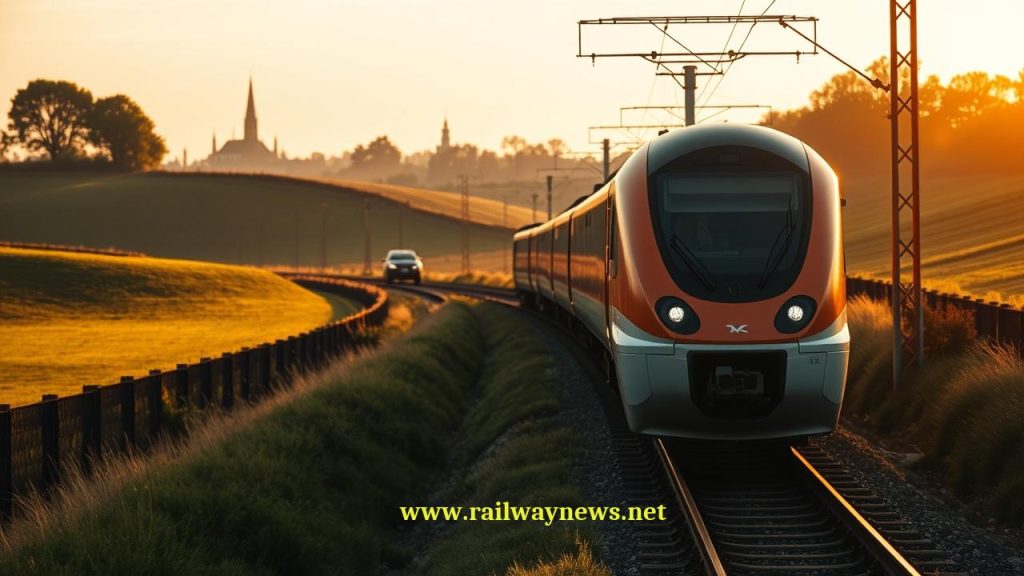
⚡ In Brief: Stadler has secured its first contract in Ireland to supply Iarnród Éireann and Translink NI Railways with eight bi-mode FLIRT Intercity trains for the Dublin-Belfast route, part of a GBP 548 million cross-border investment programme supported by PEACEPLUS funding.
DUBLIN/BELFAST – Swiss manufacturer Stadler will supply eight new bi-mode FLIRT Intercity trains to operators Iarnród Éireann and Translink NI Railways for the cross-border Enterprise service. The trains, scheduled to enter service in 2030, are a central component of a GBP 548 million (approx. EUR 698 million) project to modernize the rail link between the capitals of Ireland and Northern Ireland. The contract also includes a 15-year maintenance and service agreement.
What Does This Contract Cover?
The agreement covers the design, manufacture, and delivery of eight 200-metre-long, five-car bi-mode trains, along with a detailed 15-year service package. The trains will feature a diesel-electric and battery propulsion system, designed to operate on non-electrified sections in Northern Ireland and under 1,500V DC overhead lines in the Republic of Ireland. The value of the rolling stock procurement separate from the overall project investment was not disclosed by the parties.
Key Contract Data
| Parameter | Value |
|---|---|
| Contract Name | Enterprise Fleet Replacement Project |
| Total Value | GBP 548 million (Total project value; rolling stock cost not disclosed) |
| Parties Involved | Stadler, Iarnród Éireann, Translink NI Railways, Irish Govt, NI Executive, EU (PEACEPLUS) |
| Timeline / Completion | New fleet to enter service in 2030 |
| Country / Corridor | Ireland / Northern Ireland (Dublin–Belfast) |
How Does This Compare to Similar Contracts?
The successful cross-border funding structure for the Enterprise fleet contrasts with other major rail projects in the region facing financial uncertainty. For example, the East West Rail project connecting Oxford and Cambridge has faced repeated questions over its funding model and phasing plans, highlighting the challenges in securing long-term capital investment for UK infrastructure (Source: Construction News). The Enterprise project’s secure, multi-source funding, including EUR 165 million from the EU’s PEACEPLUS programme, provides a level of certainty not seen in all comparable large-scale rail upgrades. The total project investment also aligns with significant infrastructure commitments seen in North America, such as the $16 billion Hudson Tunnel project, indicating a global trend towards major public investment in core rail corridors (Source: Construction Dive).
Editor’s Analysis
This contract marks a strategic entry for Stadler into the all-island Irish rail market, a territory historically dominated by other manufacturers. The tri-mode capability (diesel, battery, electric) of the FLIRT platform is a key differentiator, offering a pragmatic solution for decarbonising routes with inconsistent electrification. This “bridging technology” approach is a model likely to be replicated on other secondary mainlines across Europe that await full electrification as part of net-zero strategies. The deal solidifies the Dublin-Belfast corridor as a priority for economic and political cooperation, underwritten by significant international funding.
FAQ
Q: How will the new trains operate across two different railway systems?
A: The Stadler FLIRT trains will use a battery for non-electrified sections around Belfast, a diesel engine to the border area, and then switch to 1,500V DC electric power from the overhead lines to Dublin. The transition between power modes is designed to be automatic and imperceptible to passengers.
Q: What specific improvements will passengers see from 2030?
A: Passengers can expect a reduced journey time of under two hours between Dublin and Belfast, an increased frequency to 16 daily services in each direction, and enhanced onboard amenities. The trains will feature 407 seats, improved Wi-Fi, better catering, and full accessibility with step-free access.
Q: Who is funding this GBP 548 million project?
A: The project is jointly funded by the Government of Ireland through the Department of Transport and the Northern Ireland Executive via the Department for Infrastructure. It also receives EUR 165 million from the European PEACEPLUS programme, which is co-funded by the EU, UK, and Irish governments.

Railway infrastructure, rolling stock and transport technologies specialist focused on global rail industry developments, high-speed rail systems, signaling technologies and freight transportation. Covering railway investments, public transport modernization, rail operations and international mobility projects across Europe, Asia and North America.
RELATED POSTS

October 8, 2026 1:15 pm
Alstom secured a €1bn contract to build 13 automated trains,...

October 1, 2026 7:09 am
United States regulators confirmed a September 30 deadline for the...

October 8, 2026 12:18 pm
Siemens Mobility signed an agreement with VinSpeed to supply 350...

October 4, 2026 5:14 pm
Alstom secured a CA$4.7 billion order from VIA Rail Canada...

October 5, 2026 6:12 pm
AECOM and Jacobs secured a contract in September 2026 to...

October 1, 2026 12:13 am
Illinois approved $1.5 billion annually for the Northern Illinois Transit...