
Global Rail Industry: Major Contracts & Trends
Major rail players like Bombardier, British Steel, and Siemens are securing massive contracts globally. Discover how these deals are shaping the future of rail!
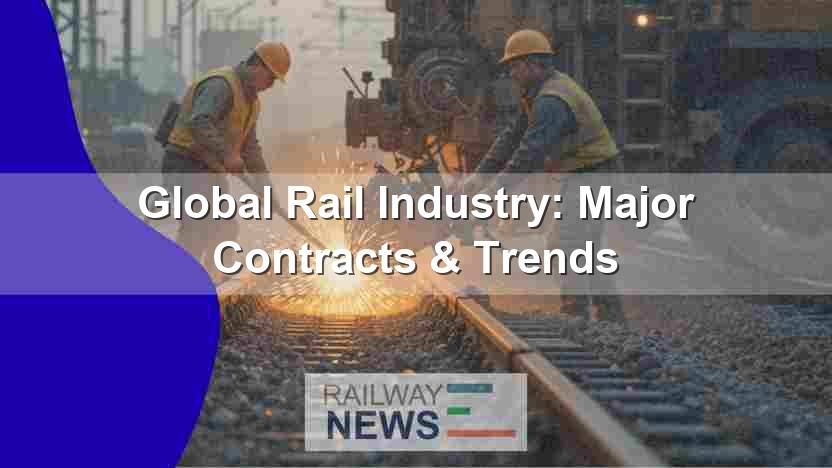
The global railway industry is a dynamic sector characterized by continuous technological advancements and significant investments in infrastructure upgrades and rolling stock modernization. This article examines several recent major contracts awarded to prominent players in the industry, highlighting the diverse range of projects and the technological innovations involved. These contracts showcase the growing demand for high-speed rail, the increasing importance of sustainable and efficient transit solutions, and the ongoing competition among leading manufacturers to secure market share in this lucrative sector. We will analyze contracts awarded to Bombardier Transportation, British Steel, and Siemens Mobility, examining their scope, implications, and significance within the broader context of global rail infrastructure development. The analysis will delve into the technological aspects of the projects, focusing on the types of rolling stock involved, their features, and the broader strategic implications for the respective companies and the rail industry as a whole. This examination aims to provide a detailed overview of current trends and future directions within the rail sector.
Bombardier Transportation’s Success in Tram and High-Speed Rail
Bombardier Transportation secured a substantial contract with Albtal-Verkehrs-Gesellschaft (AVG) in Germany for the supply of 20 dual-system Bombardier FLEXITY trams, valued at $98 million. This order increases AVG’s FLEXITY fleet to 62 units and showcases the enduring popularity of Bombardier’s tram technology. The dual-system capability underscores the growing need for versatile rolling stock capable of operating on different power systems. Further cementing their position in the high-speed rail market, Bombardier Sifang (BST) (a joint venture between Bombardier Transportation and Sifang Locomotive & Rolling Stock Co.) won a $453 million contract from China Railway (CRC) for the delivery of 168 CR400AF high-speed rail cars. These cars, operating at a maximum speed of 350 km/h, will be configured into 15 eight-car and three sixteen-car trainsets. This highlights Bombardier’s success in penetrating the large and rapidly expanding Chinese high-speed rail market. The contract demonstrates the growing demand for high-speed rail solutions globally, and Bombardier’s capacity to meet this demand through its strategic partnerships.
British Steel’s Contribution to Rail Infrastructure
Rete Ferroviaria Italiana (RFI) (Italian Railway Network), a major player in Italian railway infrastructure, awarded a contract to British Steel for the supply of 86,000 tonnes of rail. This significant order includes 18,000 tonnes of premium stress-free (SF) heat-treated rail, designed to reduce fatigue on curved or heavy-haul tracks, and 68,000 tonnes of standard-grade rail. The use of 108m long rails demonstrates a focus on efficiency in track laying and reducing maintenance requirements. The contract highlights the critical role of steel manufacturers in supporting railway infrastructure development and their ability to provide specialized rail products tailored to specific operational demands. The use of premium SF heat-treated rail signifies a trend towards improved rail quality and performance.
Siemens Mobility’s Expansion in North America
Siemens Mobility secured a €650 million ($740.7 million) contract with VIA Rail Canada for the supply of 32 bi-directional trainsets, along with a 15-year technical services and spares supply agreement (TSSSA). This contract marks a significant step for Siemens Mobility in the North American market and highlights the growing demand for modern, efficient rolling stock in passenger rail services. The bi-directional capability of the trainsets enhances operational flexibility. The inclusion of a long-term maintenance contract underscores the importance of detailed lifecycle support in securing such large-scale contracts. The replacement of existing VIA trains on the Quebec City-Windsor Corridor demonstrates a commitment to improving passenger comfort and service quality.
Conclusions
The contracts discussed in this article represent a cross-section of current activity in the global rail industry, spanning tram systems, high-speed rail, and the supply of essential railway infrastructure components. Bombardier Transportation’s success reflects its strength in both urban transit and high-speed rail technologies, demonstrating adaptability and market reach. The British Steel contract underlines the importance of robust and specialized steel production for building and maintaining modern rail networks, emphasizing the quality and performance requirements of modern railway infrastructure. Siemens Mobility’s win in North America highlights the company’s strategic expansion into new markets and signifies the demand for technologically advanced and detailedly supported rail systems. These contracts collectively illustrate a broader trend of investment in upgrading and expanding rail networks globally. The emphasis on high-speed rail, advanced materials, and long-term maintenance agreements underscores the commitment to efficient, sustainable, and passenger-focused rail transportation. Additionally, these contracts highlight the importance of strategic partnerships and collaborations across the rail supply chain, from component manufacturing to rolling stock production and maintenance services. The future of the rail industry will continue to be driven by innovation, sustainability, and the ongoing demand for efficient and high-performance transportation solutions.

Railway infrastructure, rolling stock and transport technologies specialist focused on global rail industry developments, high-speed rail systems, signaling technologies and freight transportation. Covering railway investments, public transport modernization, rail operations and international mobility projects across Europe, Asia and North America.
RELATED POSTS

October 8, 2026 1:15 pm
Alstom secured a €1bn contract to build 13 automated trains,...

October 1, 2026 7:09 am
United States regulators confirmed a September 30 deadline for the...

October 8, 2026 12:18 pm
Siemens Mobility signed an agreement with VinSpeed to supply 350...

October 4, 2026 5:14 pm
Alstom secured a CA$4.7 billion order from VIA Rail Canada...

October 5, 2026 6:12 pm
AECOM and Jacobs secured a contract in September 2026 to...

October 1, 2026 12:13 am
Illinois approved $1.5 billion annually for the Northern Illinois Transit...