
Arlanda Express High-Speed Rail Project: Stockholm, Sweden
Arlanda Express high-speed rail link, a successful public-private partnership, connects Stockholm Central Station to Arlanda Airport. This railway project showcases innovative financing and efficient operations.
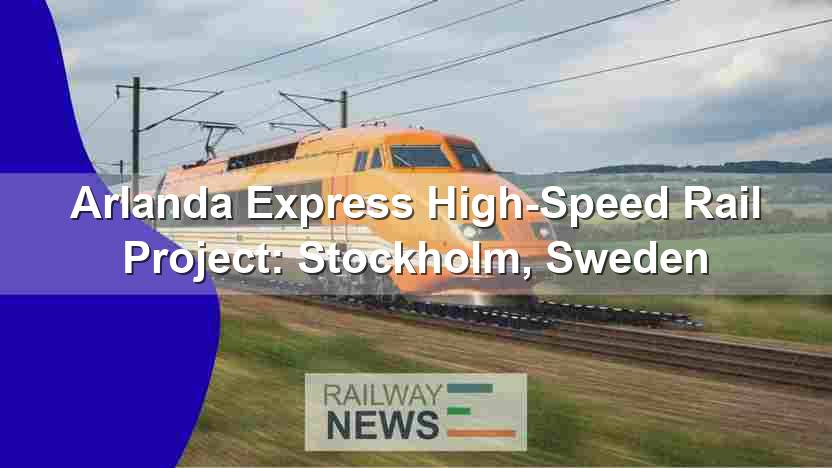
This article examines the Arlanda Express high-speed rail link, a successful example of a public-private partnership (PPP) in rail infrastructure development. The project, connecting Stockholm Central Station to Arlanda Airport, serves as a compelling case study for analyzing the complexities and benefits of this collaborative model. We will delve into the project’s planning, construction, operation, and technological aspects, highlighting the challenges overcome and the lasting impact on Sweden’s transportation infrastructure. The analysis will focus on the financial structure, the technical specifications of the system, and the operational performance achieved since its inception, examining its contribution to improved passenger experience and economic benefits for both the private investors and the Swedish state. The ultimate aim is to provide a detailed understanding of the Arlanda Express project and its relevance to future high-speed rail ventures globally.
Project Development and Financing
The Arlanda Express project began in 1993 with a call for tenders for a new high-speed rail line connecting Stockholm’s Rosersborg station to Arlanda Airport, rejoining the main line at Odensala. The winning consortium, Arlanda Link Consortium (ALC), comprised Swedish companies NCC (construction), Siab (construction), and Vattenfall (power utility), along with British companies Mowlem (track and points) and GEC Alsthom (rolling stock). ALC formed a ‘finance, build, and operate’ company, A-Train AB, to manage the project. This PPP model allocated construction risk and responsibility to the private sector while ensuring public ownership of the infrastructure after a specified period. In 2004, Macquarie Group acquired A-Train AB, demonstrating the project’s attractiveness to international investors. The project demonstrates a successful model for attracting private investment in large-scale public infrastructure projects.
Construction and Engineering
Construction commenced in 1995, with the original completion target of summer 1999 delayed to meet stringent reliability and punctuality targets. The 20km double-track line includes 7km of tunnels, primarily built within 22m-deep rock caverns at the airport stations. Approximately 20 bridges, tunnels and portals were constructed. NCC and Siab were responsible for construction, civil engineering, and overhead lines, while Mowlem supplied and installed 39km of track, including 29 turnouts and crossovers. The project showcased sophisticated engineering techniques necessary to navigate challenging geographical conditions, highlighting the expertise required for successful large-scale railway infrastructure construction.
Rolling Stock and Operational Systems
The Arlanda Express utilizes seven four-car electric multiple units (EMU), each capable of 200km/h, built by GEC Alstom (now Alstom). The trains feature 190 seats, ample luggage space, and Alstom’s Onix dedicated traction system with regenerative, disc, and track braking. The extensive testing program—130,000km of running and 1,150 round trips—ensured the high availability target of 98% or better was achieved. The integration of advanced signaling and communication systems, including automatic train protection (ATP) from Adtranz (now Bombardier Transportation) and a central train control system, played a crucial role in ensuring safety and operational efficiency. Alcatel provided onboard radio systems for both passenger communication and emergency services.
Project Performance and Future Outlook
The Arlanda Express commenced operations with a 20-minute interval service between Stockholm Central Station and Arlanda Airport, running at 160km/h. Although the initial target of a 15-minute interval was not immediately realized, the service has consistently met high reliability and punctuality standards. Passenger numbers have been significant, with approximately 3.2 million passengers using the service in 2008. The project successfully integrated automatic ticketing and fare collection systems, enhancing passenger convenience. After the completion of the construction phase, A-Train AB transferred the system to the Swedish state under a leaseback agreement, with A-Train AB receiving all fare proceeds until 2040. This showcases a sustainable and efficient model for infrastructure financing and management.
| Project Parameter | Value |
|---|---|
| Project Length | 20 km (double-track) |
| Number of Stations | 3 (2 at Arlanda Airport, 1 at Stockholm Central) |
| Tunnel Length | 7 km |
| Number of Bridges/Portals | Approximately 20 |
| Track Length (including points and crossovers) | 39 km |
| Number of Trainsets | 7 (four-car EMUs) |
| Maximum Train Speed | 200 km/h |
| Initial Service Frequency | Every 20 minutes |
| Passenger Numbers (2008) | Approximately 3.2 million |
Conclusions
The Arlanda Express high-speed rail link stands as a testament to the efficacy of public-private partnerships in delivering complex infrastructure projects. The project’s success can be attributed to several factors, including a clear definition of roles and responsibilities between the public and private sectors, a robust financial model that attracted private investment, and the deployment of state-of-the-art technology to ensure high operational performance. The project’s innovative financing mechanism, where the private sector undertakes construction risk and receives long-term revenue streams, provides a valuable model for future infrastructure developments. The achievement of high reliability and punctuality targets, despite challenging geological conditions and tight deadlines, demonstrated the exceptional engineering and construction capabilities involved. The integration of advanced signaling and communication systems, coupled with comfortable and efficient rolling stock, significantly enhanced passenger experience, contributing to the project’s overall success.
The Arlanda Express demonstrates that well-structured PPPs can successfully deliver high-quality, efficient, and sustainable rail infrastructure. The long-term leaseback agreement with the Swedish state showcases a viable model for balancing private sector investment with public ownership of crucial assets. This project serves as a powerful case study for other countries and regions contemplating high-speed rail development, illustrating how a collaborative approach can overcome significant hurdles and provide enduring societal benefits. The continued success of the Arlanda Express, even after more than two decades of operation, underscores the importance of thorough planning, robust engineering, and the right mix of public and private sector collaboration in large-scale infrastructure undertakings. Future developments should focus on expanding such models and further integrating rail networks for enhanced connectivity and economic growth.
Company Information:
- Alstom: A multinational transportation company providing rolling stock, signaling, and infrastructure solutions.
- Bombardier Transportation (formerly Adtranz): A major manufacturer of railway equipment.
- Alcatel: A telecommunications company providing communication systems.
- NCC: A major Swedish construction and property development company.
- Siab: A Swedish construction company.
- Vattenfall: A Swedish multinational energy company.
- Mowlem: A British construction company (now part of Carillion).
- Macquarie Group: A global financial services group.

Railway infrastructure, rolling stock and transport technologies specialist focused on global rail industry developments, high-speed rail systems, signaling technologies and freight transportation. Covering railway investments, public transport modernization, rail operations and international mobility projects across Europe, Asia and North America.