
Europe’s New Welding Standard: EN 14587-2 Enhances Track Safety
Discover EN 14587-2: the European standard for on-site mobile flash butt welding. It ensures safe, high-quality, and durable continuous welded rail infrastructure.
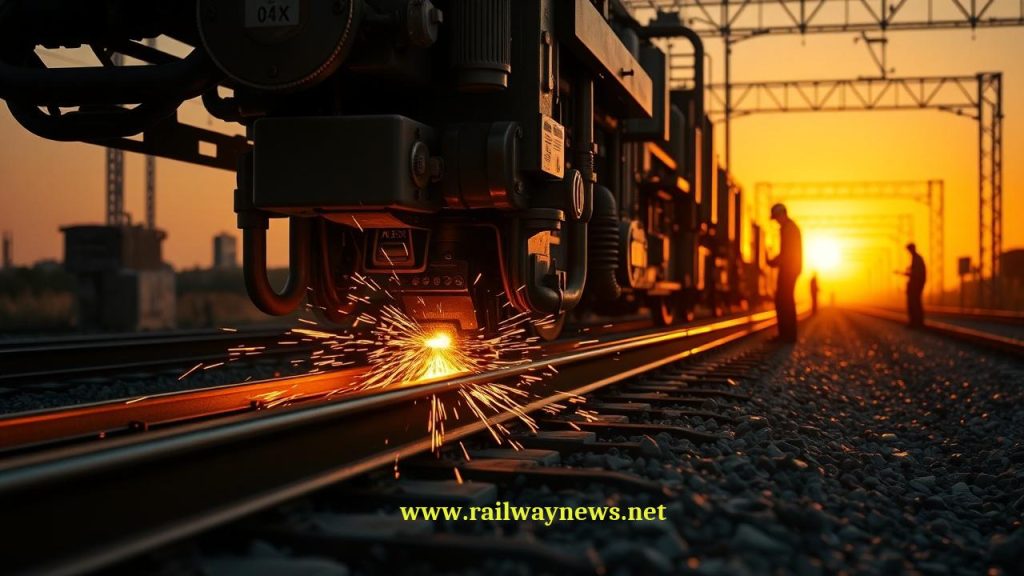
Understanding EN 14587-2: On-Site Flash Butt Welding of Rails
EN 14587-2 is a European Standard that specifies the technical requirements and quality assurance protocols for the flash butt welding of new rails using mobile welding machines. This standard is specifically focused on on-site applications, distinguishing it from processes conducted in fixed, stationary plants. It provides a framework for contractors, railway authorities, and welders to ensure the integrity, safety, and longevity of continuous welded rail (CWR) tracks.
The scope of this standard exclusively covers new, unused Vignole rails of grades R220, R260, R260Mn, and R350HT. By standardizing the procedure for mobile welding units, EN 14587-2 plays a critical role in both the construction of new railway lines and the maintenance or repair of existing tracks directly in the field, minimizing disruption and logistical complexity.
Key Objectives and Scope of the Standard
The primary goal of EN 14587-2 is to establish a verified and repeatable process for producing high-quality rail welds in a challenging, non-factory environment. This involves strict controls over every phase of the operation. The standard’s main areas of focus include:
- Welding Procedure Approval: It mandates a formal approval process for any welding procedure before it can be used. This involves creating a test weld under representative site conditions and subjecting it to rigorous laboratory testing to verify its mechanical properties.
- Welder and Operator Qualification: The standard requires that all personnel operating the mobile welding machines and performing associated tasks are properly trained, assessed, and certified as competent.
- Pre-Weld Requirements: It details the necessary preparations, including rail end inspection for defects, cleaning, and precise geometric alignment to ensure a successful weld.
- Control of Welding Parameters: It outlines the critical parameters of the flash butt welding cycle (e.g., current, voltage, flashing time, upset force) that must be controlled and monitored by the mobile welding machine.
- Post-Weld Finishing and Inspection: The standard defines the procedures for removing excess weld material (shearing), grinding the rail profile to precise tolerances, and performing non-destructive testing (NDT) to ensure the final weld is free from internal and external defects.
- Acceptance Criteria: It provides clear, measurable criteria for a weld to be accepted, covering dimensional accuracy, surface finish, hardness, and internal soundness.
Technical Aspects of the Mobile Welding Process
The flash butt welding process, as defined by EN 14587-2 for mobile applications, is a highly controlled electro-mechanical procedure. It can be broken down into several distinct technical phases.
Pre-Weld Preparations and Alignment
Before the welding cycle begins, meticulous preparation is essential. The rail ends must be perfectly clean, free from scale, rust, grease, or any contaminants. They are then precisely aligned within the jaws of the mobile welding head. The standard specifies tight tolerances for both vertical and horizontal alignment to prevent mismatches that could compromise the integrity of the running surface and the overall strength of the weld.
The Flash Butt Welding Cycle
This automated cycle is the core of the process:
- Flashing: The two rail ends are brought close together and a high electric current is passed through them. As the ends touch, the current creates an arc (flashing) that melts and burns away surface material and impurities. This process continues as the rails are slowly advanced toward each other, creating a uniform, super-heated zone at the interface.
- Upsetting: Once the optimal temperature and conditions are reached, the flashing process is stopped, and the rail ends are rapidly and forcefully forged together under immense pressure (upsetting). This action expels any remaining molten metal and contaminants from the joint, creating a solid-state forge weld with a refined grain structure.
- Post-Weld Heat Treatment (PWHT): For certain high-strength rail grades, such as R350HT, a controlled cooling or post-weld heat treatment may be required to achieve the desired metallurgical properties in the weld and the heat-affected zone (HAZ), preventing brittleness.
Post-Weld Finishing and Inspection
After the weld is forged, the “upset” material that was expelled from the joint must be removed. This is typically done while the weld is still hot using an integrated hydraulic shearing tool. The final step is precision grinding, where the head and running surfaces of the rail are ground to match the parent rail profile exactly, ensuring a smooth transition for train wheels. The finished weld is then subjected to visual and dimensional checks, followed by ultrasonic or other non-destructive testing methods to detect any internal flaws.
Rail Grades Covered by EN 14587-2
The standard is specifically written for a range of modern rail steel grades used across European networks. The differences in their properties influence the required welding parameters.
| Rail Grade | Typical Hardness (HBW) | Key Characteristics & Application |
|---|---|---|
| R220 | 220-260 | Standard carbon steel rail, typically used for lower-tonnage lines, sidings, or tracks with less demanding conditions. Softer and more ductile. |
| R260 | 260-300 | The most common grade for mainline tracks in Europe. Offers a good balance of wear resistance, strength, and fatigue life for mixed traffic. |
| R260Mn | 260-300 | A variation of the R260 grade with added manganese, which enhances its wear resistance and durability, making it suitable for sections with higher wear rates. |
| R350HT | 350-390 | A premium, head-hardened rail. The “HT” signifies that it has undergone a heat treatment process to create a very hard and wear-resistant running surface. Used for heavy-haul freight lines, high-speed lines, and sharp curves where wear and fatigue are major concerns. |
Why EN 14587-2 is Crucial for Railway Infrastructure
Adherence to EN 14587-2 provides multiple benefits that are fundamental to the safety and efficiency of modern railways:
- Safety and Reliability: By ensuring welds are free from defects and meet strict mechanical standards, the standard minimizes the risk of weld failure, a potential cause of catastrophic derailments.
- Track Longevity: High-quality welds create a truly continuous rail, eliminating the mechanical wear and tear associated with traditional jointed tracks. This reduces maintenance costs and extends the life of the track infrastructure.
- Operational Efficiency: Mobile welding units allow for the rapid installation and repair of CWR in situ. This is far more efficient than transporting pre-welded strings from a fixed plant, reducing track possession times and overall project costs.
- Interoperability and Consistency: As a European Norm, it guarantees a consistent level of quality and safety for welding procedures across different countries and railway networks, which is vital for cross-border rail traffic.
Conclusion
EN 14587-2 is more than just a procedural document; it is a cornerstone of modern railway engineering that underpins the safety and integrity of continuous welded rail tracks. By providing a robust framework for the on-site flash butt welding of key rail grades, it empowers railway infrastructure managers to build and maintain durable, reliable, and high-performance networks fit for the demands of 21st-century rail transport.
Frequently Asked Questions (FAQ) about EN 14587-2

Railway infrastructure, rolling stock and transport technologies specialist focused on global rail industry developments, high-speed rail systems, signaling technologies and freight transportation. Covering railway investments, public transport modernization, rail operations and international mobility projects across Europe, Asia and North America.