
Europe’s New Rail Standard: Enhancing Safety & Interoperability
EN 15807 standardizes railway pneumatic half couplings, ensuring vital interoperability for train braking and air supply. This European standard enhances safety and efficiency.
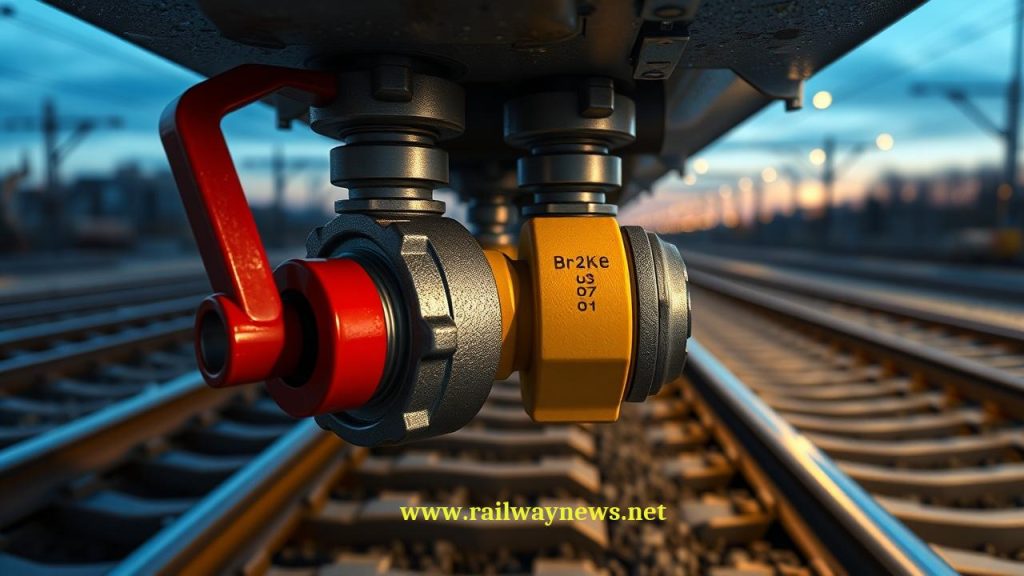
What is EN 15807: Pneumatic Half Couplings in Railway Applications?
EN 15807 is a European Standard that specifies the technical requirements for the design, dimensions, materials, testing, and marking of pneumatic half couplings. These components are critical for connecting the pneumatic lines between railway vehicles, forming the continuous brake pipe and main reservoir pipe essential for train operation and safety.
The primary purpose of this standard is to ensure full interchangeability and interoperability between half couplings from different manufacturers and on rolling stock from various operators. This standardization is fundamental for the safe and efficient operation of trains, especially in cross-border European rail traffic.
The Core Function of Pneumatic Half Couplings
Pneumatic half couplings are the interface points for the train’s air system. Every freight wagon, passenger coach, and locomotive is equipped with flexible air hoses at each end, terminating in these standardized metal coupling heads. When two vehicles are coupled, their respective half couplings are connected by hand to form a complete, sealed joint. This allows compressed air to flow uninterrupted through the entire length of the train for two main purposes:
- Brake Pipe (BP): This is a “fail-safe” system. The pipe is charged with a specific pressure (e.g., 5 bar) to keep the brakes released. To apply the brakes, the driver reduces the pressure in this pipe. Any unintended disconnection or major leak also causes a pressure drop, automatically applying the brakes.
- Main Reservoir Pipe (MRP): This pipe acts as a high-pressure supply line, transmitting compressed air from the locomotive’s compressor to charge the air reservoirs on each vehicle. This stored air is then used by the brake system and other pneumatic equipment like doors or suspension systems.
Key Technical Specifications and Requirements of EN 15807
The standard is highly detailed, covering every aspect of the half coupling’s lifecycle from design to in-service performance. The key technical areas are broken down into several sections.
Dimensional and Geometric Requirements
This is the cornerstone of interchangeability. EN 15807 defines the precise geometry and tolerances for all functional parts of the coupling head. This includes the shape of the sealing face, the position and profile of the locking lugs, and the overall external dimensions. Adherence to these dimensions guarantees that any compliant half coupling can securely connect to any other, creating an effective and airtight seal without excessive force.
Material Specifications
The materials used must withstand the harsh operating environment of a railway, which includes wide temperature fluctuations, vibration, impact, and exposure to grease and moisture.
- Coupling Body: Typically manufactured from malleable cast iron, providing an excellent balance of strength, impact resistance, and manufacturability. The standard specifies the required material grades and mechanical properties like tensile strength and elongation.
- Sealing Ring: The seal is a critical component for preventing air leakage. It is usually made from synthetic rubber compounds like Nitrile Butadiene Rubber (NBR) or Ethylene Propylene Diene Monomer (EPDM). The material must remain flexible and effective across a specified temperature range (e.g., -40°C to +70°C) and be resistant to mineral oils and ozone.
Performance Criteria
To ensure reliability and safety, half couplings must meet stringent performance requirements defined and tested according to the standard:
- Pressure Resistance: The coupling assembly must withstand a specified proof pressure (significantly higher than its operating pressure) without any permanent deformation or failure.
- Leakage Rate: When coupled, the joint must be extremely airtight. The standard defines the maximum permissible leakage rate at a given test pressure.
- Coupling and Uncoupling Forces: The forces required to connect and disconnect the half couplings must fall within a specific range to ensure they can be operated manually by railway staff without excessive effort, yet remain securely connected in service.
- Durability: The coupling must be designed to withstand a high number of coupling/uncoupling cycles without significant wear or degradation in performance.
- Corrosion Resistance: The surface of the coupling body is typically treated with a protective coating (e.g., zinc plating or cataphoretic coating) to resist corrosion. The standard specifies the requirements for this coating and how it should be tested (e.g., salt spray test).
Marking and Identification
For traceability and compliance verification, each half coupling must be permanently marked with specific information. This typically includes the manufacturer’s name or trademark, the reference to the standard (EN 15807), and the year of manufacture.
Comparison of Brake Pipe (BP) and Main Reservoir Pipe (MRP) Couplings
While visually similar, BP and MRP half couplings are not interchangeable. This is a crucial safety feature to prevent incorrect connection of the pneumatic lines. EN 15807 ensures this by defining slightly different lug positions or “keying” for each type.
| Feature | Brake Pipe (BP) Half Coupling | Main Reservoir Pipe (MRP) Half Coupling |
|---|---|---|
| Primary Function | Controls the application and release of the train’s brakes via pressure changes. | Supplies high-pressure air from the locomotive to charge reservoirs along the train. |
| Operating Principle | Fail-safe: pressure reduction applies the brakes. Maintained at a nominal pressure (e.g., 5 bar) to release brakes. | Supply line: Maintained at a high pressure (e.g., 8-10 bar). |
| Physical Keying | Features a specific lug arrangement to prevent connection with an MRP coupling head. | Features a different lug arrangement that prevents connection with a BP coupling head. |
| Common Identification | Often has a red handle or is attached to a red-painted hose end tap (cock). | Often has a yellow or blue handle or is attached to a yellow/blue painted hose end tap (cock). |
Testing and Conformance Assessment
Manufacturers must demonstrate compliance with EN 15807 through a rigorous series of type tests on new designs and routine production tests. These tests validate every requirement specified in the standard, from dimensional accuracy and material composition to performance under pressure, temperature, and cyclic loading. This ensures that any product placed on the market is safe, reliable, and fully interoperable.
The Importance of EN 15807 for Railway Interoperability
The significance of EN 15807 cannot be overstated. By creating a unified technical specification, the standard removes technical barriers, allowing locomotives, coaches, and wagons from any country or operator to be seamlessly integrated into a single train. This fosters a more efficient, competitive, and safer European rail network, underpinning the reliability of the most critical safety system on any train: the pneumatic brakes.

Railway infrastructure, rolling stock and transport technologies specialist focused on global rail industry developments, high-speed rail systems, signaling technologies and freight transportation. Covering railway investments, public transport modernization, rail operations and international mobility projects across Europe, Asia and North America.