
EU Standard EN 13260: Ensuring Wheelset Safety & Quality
EN 13260 is the cornerstone European standard for railway wheelsets. It ensures safety, reliability, and interoperability through strict technical requirements and assembly processes.
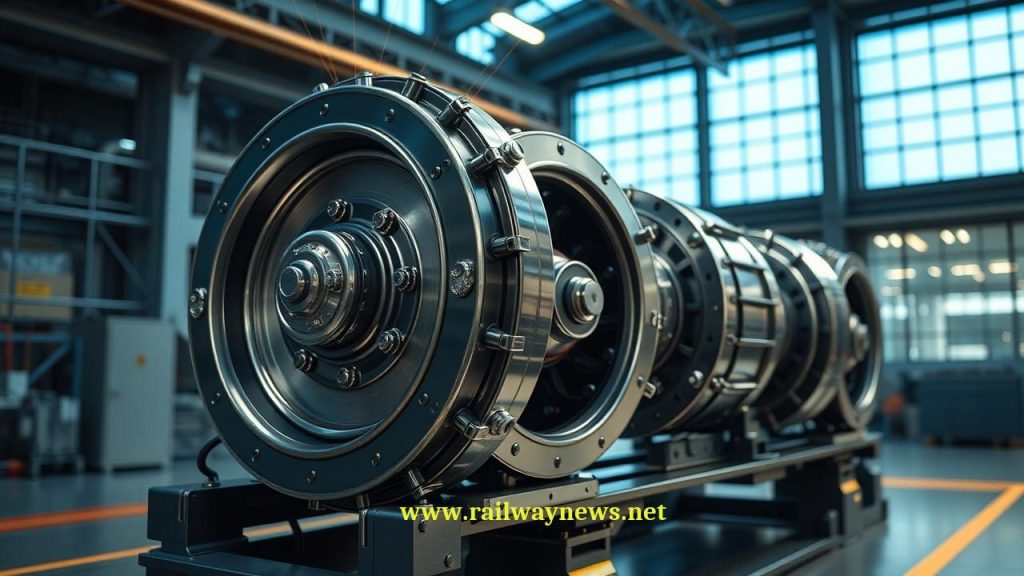
What is EN 13260? A Technical Guide to Railway Wheelset Requirements
EN 13260 is a key European standard that specifies the product requirements for complete railway wheelsets. It defines the technical characteristics, assembly procedures, and quality assurance criteria that a fully assembled wheelset—comprising an axle and two wheels—must meet to ensure safety, reliability, and interoperability across the European railway network.
This standard is fundamental for manufacturers of wheelsets, maintenance workshops, and railway operators. It serves as the primary technical document for the delivery condition of new and reassembled wheelsets, covering applications for freight wagons, passenger coaches, locomotives, and other rail vehicles.
Scope and Application of the Standard
The scope of EN 13260 is precisely focused on the assembled product. It does not detail the manufacturing requirements of the individual components, but rather governs how these components must perform once they are brought together. For the specific requirements of the individual components, EN 13260 refers to other dedicated standards:
- EN 13261: Railway applications – Wheelsets and bogies – Axles – Product requirements.
- EN 13262: Railway applications – Wheelsets and bogies – Wheels – Product requirements.
Therefore, a wheelset compliant with EN 13260 must be assembled from an axle compliant with EN 13261 and wheels compliant with EN 13262. The standard primarily applies to wheelsets designed for the standard European gauge (1435 mm) but its principles can be adapted for other track gauges.
Core Technical Requirements of EN 13260
EN 13260 outlines a detailed set of technical specifications that are critical for the performance and safety of the wheelset. These can be broken down into several key areas.
Geometric and Dimensional Tolerances
Precise geometry is paramount for stable vehicle running, minimizing wear, and ensuring compatibility with track infrastructure. The standard defines strict tolerances for several parameters, including:
- Distance between internal faces of the wheels: This is a critical dimension for correct interaction with the track and switches.
- Difference in tread circle diameters: The two wheels on a single axle must have very similar diameters to prevent hunting oscillation and uneven flange wear.
- Radial and axial run-out: These measurements quantify how much the wheel wobbles or deviates from a perfect circle as it rotates. Excessive run-out leads to vibrations, poor ride quality, and increased dynamic loads on the track.
- Static imbalance: The standard specifies the maximum permissible static imbalance of the complete wheelset to minimize vibration at high operational speeds.
The Assembly Process – Press-Fitting
One of the most critical aspects governed by EN 13260 is the assembly of the wheels onto the axle. This is achieved through a high-force interference fit, also known as press-fitting. The standard mandates strict control over this process:
- Force-Displacement Diagram: For every press-fitting operation, a continuous recording of the applied force versus the axial displacement of the wheel must be produced.
- Diagram Analysis: This diagram must conform to a specific shape, showing a smooth and continuous increase in force as the wheel is pressed onto its seat. Any sudden drops or irregularities in the curve could indicate galling, incorrect lubrication, or a defective component, leading to the rejection of the assembly.
- Final Fitting Force: The final force achieved at the end of the press-fit must fall within a specified range, calculated based on the wheel seat diameter and the interference value. This ensures the joint is strong enough to transmit torque and resist axial movement but not so tight as to over-stress the components.
Inspection, Testing, and Quality Assurance
To verify compliance, EN 13260 requires a rigorous testing and inspection regime before a wheelset can be delivered. This includes:
- Verification of Components: Ensuring that the wheels and axle used have been manufactured and certified according to EN 13262 and EN 13261, respectively.
- Dimensional Checks: All geometric and dimensional tolerances specified in the standard must be measured and verified to be within the acceptable limits.
- Press-Fitting Record Review: Each force-displacement diagram is checked for conformity.
- Non-Destructive Testing (NDT): After assembly, the axle is subjected to NDT (typically magnetic particle inspection) to ensure that no cracks or surface defects were initiated by the high stresses of the press-fitting operation.
- Marking: Each wheelset must be permanently marked with essential information for traceability, including a unique serial number, manufacturer identity, and date of assembly.
Key Wheelset Parameters Defined by EN 13260
The following table summarizes some of the most critical parameters controlled by the standard and their importance in railway operations.
| Parameter | Description | Technical Importance |
|---|---|---|
| Internal Distance (Back-to-Back) | The distance measured between the internal faces of the two wheel flanges. | Ensures proper guidance through switches and crossings and prevents derailment. Critical for track compatibility. |
| Radial Run-out | The variation in the radius of the wheel tread as it rotates. | Minimizes vibration, reduces dynamic load on the track and bearings, and improves passenger comfort. |
| Axial Run-out | The side-to-side “wobble” of the wheel flange or rim face during rotation. | Reduces hunting instability and uneven wear on the wheel flanges and rails. |
| Static Unbalance | The measure of the wheelset’s mass distribution around its rotational axis. | Prevents excessive vibrations at high speeds, which can damage both the vehicle and the track infrastructure. |
| Press-fitting Force | The final force required to press the wheel onto the axle seat. | Guarantees a secure interference fit, ensuring that the wheels will not shift on the axle under operational loads. |
Conclusion: The Role of EN 13260 in Railway Safety
EN 13260 is more than just a technical specification; it is a cornerstone of railway safety and interoperability. By providing a clear and unified set of requirements for the finished wheelset, the standard ensures that these safety-critical components are manufactured and assembled to a consistently high quality, regardless of the supplier. Adherence to EN 13260 guarantees that wheelsets will perform reliably under the demanding conditions of railway service, safeguarding passengers, cargo, and infrastructure.

Railway infrastructure, rolling stock and transport technologies specialist focused on global rail industry developments, high-speed rail systems, signaling technologies and freight transportation. Covering railway investments, public transport modernization, rail operations and international mobility projects across Europe, Asia and North America.